Every guide to Andorra eventually breaks the news as if announcing a death in the family: there is no airport, and there is no train station. I’d like to reframe that. Andorra’s lack of an airport isn’t a problem to route around — it’s the price of admission that keeps a three-hour mountain approach between you and one of Europe’s most distinctive small countries, and the approach itself is half the fun. The road in winds past gorges, duty-free superstores and eventually snow-line hairpins; done right, arrival day already feels like holiday.
Here’s how to get to Andorra in one paragraph: fly to Barcelona or Toulouse and ride a direct bus about three hours to Andorra la Vella (from roughly €33); drive in through Spain or France; fly Madrid to the tiny Andorra–La Seu d’Urgell airport 24 km away; or — my romantic favourite — take the Paris night sleeper to a mountain station and bus in for breakfast.
This guide compares every route honestly — costs, timings, the catches nobody mentions — then covers the border, winter driving rules and how to move around once you’re inside. Numbers reference 2026 schedules and fares; operators tweak both seasonally, so confirm on the linked official sites before you book around a tight connection.
Last updated: June 2026.
Every route to Andorra at a glance
| Route | Time (door to ALV) | Cost (one-way guide) | Verdict |
|---|---|---|---|
| Barcelona airport → direct bus | 3–3.5 hrs | ~€33–35 | The default; book it and relax |
| Toulouse airport → bus | ~3–3.5 hrs | ~€38 | Quieter, prettier, fewer departures |
| Drive from Barcelona | ~2.5–3 hrs | fuel + ~€13 tunnel (optional) | Freedom; mind winter rules |
| Paris → night sleeper → bus | overnight + 75 min | from ~€51 train + ~€25 bus | The adventure option |
| Madrid → fly to La Seu (LEU) | ~1h20 flight + 40 min | varies (often €60–120) | Fastest from Madrid, niche schedules |
| Madrid → AVE to Lleida + bus | ~5 hrs total | ~€40–70 | Solid rail-land combo |
| Day tour from Barcelona | 12-hr round trip | ~€60–150 | A sampler, not a visit |

First decision: Barcelona or Toulouse?
Andorra sits almost exactly between two international airports, and your whole arrival plan flows from which one you pick. Barcelona wins on flight choice (it’s one of Europe’s best-connected airports, decisive if you’re coming from the UK, Ireland or North America), bus frequency (departures from the airport and Sants station all day) and price. Its costs: the busiest road, and on winter Saturdays a bus station’s worth of fellow skiers. Toulouse is marginally closer, noticeably calmer, and its approach road over the high border is the more dramatic drive — but flight options are thinner and buses run only a handful of times daily, so a delayed flight hurts more. Madrid becomes relevant only because of one curiosity covered below: the only scheduled flights anywhere near Andorra.
My rule of thumb after watching many groups do this: if your flight lands by mid-afternoon, either gateway works; if you land in the evening, choose Barcelona, where a missed bus costs you an hour rather than the night.
From Barcelona: the main highway in
The direct bus (how almost everyone arrives)
The workhorse is the Andorra Direct Bus run by Autocars Nadal — comfortable coaches from Barcelona El Prat airport (pickups at both terminals) and Sants station straight to Andorra la Vella’s bus station, with a stop in Sant Julià de Lòria on the way in. Count on three to three-and-a-half hours depending on traffic and your boarding point, fares from around €33–35 one-way (returns shave a little off), and roughly sixteen departures a day across the airport and city stops. Andbus runs the same corridor with its own timetable, and Flixbus has muscled in with budget departures that reward flexible bookers. Three tips from experience: book online a few days ahead in ski season (Saturday buses genuinely fill), put skis or big luggage in the hold without fear — these coaches are built for it — and sit on the right side northbound for the better gorge views once you leave the motorway.
Step by step: from the El Prat baggage hall to the bus seat
Because first-timers ask: collect bags, follow signs to the coach stops — at Terminal 1 the Andorra buses load on the lower level (the same platforms the regional coaches use), at Terminal 2 by the stop between sections B and C — and look for the Andorra-liveried coach rather than a route number. Tickets work three ways: book online and show the QR (the move in ski season), buy from the driver if seats remain, or use the operator’s airport desk when staffed. The coach typically pauses at the other terminal, threads out to the motorway, and makes one comfort-and-coffee stop along the way; you’ll have signal the whole ride and the on-board Wi-Fi when it feels like cooperating. Arriving in Andorra, every bus terminates at the national bus station on the capital’s eastern edge — ten walking minutes from the centre, with taxis and the local valley buses outside, and most central hotels closer than the queue for either.
If your flight runs late: tickets are date-flexible with most operators if you call or rebook online before departure, and because the airport stops are mid-route, the next coach is rarely more than ninety minutes away in daytime. It’s a forgiving system; the only unforgivable error is booking the last bus of the night against an evening arrival in February.
Driving up (and the toll question)
The drive from Barcelona runs about 2.5–3 hours in clear conditions: motorway to Manresa, then either the C-16 through the Cadí Tunnel (a ~€13 toll that buys you the fastest, most weatherproof route) or the toll-free C-14/N-260 by way of Ponts towards La Seu d’Urgell — slower, twistier, free, and prettier. Both funnel into the N-145 for the final toll-free climb from La Seu to the Spanish-Andorran border at the Riu Runer. It’s a genuinely easy drive by mountain standards; the caveats live in winter, covered below.
Day tours and private transfers
Organised coach day-tours from Barcelona bundle the ride with a few guided hours and run €60–150 — fine as a sampler, though as I argue in the things-to-do guide, a single day buys you the capital and Caldea, not the country. Private transfers (from around €200 per car each way, more in ski season) make sense for families with gear or groups of four-plus splitting the fare; every Andorran hotel can arrange one, as can the airport desks.
Choosing a day tour that isn’t a shopping decoy
One buyer’s note on those Barcelona day tours, because the market splits in two: the good ones sell you the Pyrenees — a guided stop or two, free time balanced between the old quarter and a viewpoint, clear timings; the cynical ones are duty-free shuttle runs wearing a tour’s clothing, engineered around commission stops. Read the itinerary for named places rather than “free time for shopping,” check the on-the-ground hours (under five and you’re mostly photographing motorway), and cross-reference the operator’s reviews mentioning winter — a tour that handles February competently will handle June beautifully. Or assemble your own: the scheduled bus plus a planned day from the things-to-do guide costs less and answers to nobody’s commission.
From Toulouse: the quieter French door
Toulouse-Blagnac sits a touch closer than Barcelona and sends Andbus coaches to Andorra la Vella several times daily (around 3 hours 15 minutes, fares about €38, picking up at both the airport and the city’s bus station). The route climbs through Foix and Ax-les-Thermes before entering Andorra at Pas de la Casa — at over 2,000 m, which is exactly as scenic and exactly as weather-exposed as it sounds. In hard winter weather the coach uses the Envalira Tunnel and you barely notice; in clear weather you crest near the Port d’Envalira with the whole principality unrolling below, which beats anything Barcelona’s motorway offers. The thinner timetable is the only real drawback: build slack between flight and bus, or you’ll discover Toulouse airport’s seating at length. Worth knowing: the coaches serve both the airport and the Gare Routière beside Matabiau station, so rail arrivals from elsewhere in France connect without crossing the city, and the route’s Ax-les-Thermes stop doubles as a back door for anyone already holidaying in the Ariège. Book the 2pm-ish departure against a morning flight and you’ll crest into Andorra with the late-afternoon light doing its best work on the Cerdanya.
The unsung hub: La Seu d’Urgell (and other Spanish starting points)
Ten kilometres south of the border, the Catalan cathedral town of La Seu d’Urgell is quietly the most useful transport fact in this guide. Local buses shuttle between La Seu and Andorra la Vella every half hour or so through the day for pocket change, which turns anywhere-with-a-bus-to-La-Seu into an Andorra route: Lleida (and its AVE station) connects several times daily, the airport sits on its doorstep, and drivers coming off the toll-free C-14 roll straight through it. If you’re piecing together an unconventional approach — coming off a Camino, a Pyrenean road trip, a slow loop through Catalan hill towns — solve for La Seu and the last leg solves itself. From Girona or the Costa Brava, by contrast, there’s no direct service; backtrack through Barcelona rather than inventing a three-change odyssey, unless you’ve hired a car, in which case the C-16 through the Cadí Tunnel collects you en route.
By train: the night-sleeper route nobody tells you about
Andorra has no railway, but France parks a station teasingly close: Andorre-l’Hospitalet (renamed in 2023 from L’Hospitalet-près-l’Andorre), a tiny halt on the gorgeous Toulouse–Latour-de-Carol mountain line, 38 km from Andorra la Vella. And the way to use it is one of Europe’s great under-the-radar journeys: the Intercités de Nuit sleeper from Paris.
The choreography: leave Paris Austerlitz at 22:13 in a couchette, wake to granite and pine, and step onto a Pyrenean platform at 09:39. A connecting bus run by Hife leaves the station at 10:15 and rolls into Andorra la Vella at 11:30 — you’ve crossed France asleep and you’re checking in before lunch. Couchette fares start around €29 in six-berth, about €60 in first-class four-berth, with bare reclining seats from €22 for the young and unbreakable; the connecting bus runs around €25, or a pre-booked taxi covers the 38 km in 47 minutes for roughly €115 a carload. Heading home, the bus leaves Andorra at 17:00 to meet the 19:16 sleeper, which lands you in Paris at 07:08.
The fine print for 2026: trackwork has the sleeper running only Fridays and Saturdays for much of the year (returns Saturdays and Sundays), going daily from June to September — so check your date on SNCF Connect or Rail Europe before building a trip around it, and note these night trains often open for booking only a month or so out. If the sleeper dates don’t fit, the workaround keeps most of the romance: TGV from Paris to Toulouse (~4.5 hours) and the Andbus connection from there. Either way you’ve turned the “no railway” problem into the best arrival story in the Pyrenees — and from London, Eurostar (from ~£51) bolts onto the front of the sleeper for a genuinely civilised UK-to-Andorra journey with zero airports involved.
Two craft notes for the sleeper: book a bottom berth (luggage lives under it, and you’ll thank yourself at 6am), and pack breakfast plus water in Paris — the train sells little, and the l’Hospitalet platform sells nothing but mountain air. The station itself is a marvel of nowhere: a couple of platforms, a shuttered building, peaks on every side, and the particular silence that makes arriving feel like the opening scene of a film you’re suddenly in. Forty-seven kilometres of winding bus later, that film has duty-free perfume in it, but the opening scene stays with you.
The slow-rail curiosities: Latour-de-Carol and the R3
Two more rail approaches for collectors of odd journeys. The same Pyrenean line continues past l’Hospitalet to Latour-de-Carol, the border station where three gauges meet — French mainline, Spain’s Rodalies R3, and the narrow-gauge Petit Train Jaune toy of the Cerdagne. That R3 connection means you can, with patience, ride a commuter train from Barcelona’s Plaça de Catalunya up through the Pyrenees for pocket change and connect toward l’Hospitalet two stops down the French side — a five-plus-hour budget epic that beats the motorway for scenery the entire way. And from the south of France in summer, the Train Jaune itself makes Andorra part of a gloriously slow Pyrenean rail circuit. None of this is the fast way. All of it is the good way.

Flying close: the airports, compared

| Airport | Distance / transfer | Why (and why not) |
|---|---|---|
| Barcelona El Prat (BCN) | ~200 km / ~3 hrs by direct bus | Maximum flights, maximum buses; the default |
| Toulouse-Blagnac (TLS) | ~190 km / ~3.25 hrs by bus | Calm and scenic; thinner schedules |
| Andorra–La Seu d’Urgell (LEU) | 24 km / ~40 min | The closest by far; only Madrid (+ seasonal Palma) flies here |
| Girona (GRO) / Reus (REU) | ~200–230 km | Budget-carrier options; no direct Andorra buses — connect via Barcelona |
| Lleida-Alguaire (ILD) | ~150 km | Winter ski charters only, transfer-dependent |
The curiosity worth knowing: Andorra–La Seu d’Urgell, a former regional strip reborn in 2021 as the country’s “almost airport,” twelve kilometres south of the border. As of 2026 it hosts about seven weekly scheduled flights to Madrid (Air Nostrum operating for Iberia regional, ~1 hour 20 in the air) plus seasonal Palma de Mallorca rotations — and that’s the entire timetable. If you’re starting in Madrid, it converts a seven-hour land journey into a two-hour door-to-door hop, with buses and taxis covering the last 40 minutes to the capital. Fares swing widely (€60–120 one-way is typical), the mountain weather occasionally bounces a landing, and the whole experience — walking across the apron with the Pyrenees filling the windscreen view — feels charmingly pre-globalisation. Check current schedules on the airport’s site; routes here evolve year to year.
From Madrid by land, the rail-bus combo beats the long direct coach: AVE to Lleida in about two hours, then the connecting bus up through La Seu to Andorra in roughly two and a quarter more. The direct Madrid coaches exist but make a meal of it at eight-plus hours — defensible only as an overnight money-saver.
What arriving actually costs: three honest budgets
| Scenario | Route | Arrival cost (one-way, per party) |
|---|---|---|
| Solo traveler, no fuss | BCN flight + direct bus | ~€33–35 bus; total under €40 from the airport kerb |
| Couple, story-collectors | Paris sleeper + Hife bus | ~€110–170 for two (couchettes + buses) — and it includes the night’s accommodation |
| Family of four with ski bags | Hire car from BCN via Cadí Tunnel | ~€45–60 fuel + €13 toll + hire; door-to-door and gear-friendly |
| Madrid start, time-poor | LEU flight + transfer | ~€70–130 pp flight + €10–40 transfer; ~2 hrs total |
| Group of 4–6, zero logistics | Private transfer from BCN | ~€200–280 per van each way — competitive split four ways |
The pattern worth noticing: under about three people, the bus wins on cost every time; at four-plus with luggage, cars and private transfers close the gap fast; and the sleeper is the only option where the transport bill quietly deletes a hotel night. Ski-season Saturdays add €5–15 of demand pricing to almost everything, which is one more argument for the midweek arrival the ski guide keeps making.
Driving to Andorra: two doors, one rulebook
Andorra has exactly two road entrances, and they have opposite personalities.
The Spanish door (La Seu d’Urgell)
The N-145 from La Seu d’Urgell climbs gently to the border at the Riu Runer and into Sant Julià — low altitude, rarely weather-troubled, toll-free, and the sensible winter choice. From Barcelona you’ll reach it via the Cadí Tunnel (toll) or the free C-14; from anywhere in western Spain, via Lleida. It’s the door I’d use nine times out of ten with a car full of family.
The French door (Pas de la Casa)
The RN-20/N-22 from Ax-les-Thermes arrives at Pas de la Casa at 2,050 m, where you choose: over the top via the Port d’Envalira — at 2,408 m the highest paved pass in the Pyrenees, magnificent on a blue day — or through the Envalira Tunnel (a toll in the €7–8 range each way), which deletes the summit hairpins and most of the weather risk. In a storm this side closes first and queues first; in summer it’s the most beautiful approach to the country.
The winter rulebook (it’s the law, not advice)
From November through April, Andorra and the access roads on both sides legally require winter equipment when conditions demand — winter tyres fitted or chains carried and used. Police do check during snow episodes, rental desks in Barcelona will happily add chains if you ask (ask), and the fine-plus-stranded combination is the most avoidable bad day in Pyrenean motoring. A note for electric drivers: charging infrastructure inside Andorra has grown fast — the capital’s car parks and a good share of hotels now offer points — but the climbs eat range, so arrive with comfortable margin and confirm your hotel’s charger before relying on it. Two more local realities: fuel in Andorra is cheap enough that arriving near-empty is a strategy, not negligence; and border queues peak on Sunday evenings and shopping-weekend afternoons, when half of Catalonia heads home with full boots — time your exit off-peak or bring podcasts.

Why is there no airport or railway? (A short, telling story)
The short answer is topography with a side of politics. Andorra’s valleys are deep, curved and walled by 2,900-metre ridges — terrain that defeated every twentieth-century railway proposal on cost before ink dried, and that makes a full-size runway geometrically impossible anywhere inside the borders (the La Seu strip next door occupies the first adequately flat ground south of the mountains). Periodic schemes resurface — a national heliport has been debated and announced in various forms for years, and helicopter transfers from Barcelona and Toulouse do operate commercially for those with more budget than patience — but the structural fact endures: every visitor since the Middle Ages has arrived along the valleys, and the modern N-145 and RN-22 simply pave the mule routes. I find this genuinely charming. The three-hour approach isn’t an infrastructure failure; it’s the moat that keeps Andorra feeling like somewhere, in an era when most places feel like anywhere.
The border: passports, checks and the Schengen quirk
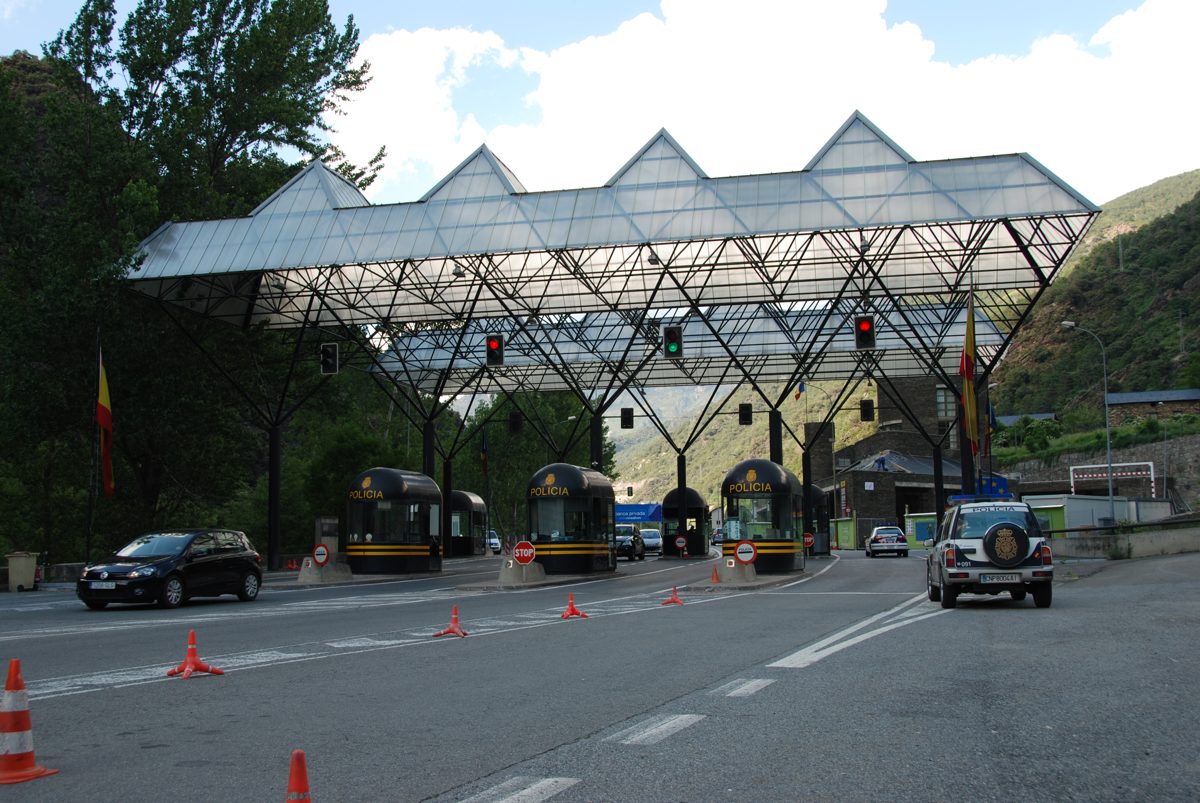
Crossing into Andorra feels casual — often a wave-through — but it’s a real international border with real spot-checks, so carry your passport even from Spain or France (a driving licence is not a travel document, as a queue of embarrassed day-trippers discovers weekly). The quirk worth understanding: Andorra isn’t in the EU or Schengen, but you can only reach it through Schengen countries, so non-European visitors should make sure their Schengen entry allows re-entry — coming back out of Andorra means re-entering France or Spain, and on the rare occasions officials check, a single-entry visa becomes a genuine problem. EU, UK, US and most developed-world passports stroll through without thinking about any of this.
Leaving is when the border earns its keep: customs allowances on alcohol, tobacco and general goods are enforced with enthusiasm on busy weekends, because half the queue is carrying exactly the duty-free haul the limits describe. Keep receipts handy, stay inside the posted allowances, and the whole thing stays a formality.
Getting around once you’re in
Here’s the pleasant surprise after the three-hour approach: internal distances collapse. The whole country is one Y of valleys about 40 minutes end to end, and you have four ways to work it. Inter-parish buses run constantly along the main roads for a few euros a hop — perfectly usable for the capital, Escaldes, Encamp, Canillo and the valley towns. Ski shuttles loop the lift bases in season, and Encamp’s Funicamp gondola is effectively public transport into the middle of the Grandvalira ski area — the reason savvy budget skiers base there, as covered in the skiing guide. Taxis exist but price like a duty-free luxury; book ahead for early airport departures. And a car stops being necessary the moment you’re based in the central valley — it earns its keep only for trailheads, Arcalís and flexible mountain mornings.
Driving-in details that save circling: Andorra la Vella runs on underground car parks (plentiful, signposted, a few euros an hour, many hotels discount or include them) plus metered street zones — don’t improvise on yellow kerbs, the country is small enough that enforcement is a personal relationship. The valley buses, for their part, are simple single-line affairs radiating from the capital along each arm of the Y — you flag, you pay a couple of euros aboard or tap a card, and the timetable is honest “every 20–30 minutes on the trunk, hourly up the side valleys.” Nobody needs an app; the stop signs list everything.
My honest sizing: city-and-spa trips need no wheels at all; ski trips need none if you base by a gondola; hiking trips genuinely benefit from a car. If you arrive by bus and change your mind, the capital has rental desks happy to fix that for a day or two rather than a week.
Putting it together: arrival plans that work
fly to Barcelona (widest choice, lowest fares), pre-book the direct bus for ninety minutes after landing, and you’re checking in about five hours after takeoff. The zero-flights alternative — Eurostar plus the Paris sleeper — turns the journey into part of the holiday and lands you in Andorra by late morning.
land at Barcelona or Madrid. Barcelona hands you the bus; Madrid hands you the LEU flight trick — if the schedule aligns, you’re in the Pyrenees two hours after clearing customs, which feels faintly illegal.
Saturday is changeover day across European skiing, and the buses and borders know it. Book bus seats the moment flights are ticketed, pad any flight-to-bus connection to two hours in winter (snow delays cascade), and if driving, treat the Spanish door as the default and the French door as the fair-weather scenic bonus. The full ski guide covers where to base once you’ve arrived.
arrive by bus, base centrally, do the country by valley bus and one rental-car day — then spend what the car-week would have cost on a better dinner and a Caldea evening, as the things-to-do guide recommends.
When things go wrong: delays, strikes and plan B
The failure modes are few and all survivable with the right reflexes. Missed the last bus from Barcelona airport? The sensible play is a cheap airport-area hotel and the first morning coach — a late-night private transfer can be summoned but prices in the hundreds. French rail strike or the sleeper not running your date? The TGV-to-Toulouse plus Andbus combination is the all-weather backup, bookable same-day more often than not. Storm closing the French door? Reroute via the Spanish side — longer from Toulouse, but it moves when Envalira doesn’t; check Andorra’s official mobility service (mobilitat.ad) for live road status, webcams and chain requirements before committing to either climb. Bus sold out on a peak Saturday? Check the rival operator and Flixbus before panicking, then the Lleida-via-La Seu back door. The deeper insurance is simply margin: in winter, never book the last connection of the day that your plan technically allows.
Leaving Andorra: the reverse logistics
Departure planning is mostly about respecting two bottlenecks. First, the border: Sunday evenings and the last afternoons of French and Spanish holiday weekends bring real queues at both doors as the duty-free convoys head home — leaving before 15:00 or after 21:00 on those days converts an hour’s crawl into a wave-through. Second, the bus-to-flight margin: from the moment a coach leaves Andorra la Vella, treat Barcelona check-in as four hours away (three and a half of road plus airport buffer), and book the bus that lands that margin even if it means an earlier alarm — winter weather eats optimistic connections for breakfast. Buy your return bus seat when you buy the outbound in ski season; the Saturday and Sunday midday departures genuinely sell out. And do your last duty-free shop the evening before, not on the way out: the border-adjacent superstores on departure day are where holiday moods go to die.
Luggage, skis, bikes and other practicalities
The coaches are built for this market: ski and snowboard bags ride the hold free or for a small fee depending on operator (declare them when booking in peak weeks), ordinary luggage is generous, and bikes travel boxed or bagged subject to space — book those by phone rather than hoping. Families: children’s fares run roughly half-price on the buses, car seats are bring-your-own, and the airport coaches’ single mid-route stop is mercifully timed for small bladders. Travelers with reduced mobility should contact operators a few days ahead — the modern fleet is largely adapted, the guarantee isn’t universal. And no, there’s no Uber in Andorra; the taxi trade is regulated, reliable and priced accordingly, so pre-book the dawn airport run through your hotel rather than gambling on a street hail at 6am.
Timing your journey: the calendar that matters
The road system has moods. Ski-season Saturdays are the big one — changeover day stacks buses, borders and the Cadí approach simultaneously; arrive Friday or Sunday and the same journey drops a class in difficulty. Storm days hit the French door first and hardest (the tunnel keeps it honest); if you must cross in active snowfall, go Spanish-side and go early. August swaps snow for shopping traffic — mid-month weekends jam the N-145 with bargain pilgrims. Sunday evenings year-round are the classic exit-queue window. And the golden slots? Weekday mid-mornings, almost any season: empty buses, flowing borders, mountain light, and coffee in Andorra la Vella before noon. As with everything in this country, the calendar is the cheat code — the same principle the things-to-do guide applies to attractions works on asphalt too.
My honest verdict on every route
The direct bus from Barcelona is the right answer for most people most of the time — cheap, frequent, comfortable, zero-stress — and pretending otherwise would be contrarianism. But the routes I actually look forward to are the odd ones: the night sleeper into a silent mountain station with the smell of pine and diesel and a connecting bus idling outside; the Port d’Envalira on a clear June morning with the country tipping open below the windscreen; the tiny Madrid plane banking between ridgelines toward a runway that barely interrupts the fields. Andorra makes you work a little to arrive. Choose the version of the work that sounds like a story you’d tell.
How to get to Andorra: FAQ
Is there an airport in Andorra?
Not inside the country. The nearest runway is Andorra–La Seu d’Urgell (LEU), 24 km south in Spain, with around seven weekly Madrid flights and seasonal Palma routes. The practical gateways remain Barcelona and Toulouse, each about three hours away by direct bus. Helicopter transfers exist for those whose budgets bend that way.
What’s the closest train station to Andorra?
Andorre-l’Hospitalet, in France, 38 km from Andorra la Vella on the Toulouse–Latour-de-Carol line — including a direct night sleeper from Paris on selected days. A connecting Hife bus meets the morning train and reaches Andorra in 75 minutes; taxis cover the gap in about 47 minutes for roughly €115.
How do I get from Barcelona to Andorra?
The direct bus is the standard answer: around three to three-and-a-half hours from El Prat airport or Sants station to Andorra la Vella, from about €33–35 one-way, with roughly sixteen daily departures between Direct Bus, Andbus and Flixbus. Driving takes 2.5–3 hours; organised day tours bundle transport with a guided few hours.
How far is Andorra from Barcelona?
About 200 km by road — roughly 2.5–3 hours driving, or 3–3.5 by direct bus depending on traffic and your boarding point. Toulouse sits a similar 190 km on the French side. There’s no faster rail or air shortcut between Barcelona and Andorra; the road is the route.
Do you need a passport to enter Andorra?
Yes — bring it even from Spain or France. Andorra is outside the EU and Schengen, the crossings are genuine borders with spot-checks, and hotels require ID at check-in. Non-European visitors should ensure their Schengen visa permits re-entry, since leaving Andorra means re-entering France or Spain.
Can you get to Andorra without a car?
Easily — most visitors do. Direct buses connect both gateway airports to Andorra la Vella’s bus station, valley buses link every town for a few euros, ski shuttles serve the lifts in season, and the Funicamp gondola climbs into the ski area straight from Encamp. A car only matters for remote trailheads and maximum flexibility.
Is driving to Andorra dangerous in winter?
No — but it’s mountain driving with legal obligations. Winter tyres or chains are required in season, the Spanish-side N-145 is the gentler, lower entrance, and the French side’s high road closes first in storms (its tunnel usually keeps moving). Check conditions before crossing the Envalira in active snowfall and you’ll be fine.
What’s the cheapest way to get to Andorra?
Budget airline to Barcelona plus a promo bus fare gets the airport-to-Andorra leg near €30; Flixbus departures sometimes undercut that. From Paris, the sleeper’s €29 couchettes plus the €25 connecting bus is startling value for an overnight journey that doubles as accommodation.
How do you get to Andorra from Madrid?
Fastest: the scheduled flight to Andorra–La Seu d’Urgell (about 1h20) plus a 40-minute transfer. Best by land: AVE to Lleida (~2 hrs) then the connecting bus through La Seu (~2.25 hrs). The direct coaches run eight-plus hours and only make sense as an overnight budget play.
Is there Uber or Lyft in Andorra?
No — ride-hailing apps don’t operate in Andorra. The licensed taxi trade covers the country reliably at regulated (read: premium) rates, hotels happily pre-book airport runs and early starts, and the valley buses handle everyday hops for a couple of euros. For dawn departures, book the cab the night before rather than trusting luck.
Once your route in is fixed, the next questions are the best time to visit Andorra and where to base yourself — start with my guide to Andorra la Vella.
Once you’ve sorted how you’re arriving, two companion guides smooth the rest: my Andorra travel tips for the micro-state quirks first-timers get wrong, and the guide to shopping in Andorra, since most visitors fill the boot with duty-free before driving back down.
Getting to Andorra & Around: the in-depth guides
Every route on this page is covered in detail in its own guide:
- Barcelona to Andorra — Bus, Car or Tour – Which Wins?
- Is There an Andorra Airport? The Truth About Flying In
- The Nearest Airports to Andorra, Compared
- Andorra Direct Bus and Andbus — Timetables, Prices and Booking Tips
- Toulouse to Andorra — The Quieter French Approach
- Madrid to Andorra — Your Realistic Options
- Getting to Andorra by Train — The L’Hospitalet Route
- Driving to Andorra — Routes, Tolls, Tunnels and Winter Rules
- Getting Around Andorra Without a Car
- The Andorra Border — Customs Checks, Queues and What to Expect
Related Andorra travel guides
Keep planning your trip with my other in-depth Andorra guides — including a day-by-day itinerary, Andorra’s villages, Andorran food, hiking in Andorra, the full range of activities, and the history of Andorra.
Photo credits
All images via Wikimedia Commons: Andorre-l’Hospitalet station by Carsten Pietzsch (CC0); Port d’Envalira panorama by Krzysztof Golik (CC BY-SA 4.0); Envalira Tunnel by Occitandu34 (public domain); Barcelona-El Prat airport by МаратД (CC BY-SA 4.0); the Spain–Andorra border crossing by Mick Hoey (CC BY 2.0).


