
The history of Andorra is the improbable story of how a cluster of high Pyrenean valleys avoided a thousand years of trouble. Founded by legend under Charlemagne, fixed in place by a treaty in 1278 that saddled it with two rulers at once, it is still governed today as a co-principality — its joint heads of state the President of France and a Spanish bishop. It is Europe’s last living scrap of the Middle Ages.
I find Andorra’s past more entertaining than any guidebook lets on, because it is fundamentally a story about a very small place outwitting much larger ones for a millennium. No empire ever bothered to swallow it whole. No modern revolution swept its medieval constitution away. While the rest of Europe spent the last seven centuries redrawing borders in blood, Andorra kept the exact frontiers it agreed to in 1278 and quietly got on with grazing sheep, smuggling tobacco and, eventually, selling duty-free perfume.
This guide is the capstone to everything else on this site: the why behind the place you’re planning to visit. I’ll explain how the country came to exist, who its two princes actually are in 2026 (one of them changed last year, and most articles online haven’t noticed), what survives of its Romanesque and folk heritage that you can still walk into, and where to trace all of it on the ground in a single day. Come for the co-principality trivia; stay for the forty medieval churches, the fire festivals, the basilica that burned down, and the summer when Cirque du Soleil moved in.
Last updated: June 2026. Facts below — co-princes, government, opening details, UNESCO listings and festival dates — were verified against official sources (visitandorra.com, the Casa de la Vall and Govern d’Andorra sites, UNESCO, and the Diocese of Urgell) in June 2026.
Andorra at a glance: the facts behind the story
Before the narrative, the scaffolding. Here’s the country in one screen — the numbers and names the rest of this article keeps coming back to.
| Essential | The facts |
|---|---|
| Official name | Principat d’Andorra — the Principality (really co-principality) of Andorra |
| Form of government | Parliamentary co-principality; two joint heads of state |
| Co-princes (2026) | Emmanuel Macron (President of France) and Josep-Lluís Serrano Pentinat (Bishop of Urgell) |
| Head of government | Xavier Espot Zamora, in office since 2019 |
| Borders unchanged since | 1278 — the year of the founding treaty |
| Area / population | 468 km²; about 89,000 people across 7 parishes |
| Official language | Catalan — the only country on earth where it’s the sole official language |
| Currency | Euro (used officially, though Andorra isn’t in the EU) |
| National day | 8 September — Our Lady of Meritxell, the patron saint |
| UNESCO listings | Madriu-Perafita-Claror Valley (World Heritage, 2004); Pyrenean fire festivals (Intangible Heritage, 2015) |
| National motto | Virtus, Unita, Fortior — “strength united is stronger” |
Why is Andorra even a country? The short answer
Here’s the question everyone actually arrives with, answered plainly: Andorra exists because in 1278 two feuding medieval lords — a French count and a Catalan bishop — got tired of fighting over the same mountain valleys and signed a treaty to share them instead. That treaty, the paréage, never expired. The valleys it created were too poor, too high and too useful as a neutral buffer for anyone to bother conquering, so the arrangement simply… kept going. Seven hundred and fifty years later, the descendants of those two lords are still Andorra’s joint heads of state — except the count’s half has passed, through a chain of inheritances and revolutions, all the way to the President of the French Republic.
That’s the whole trick, and it’s worth sitting with for a second. Andorra isn’t a country because it won a war or declared independence. It’s a country because two bigger powers agreed to a tie, wrote it down, and then never found a good enough reason to break it. Almost everything distinctive about the place — the two princes, the unbroken borders, the deep streak of pragmatism — flows from that single decision to compromise rather than conquer. Now let’s see how it happened.
A short history of Andorra: a thousand years of staying out of trouble
Andorra’s recorded story runs from Charlemagne to the euro with remarkably few violent interruptions. If you want the version that fits on a postcard, here it is as a timeline; the sections below fill in the good bits.
| When | What happened |
|---|---|
| c. 803–805 | Legend: Charlemagne frees the valleys from the Moors; his son Louis the Pious grants a charter of liberties |
| 9th century | First written mention of Andorra, in the consecration act of the cathedral of La Seu d’Urgell |
| 988 | The Count of Urgell hands the valleys to the Bishop of Urgell — the Church becomes lord of Andorra |
| 1278 & 1288 | The two paréatges end the war between the bishop and the Count of Foix; shared sovereignty is born |
| 1419 | The Consell de la Terra is created — the seed of today’s parliament, one of Europe’s oldest |
| 1607 | Henry IV of France makes the French crown permanent co-lord alongside the bishop |
| 1748 & 1763 | The Manual Digest and Politar Andorrà set down Andorran law and identity in writing |
| 1934 | Boris Skossyreff briefly declares himself “Boris I, King of Andorra” before being arrested |
| 1970–73 | Women win the vote, then the right to stand for office |
| 1993 | A written constitution turns Andorra into a modern democracy; it joins the UN |
The Charlemagne legend and the first written mention
Every Andorran child learns the founding myth: that Charlemagne, sweeping the Muslim armies back over the Pyrenees around the year 803, was guided through the high passes by the local valley people — and rewarded them with a charter of self-government in gratitude. The national anthem, El Gran Carlemany, is sung in the voice of Charlemagne himself (“The great Charlemagne, my father, freed me from the Saracens”). It’s a wonderful story, and there isn’t a shred of contemporary evidence for it. Charlemagne almost certainly never set foot in these valleys.
What we can document starts a little later and a lot less romantically. Andorra’s first appearance in the written record is mundane in the extreme: a property list. The act of consecration of the cathedral of Santa Maria d’Urgell, drawn up in the 9th century, names the Andorran parishes as landholdings of the Counts of Urgell. From there the paper trail is clear enough. In 988 a Count of Urgell traded the valleys to the diocese, and the Bishop of Urgell — a churchman just over today’s Spanish border — became the lord of Andorra. That single transaction is why, more than a thousand years later, a Catalan bishop is still one of your two princes.
The Paréage of 1278: how one valley ended up with two lords
The bishops, it turned out, were not great at self-defence. Fearing aggressive neighbours, an 11th-century Bishop of Urgell put himself under the military protection of a powerful local noble, the Lord of Caboet. Protection has a way of turning into ownership. Through a marriage in 1208, the rights of the Caboet line passed to the Counts of Foix — French nobles from the far side of the mountains — and suddenly the bishop had a co-claimant with an army. The two sides spent most of the 13th century in a low-grade war over who really ran Andorra.
The solution, brokered in 1278 and confirmed in 1288, was the kind of elegant fudge medieval diplomacy did well. Rather than declare a winner, the paréage (Catalan pariatge) split Andorra down the middle in principle: the Bishop of Urgell and the Count of Foix would be equal co-lords, sharing taxes, justice and allegiance, with neither allowed to absorb the place. The Andorrans, caught between two masters who cancelled each other out, discovered they had accidentally been handed a remarkable degree of freedom. They’ve guarded that in-between status ever since. And because nobody ever tore the treaty up, Andorra’s borders today are exactly the ones drawn in 1278 — among the oldest unchanged frontiers in the world.

The count’s half of the bargain is where the French connection comes from. The County of Foix was inherited by the kings of Navarre; when Henry of Navarre became King Henry IV of France in 1589, the title of co-prince went with him, and an edict of 1607 made the French crown a permanent co-lord of Andorra. Kings became emperors became presidents, and the co-prince title rode along through every upheaval. The bishop’s half, meanwhile, never moved — it has belonged to the see of Urgell, unbroken, the entire time.
Annexations, neutrality and the art of being forgotten
For most of the next five centuries, Andorra’s great historical achievement was not having a history — at least not the dramatic kind. The valleys were briefly annexed to the Crown of Aragon in 1396 and again in 1512, but the arrangement never stuck. When Catalonia rose against the Spanish crown in the Reapers’ War of the 1640s and again during the War of the Spanish Succession, Andorrans sympathised quietly but kept their heads down. After 1716, when Madrid stripped Catalonia of its self-rule under the Nueva Planta decrees, the Bishop of Urgell argued — successfully — that Andorra had always been neutral and separate, and so the valleys kept the medieval freedoms their neighbours had just lost.
That instinct to define and defend a distinct identity produced Andorra’s founding texts. The Manual Digest of 1748, written by the Andorran jurist Antoni Fiter i Rossell, is part legal code, part history, part book of maxims for how Andorrans should behave to keep their liberty (its advice, roughly: stay united, stay neutral, trust no great power too far). A companion volume, the Politar Andorrà, followed in 1763. For a country with no army and no capital to speak of, these books did the work that fortresses did elsewhere — they told Andorrans who they were. The originals are still locked, fittingly, in a cabinet with seven separate keys, one held by each parish.
The world wars, a fake king and the smugglers’ republic
Andorra sat out both world wars as a neutral, which didn’t stop it accumulating some excellent stories. A persistent myth holds that Andorra declared war on Germany in 1914 and was then forgotten at the Versailles peace table, technically remaining at war until 1958 — a tale repeated in newspapers for decades. Andorran broadcasters went looking for the original declaration a few years ago and found no evidence it ever existed. A good legend, like the Charlemagne one, that the country is fond enough of to keep retelling.
The genuinely strange episode came in 1934, when a stateless Russian adventurer named Boris Skossyreff turned up, persuaded a few councillors of his grand plans, and proclaimed himself Boris I, sovereign prince of Andorra — then immediately declared war on the Bishop of Urgell. His reign lasted barely a week before Spanish police arrested him and escorted him out. Andorra has had exactly one self-appointed king, and he managed it for about as long as a bad holiday.
The Second World War is where Andorra’s geography paid off. Officially neutral, the country became one of the great smuggling corridors of the war: guides led downed Allied airmen, refugees and Jews fleeing occupied France south over the passes to safety, while tobacco, silk and anything else profitable moved in both directions. Smuggling — el contraban — wasn’t a wartime aberration; it was the backbone of the mountain economy for generations, a respectable family trade in a poor country with porous borders. You can still feel its afterlife in the duty-free shops that line the capital today; the modern business of cheap cigarettes and perfume is just smuggling with a cash register and a receipt. I get into the practical side of that in the guide to shopping in Andorra.
1993: the year Andorra became a modern country
For all its charm, the old system was barely a state by modern standards. Into the 1980s Andorra had no written constitution, no political parties, no real citizenship law, and two foreign princes who technically outranked any Andorran. Women only won the vote in 1970 and the right to stand for office in 1973. The pressure to modernise — driven by a tourism boom that had transformed a peasant economy in a single generation — finally broke through in 1993.
That year Andorrans voted in a referendum to adopt their first written constitution, signed at the Casa de la Vall on 28 April 1993. It kept the two co-princes as heads of state but stripped them of real power, handing it to an elected parliament. It created an independent judiciary, legalised political parties and trade unions, and let the country tax itself and run its own foreign policy for the first time. Within months Andorra joined the United Nations (28 July 1993) and, the next year, the Council of Europe. After seven centuries as a feudal curiosity, it had become, on paper and in practice, a normal European democracy — one that just happens to keep a French president and a Spanish bishop as ceremonial princes.
Who are the two princes of Andorra today?
This is the single most-asked question about the country, and it’s also the one most travel articles get wrong, because one of the answers changed in 2025. So, current as of 2026:
| Co-prince | Who holds it now | How they got it |
|---|---|---|
| French Co-Prince | Emmanuel Macron, President of France | Inherited by the French head of state from the medieval Counts of Foix, via the crown in 1607 |
| Episcopal Co-Prince | Josep-Lluís Serrano Pentinat, Bishop of Urgell | Held by the see of Urgell unbroken since 988; Serrano took office on 31 May 2025 |
A few things visitors find delightfully odd, all true. The President of France is a co-prince of a foreign country purely by virtue of his day job — French voters are, without quite realising it, electing a prince every five years. Neither co-prince is Andorran, neither lives in Andorra, and neither is allowed to do much: since 1993 their role is almost entirely ceremonial, exercised through delegates. The bishop’s side is the one that just turned over — Josep-Lluís Serrano, a young Catalan diplomat-bishop, replaced Joan-Enric Vives, who had held the title for more than two decades. If you read an article that still lists the bishop as “Vives,” you’ve found one that hasn’t been updated since 2024.
The co-principality even shapes the national symbols. Andorra’s coat of arms is quartered, with the emblems of the Bishop of Urgell and the Count of Foix in the top half and those of Catalonia and Béarn below — a heraldic group photo of everyone who ever had a claim. The flag’s blue-yellow-red tricolour blends the colours of France and of Spain/Catalonia, the country stitched literally from its two neighbours. And the motto running beneath the shield, Virtus, Unita, Fortior — “strength united is stronger” — is less a boast than a survival strategy: a country this small stays free by balancing its giants, not by fighting them.
The Romanesque heart: forty churches you can still walk into
If the co-principality is Andorra’s political inheritance, its Romanesque churches are its physical one. Scattered across the valleys are around forty small stone churches and chapels, most built between the 9th and 13th centuries, when the population was a few thousand shepherds and the parish church was the only stone building for miles. They are, to my mind, the most underrated thing in the country — you’ll queue an hour for a ski lift and have a thousand-year-old church entirely to yourself. Three are essential.
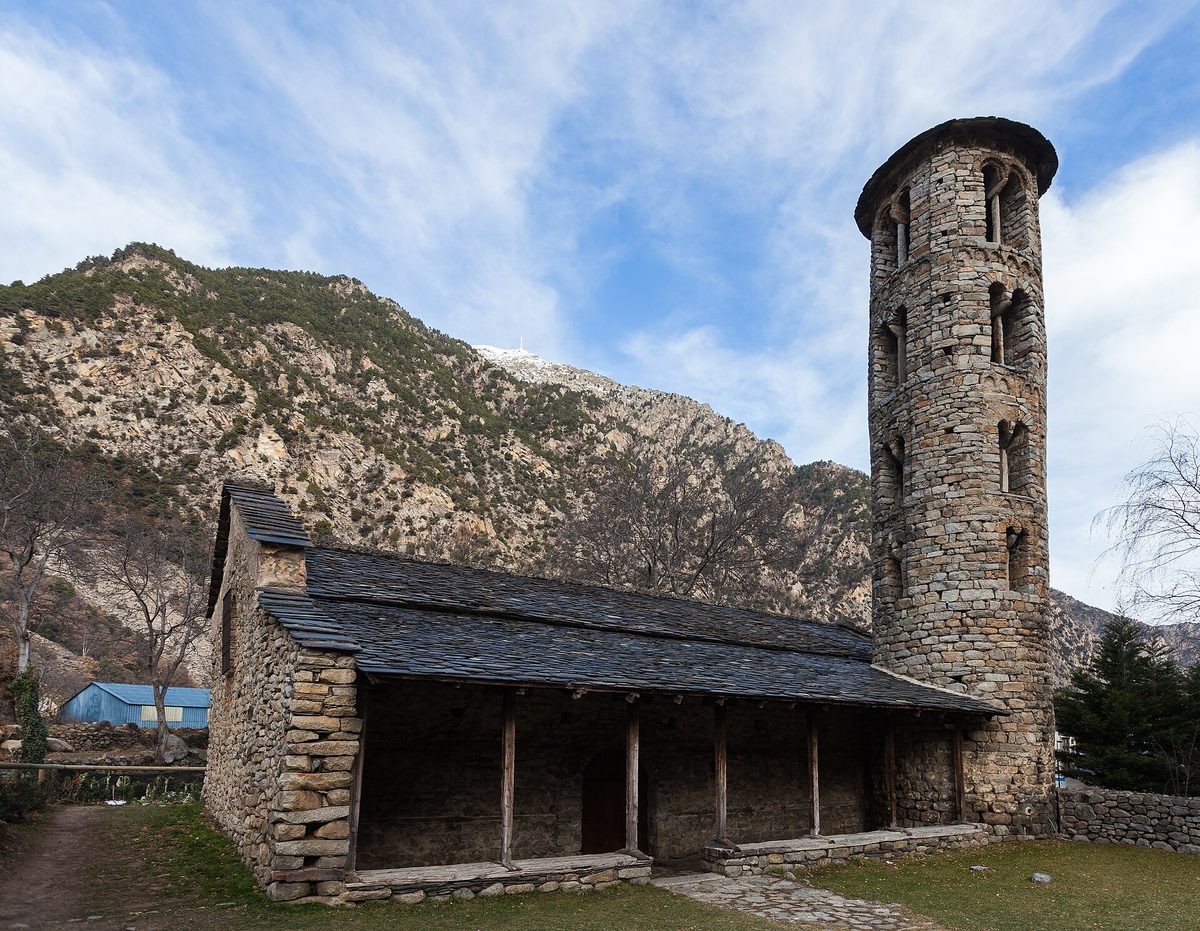
Santa Coloma — the oldest stone in the country
On the southern edge of the capital stands the little church of Santa Coloma, the oldest building in Andorra. Its core is pre-Romanesque, raised between the 9th and 10th centuries, and its most distinctive feature is unmistakable: a slender, four-storey round bell tower, a Lombard form you rarely see this far west. Inside, it once held a celebrated 12th-century mural cycle by the anonymous “Master of Santa Coloma.” Like so much Andorran church art, the originals were sold and scattered in the early 20th century — several ended up in Berlin — but they’ve since been recovered or reproduced, and a light projection now restores the lost frescoes to their walls on a timer. It’s a ten-minute walk or one bus stop from the centre; I cover it in the Andorra la Vella guide.
Sant Joan de Caselles — the Christ in Majesty
Up the eastern valley near Canillo, Sant Joan de Caselles is the picture-book one: an 11th-to-12th-century church standing alone in a green field beneath a tall, square Lombard bell tower, exactly where you’d put it if you were painting a postcard of medieval Andorra. Its treasure is inside — a remarkable Christ in Majesty, originally a painted stucco relief of the crucified Christ from around 1200, rediscovered in fragments and reconstructed against a painted backdrop of the sun, moon and the soldiers of the Passion. It is the single best piece of Romanesque art you can see in situ in the country, and most tour buses drive straight past it on their way to the ski lifts.
Meritxell — the basilica that burned and rose again

The Sanctuary of Meritxell, in the valley below Canillo, is the spiritual centre of the nation — home to Our Lady of Meritxell, Andorra’s patron saint. For centuries it sheltered a small Romanesque wooden statue of the Virgin, the most venerated object in the country. Then, on 8 September 1972 — the very day of her feast — a fire tore through the old sanctuary and destroyed both the chapel and the medieval statue. The loss hit Andorra like a death in the family.
What rose in its place is one of the more surprising buildings in the Pyrenees. The country commissioned the Catalan architect Ricardo Bofill, then at the height of his fame, to design a new sanctuary, completed in 1976. His basilica is boldly modern — arches, vaults and rough local stone reinterpreting the Romanesque rather than copying it — and it now holds a faithful replica of the lost statue. You can visit both the modern basilica and the surviving old chapel beside it, free of charge. It’s a moving stop even if you’re not religious, and an easy one to fold into a northern-valleys day; families often pair it with the nearby attractions in my guide to visiting Andorra with kids.
A living culture: language, faith and Catalan identity
Andorra’s culture is Catalan culture, distilled and mountain-bound. The official language is Catalan — and Andorra holds a genuine distinction here: it is the only country in the world where Catalan is the sole official language, which makes this microstate, improbably, the political flagship of a language spoken by millions across Catalonia, Valencia and the Balearics but official nowhere else as a state tongue. In practice you’ll hear Spanish constantly (half the residents are foreign nationals, many of them Spanish), French near the border, Portuguese in the kitchens, and enough English in the shops and hotels to get by. But the road signs, the laws and the schools run on Catalan, and Andorrans are quietly proud of it.
Faith runs just as deep, if more quietly than it once did. Andorra has no official religion, but Roman Catholicism holds a special recognised status “in accordance with Andorran tradition,” and the fact that one of your heads of state is a bishop tells you how entangled church and country have always been. The rhythm of the Andorran year is still, at bottom, a Catholic calendar — patron-saint festivals in each village, the great national feast of Meritxell in September, and the deep folk-Catholic traditions that survive in the high valleys long after they faded in the cities below.
You taste that culture as much as see it. The mountain-Catalan cooking — escudella stew, trinxat of cabbage and potato, river trout, cured embotits — is itself a historical document, the food of a poor, cold, self-sufficient place, and it comes out in force at every festival. I give it the full treatment in the guide to Andorran food; here, just know that no Andorran celebration is complete without a communal pot of something slow-cooked and a great deal of standing around eating it.
Festivals and traditions: fire, a patron saint and a coming-of-age
Andorra’s calendar is where its history stops being something in a museum and becomes something you can stand in the middle of. A handful of traditions are worth planning a trip around — and if timing matters to you, cross-reference the best time to visit Andorra guide before you book.
The summer-solstice fire festivals (UNESCO)
The most spectacular living tradition in the country involves setting things on fire on the shortest night of the year. On the summer solstice, in villages across the Pyrenees, people carry flaming torches down from the mountains to light great communal bonfires. In Andorra the central figure is the fallaire: a torchbearer in a traditional cape who whirls a falla — a bundle of burning tree-bark — in great circles of fire, the descent marking a young person’s passage from childhood into adulthood. In 2015 UNESCO inscribed these “summer-solstice fire festivals in the Pyrenees” on its list of Intangible Cultural Heritage, covering 63 towns across Andorra, Spain and France — and the international application was led by the Government of Andorra. For a country that rarely leads anything, that’s a point of real pride.
Our Lady of Meritxell — the national day
Every 8 September the whole country effectively shuts to honour its patron saint at the sanctuary of Meritxell. It’s both a religious feast and the secular National Day of Andorra, with Masses, a pilgrimage to the basilica, folk dancing, and a great deal of eating in the fields nearby. The date carries an extra weight since 1972, when the fire that destroyed the original statue happened on this very feast day; the celebration now doubles as a remembrance and a renewal.
Carnival, Sant Esteve and the old dances
Smaller traditions stitch the rest of the year together. Each parish keeps its own summer festa major, a multi-day blowout of concerts, communal meals and dancing. Carnival in February is big in the villages — Encamp and Sant Julià especially — with costumes, satire and the burning or “trial” of a Carnival effigy. Around Christmas, Andorra shares the gloriously odd Catalan tradition of the caga tió, a smiling log that children “feed” for days and then beat with sticks on Christmas Eve until it “delivers” sweets. And in a few villages the old folk dances still survive: the contrapàs, a slow-building circle dance cousin to the Catalan sardana, and the marratxa of Sant Julià de Lòria, a lively dance that — appropriately for this country — is said to commemorate the paréatges that founded it. History here doesn’t stay on the page; it gets danced.
Andorra’s culture now: Cirque du Soleil and a summer of shows
Heritage is only half the cultural story; modern Andorra has worked hard to become more than a duty-free mall with mountains, and it’s largely succeeded. The headline act is literal. Since the 2010s Andorra has hosted summer residencies by Cirque du Soleil, and the current production, Ràdio Andorra, has been confirmed to run again in summers 2026 and 2027. It’s a love letter to the real Ràdio Andorra — the legendary radio station that broadcast music across a blacked-out wartime Europe from these neutral valleys — restaged with the late-1940s jazz-and-swing era as its backdrop. The 2026 season runs roughly 22 shows from early July to early August in Andorra la Vella, with tickets from about €25; if you’re visiting in high summer, it’s the most ambitious night out the country offers, and it ties straight back into the smuggling-era history above.
Beyond the big top, the cultural scene is denser than 89,000 people have any right to support: a national chamber orchestra, the Ordino classical-music festival in the historic houses of the prettiest village, gallery spaces and a contemporary-art scene, and a steady stream of summer events. For the full menu of what’s on when you’re there, the things to do in Andorra guide keeps the seasonal calendar, and the broader Andorra activities roundup covers the rest.
Where to trace the history on the ground
You can read all this, or you can go stand in it. Andorra packs an unusual amount of visitable history into a small space, and most of it is cheap or free. These are the places where the story becomes physical.
Casa de la Vall — the parliament that was a farmhouse
If you visit one historical site, make it this one. The Casa de la Vall in the capital’s old quarter is a fortified stone manor built in 1580, bought by the Andorran parliament — the Consell de la Terra — in 1702, and used as the seat of government right up until 2011. Inside you’ll find the modest council chamber where the whole country was governed, a chapel, the old courtroom on the ground floor, and the famous Armari de les set claus — the “cabinet of the seven keys,” the national archive that could only be opened when all seven parishes were present with their keys. It’s government as physical multi-factor authentication, and it sums up the consensual, distrust-everyone-equally spirit of the place perfectly. The sleek glass parliament building next door, opened in 2011, makes the contrast the whole point. It sits in the historic core covered in the Andorra la Vella guide.
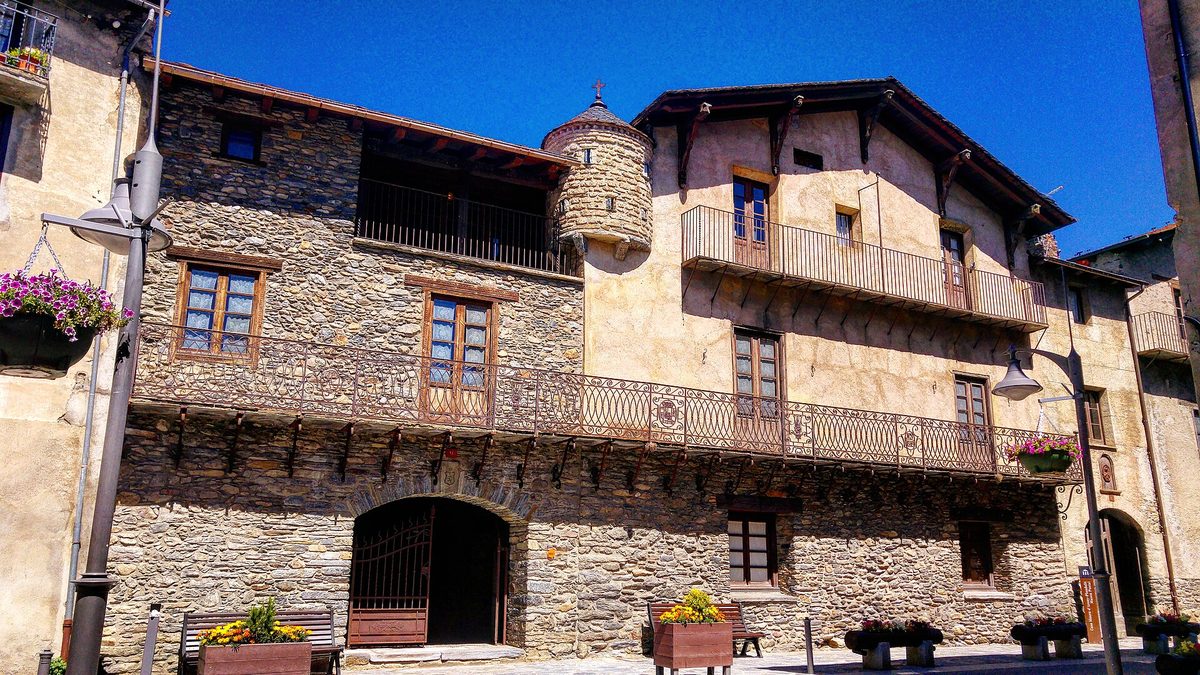
The house museums: how Andorrans actually lived
Two preserved homes do more to explain old Andorra than any plaque. The Casa d’Areny-Plandolit in Ordino is a 17th-century mansion of the closest thing Andorra had to aristocracy — a wealthy family of ironmasters and politicians — bought by the state in 1972 and open as a museum since 1984, its noble hall, library and chapel frozen in 19th-century comfort. At the other end of the social scale, Casa Rull in Sispony shows a prosperous farming household, all smoke-blackened kitchen and hay lofts. Together they bracket the whole society — and both sit in the handsome mountain villages of Ordino and La Massana, worth an unhurried wander in their own right.
The Tobacco Museum — the country’s hidden economy
Down south in Sant Julià de Lòria, the Museu del Tabac occupies the old Reig tobacco factory, which manufactured here from 1909 to 1957. It’s a sharp, well-designed museum about the crop that — alongside smuggling — kept Andorra fed before tourism arrived, and it doesn’t shy away from the contraband chapter. Tobacco is still grown in these valleys today, more for tradition than profit, the last little fields of it tucked between the shopping centres. For petrolheads, the National Automobile Museum in Encamp covers a different slice of the modern era, from an 1898 steam car onward.
The Madriu valley — UNESCO’s “spiritual heart”
Andorra’s only UNESCO World Heritage Site isn’t a building at all. The Madriu-Perafita-Claror Valley, a glacial wilderness covering nearly a tenth of the country, was inscribed in 2004 as a cultural landscape — recognition not of untouched nature but of a thousand years of human use: the shepherds’ huts, terraces, iron forges and stone paths of a communal mountain economy that has barely changed since the 13th century. There’s no road in; you reach it on foot, which is the point. It’s the place where Andorra’s history and its landscape become the same thing, and I route you into it in the hiking in Andorra guide.
A one-day history and culture route
Want to thread the best of it into a single day? Here’s the itinerary I’d give a friend who cared about the story, built around the eastern valley and the capital. It assumes a car or the national buses — see how to get to Andorra for the logistics, and the full Andorra itinerary if you’ve got more than a day.
Start north in Canillo. See Sant Joan de Caselles and its Christ in Majesty when it opens, then drop down to the Sanctuary of Meritxell for the basilica and the old chapel — an hour, free, and the emotional centre of the country. Midday: Drive down to Ordino, the handsomest village in Andorra, for the Casa d’Areny-Plandolit and a menú del dia of mountain-Catalan cooking. Afternoon: Head into the capital for the Casa de la Vall (book ahead — it’s small and tours fill) and a slow wander of the Barri Antic, finishing at Santa Coloma and its round tower as the light goes. If you have an evening in July or August: the Cirque du Soleil show. That’s a thousand years of Andorra in about nine hours, and you’ll have spent less on admissions than on lunch. For where to base yourself, see where to stay in Andorra, and for the small practicalities, the Andorra travel tips.
History of Andorra FAQ
Why is Andorra a country?
Because of a treaty, not a conquest. In 1278 a Catalan bishop and a French count agreed to share the Andorran valleys rather than keep fighting over them, creating a co-ruled buffer state too small and too useful to be worth annexing. That arrangement was never dissolved, so Andorra simply continued — and remains a sovereign country today.
Who founded Andorra?
By legend, Charlemagne, who is said to have freed the valleys from Muslim rule around 803 and granted the people a charter — there’s no historical evidence for it, but the national anthem still credits him. In documented fact, the modern state dates to the paréage treaty of 1278 between the Bishop of Urgell and the Count of Foix.
Who are the two princes of Andorra?
Andorra is a co-principality with two joint heads of state. As of 2026 they are Emmanuel Macron, the President of France (who inherits the title through his office), and Josep-Lluís Serrano Pentinat, the Bishop of Urgell in Spain, who took office in 2025. Both roles are now almost entirely ceremonial.
Why is the French president a prince of Andorra?
The co-prince title originally belonged to the medieval Counts of Foix. It passed by inheritance to the kings of Navarre, then to the French crown when Henry of Navarre became King Henry IV of France, and was made permanent in 1607. When France became a republic, the title carried over to the head of state — so every French president is automatically a prince of Andorra.
How old is Andorra, and how long has it been independent?
Andorra traces its borders and its co-ruled government to 1278, making it around 750 years old as a continuous political entity — one of the oldest in Europe. It was never fully independent in the modern sense until the 1993 constitution, but it was never absorbed by France or Spain either, which is the more remarkable achievement.
Why is Andorra not in the European Union?
Andorra has chosen to stay outside the EU, though it’s deeply tied to it: it has a customs union with the bloc dating to 1990 and has used the euro as its official currency since 2002 under a monetary agreement, despite not being allowed to mint its own notes. Its low-tax economy and small size have made full membership a complicated proposition, and negotiations on a closer association have run for years.
What language do they speak in Andorra?
The official language is Catalan, and Andorra is the only country where it’s the sole official tongue. In daily life you’ll also hear Spanish (very widely), French, Portuguese and enough English to manage as a visitor — but Catalan is the language of government, schools and street signs.
What is Andorra’s national day?
8 September, the feast of Our Lady of Meritxell, the country’s patron saint. It’s both a religious holiday and the secular National Day, centred on the Sanctuary of Meritxell. The date is especially poignant because the original medieval statue of the Virgin was destroyed by fire on this exact feast day in 1972.
What religion is Andorra?
Predominantly Roman Catholic. Andorra has no official state religion under its 1993 constitution, but Catholicism holds a specially recognised status by tradition — unsurprisingly, given that one of the country’s two heads of state is the Catholic Bishop of Urgell.
Did Andorra fight in the world wars?
No — it stayed neutral in both. A popular myth claims Andorra declared war on Germany in 1914 and was left at war until 1958, but there’s no evidence the declaration ever happened. In the Second World War the country was a key smuggling route, used to move refugees, downed Allied airmen and contraband across the Pyrenees.
What is Andorra most famous for historically?
For surviving. Andorra is celebrated as Europe’s last medieval co-principality, a country run for seven centuries by a French ruler and a Spanish bishop sharing the job, with unchanged borders since 1278. Add its Romanesque churches, its UNESCO fire festivals and Madriu valley, and its more recent reinvention as a duty-free and skiing destination, and you have the full sweep.
Related Andorra travel guides
Keep planning your trip with my other in-depth Andorra guides — including the Caldea thermal spa, and the Grandvalira ski area.
Photo credits
All images via Wikimedia Commons: Casa de la Vall by Diego Delso (CC BY-SA 3.0); Sant Joan de Caselles by Krzysztof Golik (CC BY-SA 4.0); Santa Coloma church by Diego Delso (CC BY-SA 3.0); the
2 comments
Comments are closed.