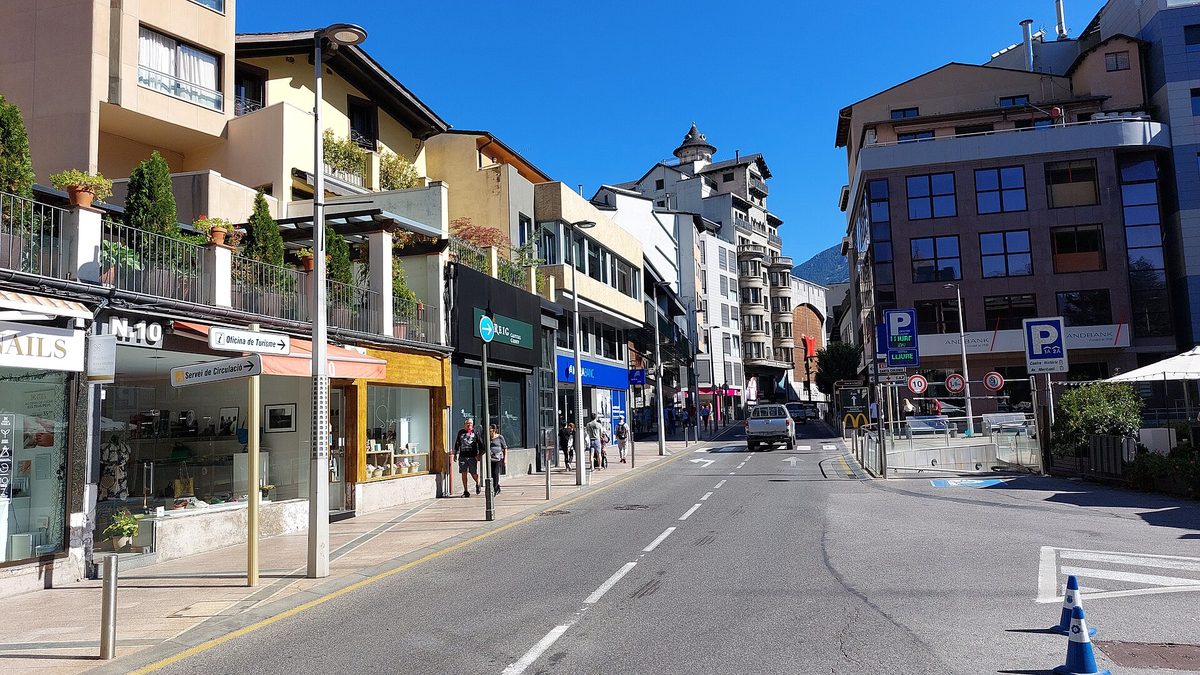
The short version: yes, shopping in Andorra is genuinely cheaper — but selectively. Tobacco runs 40–50% below Spanish and French prices, spirits 30–44%, perfume 25–35%, electronics a thinner 10–20%, and chain fashion barely anything. The country charges 4.5% sales tax against the EU’s ~21%, and customs limits on the way out are the catch.
Shopping is not a side activity here. It’s the single most common reason people come — 37.5% of all visitors name it as their main purpose, and among day-trippers that figure hits 82.5%. A country of 89,000 people maintains more than a thousand shops and absorbs over nine million visitors a year, most of whom go home with at least a bag of something. The whole national economy is, in a very real sense, organised around the duty-free run.
I’ve done that run more times than I can count — the perfume errand for relatives, the pre-Christmas tobacco-and-whisky convoy with friends from Toulouse, the ski-gear restock every November — and I’ve also stood in the Sunday-evening queue at the Spanish border long enough to watch the guards unpack an entire boot. So this guide is the one I wish someone had handed me the first time: what’s actually cheaper in 2026 (with prices I’ve re-checked this month), where to shop street by street, the official customs allowances — including the ones most blogs get wrong — and the timing tricks that decide whether your bargain day ends in smug satisfaction or a fine.
Last updated: June 2026. Prices, opening rules and customs allowances below were re-verified in June 2026 against official sources (visitandorra.com, duana.ad, the Spanish Agencia Tributaria’s Andorra traveller leaflet, store sites). Pump prices and shop promotions move; treat flagged numbers as that-week snapshots.
Shopping in Andorra at a glance
| Essential | The facts |
|---|---|
| Sales tax | IGI at 4.5% — versus 21% IVA in Spain, 20% TVA in France |
| Best buys | Tobacco (40–50% off), spirits (30–44%), perfume & cosmetics (25–35%), electronics (10–20%), fuel |
| Weak buys | Chain fashion (Zara & co. cost the same as Spain), books, fresh groceries, luxury watches |
| Main drag | The 1.5 km Shopping Mile: Avinguda Meritxell + Fener Boulevard (Andorra la Vella) and Vivand/Avinguda Carlemany (Escaldes-Engordany) |
| Shopping days | 362 in 2026 — shops close only on Jan 1, Sep 8 and Dec 25 (plus Mar 14 when it falls on a weekday) |
| Hours | Sunday–Thursday until 20:00, Friday–Saturday until 21:00; every Sunday is a shopping day |
| Customs allowance (the headline numbers) | Per adult: 300 cigarettes, 1.5 L spirits + 5 L wine + 16 L beer, €900 of other goods |
| Borders | Open 24/7 year-round: la Farga de Moles (Spain, N-145) and Pas de la Casa (France, RN22/RN320) |
| Currency | Euro; cards accepted nearly everywhere, but carry the receipts for customs |
| Sales seasons | Rebaixes in January and July–August; Shop in Andorra Festival each November |
Why everything is (somewhat) cheaper: the honest tax math
Andorra is not in the European Union. It runs its own indirect tax, the IGI, at a general rate of 4.5% — roughly a fifth of what Spain (21%) or France (20%) add to a price tag. On top of that, the excise duties that make tobacco, alcohol and fuel so expensive in the EU are dramatically lower here: Andorra taxes tobacco at around 23% of its value, where Spanish and French excise-plus-VAT stacks claim 70–80% of the final pack price.
That’s the whole secret. There’s no magic, no special “tax-free store” you need a passport for (one widely-read guide claims this; it’s nonsense — the low tax applies in every shop in the country, to everyone). And it’s why the savings vary so much by product: the more of an item’s home price is tax, the more Andorra saves you. Tobacco is mostly tax, so the gap is huge. A cotton T-shirt is mostly cotton and logistics, so the gap is pocket change.
Two honest caveats before you load the car. First, retailers here aren’t charities: some of the tax gap disappears into margins, especially on electronics, so the real-world discount is usually smaller than the headline tax arithmetic suggests. Second, online retail has eroded the old advantages — an Amazon flash deal will sometimes beat an Andorran shelf price on a camera or a pair of headphones. Perfume, spirits and tobacco remain reliably, structurally cheaper. For everything else, the rule is simple and I’ll repeat it until it sticks: know your home price before you cross the border.
It clearly still works as a draw. Andorra logged about 9.2 million visitors in the last full year — over a hundred times its population — and Spaniards and French together make up nearly 90% of them, a great many on shopping day-trips. The state’s own surveys say more visitors come primarily to shop than to ski, which in a country with the Pyrenees’ biggest ski area is saying something.
What’s actually cheaper — and what isn’t
Here’s the June 2026 reality check, built from shelf prices in Andorra la Vella and Escaldes and compared against typical Spanish high-street prices. Treat them as good-faith snapshots, not gospel — promotions move weekly.
| Product | Andorra | Spain | Real saving |
|---|---|---|---|
| Marlboro, 20 cigarettes | ~€3.50 | ~€5.50 | ~36% (France ~€12.50: ~72%) |
| Johnnie Walker Black 1 L | ~€18 | ~€32 | ~44% |
| Tanqueray gin 1 L | ~€16 | ~€27 | ~41% |
| Rioja crianza, 75 cl | ~€5 | ~€8 | ~35% |
| Chanel N°5, 100 ml | ~€85 | ~€120 | ~29% |
| Dior Sauvage EDT, 100 ml | ~€70 | ~€105 | ~33% |
| iPhone 16 Pro 256 GB | ~€1,050 | ~€1,299 | ~19% — but mind the €900 limit |
| AirPods Pro 2 | ~€199 | ~€249 | ~20% |
| Clinique moisturiser 50 ml | ~€35 | ~€48 | ~27% |
| Supermarket chocolate, coffee pods | — | — | ~30–50% on branded goods |
| Zara / H&M / Mango | — | — | ≈0%: same prices as Spain |
Tobacco: the biggest gap, the tightest limit
Proportionally nothing else comes close. A pack that costs €5.50 in Spain runs about €3.50 here; against France the same pack saves you nearly three-quarters. A carton of Marlboro lands around €35 in town (border megastores sometimes charge a few euros more for the convenience, which still amuses me) versus roughly €57 in Spain and €125 in France. The reason French cars queue at Pas de la Casa every weekend is not mysterious. The catch is the allowance — 300 cigarettes per adult, exactly 1.5 cartons — and the fact that customs officers on both borders treat tobacco as their main quarry. More on that below, because the difference between 1.5 cartons and 2 is the difference between a bargain and a bad afternoon.
Alcohol: where the supermarket beats the duty-free shop
Spirits are the second-best buy: big-brand whisky, gin and rum run 30–44% under Spanish prices, more against France. Mid-range litre bottles — Jameson, Ballantine’s, J&B — sit in the €14–18 band that Spanish supermarkets stopped seeing a decade ago. An open secret the duty-free shop windows won’t tell you: for standard brands, supermarkets usually beat the specialist liquor stores. The Carrefour inside Epizen and the big Bonpreu and E.Leclerc-style grocery floors price Absolut and Havana Club lower than the neon-lit “liquors” shops a hundred metres from the border. The specialists earn their keep on premium malts, cognac and champagne, where the selection genuinely is better. Wine is quietly excellent value too — decent Rioja and Priorat at €4–10 — and the allowance (5 litres of still wine per adult, on top of spirits) is more generous than most people realise.
Perfume and cosmetics: the classic Andorran errand
This is the category Andorra built its retail reputation on, and it still delivers: 25–35% off the big houses, with the bonus that perfumery here is a competitive local industry rather than an airport afterthought. The standard play is to walk Avinguda Meritxell comparing the two or three big chains’ prices on your specific bottle — they undercut each other constantly, and the same 100 ml of Sauvage can vary €8 between shops two doors apart. Stack a seasonal promotion on top of the structural discount and you can occasionally halve the Spanish price. Skincare with actives (retinol, vitamin C serums) is also notably cheaper than in Spanish pharmacies and perfumeries.
Electronics: real savings, real fine print
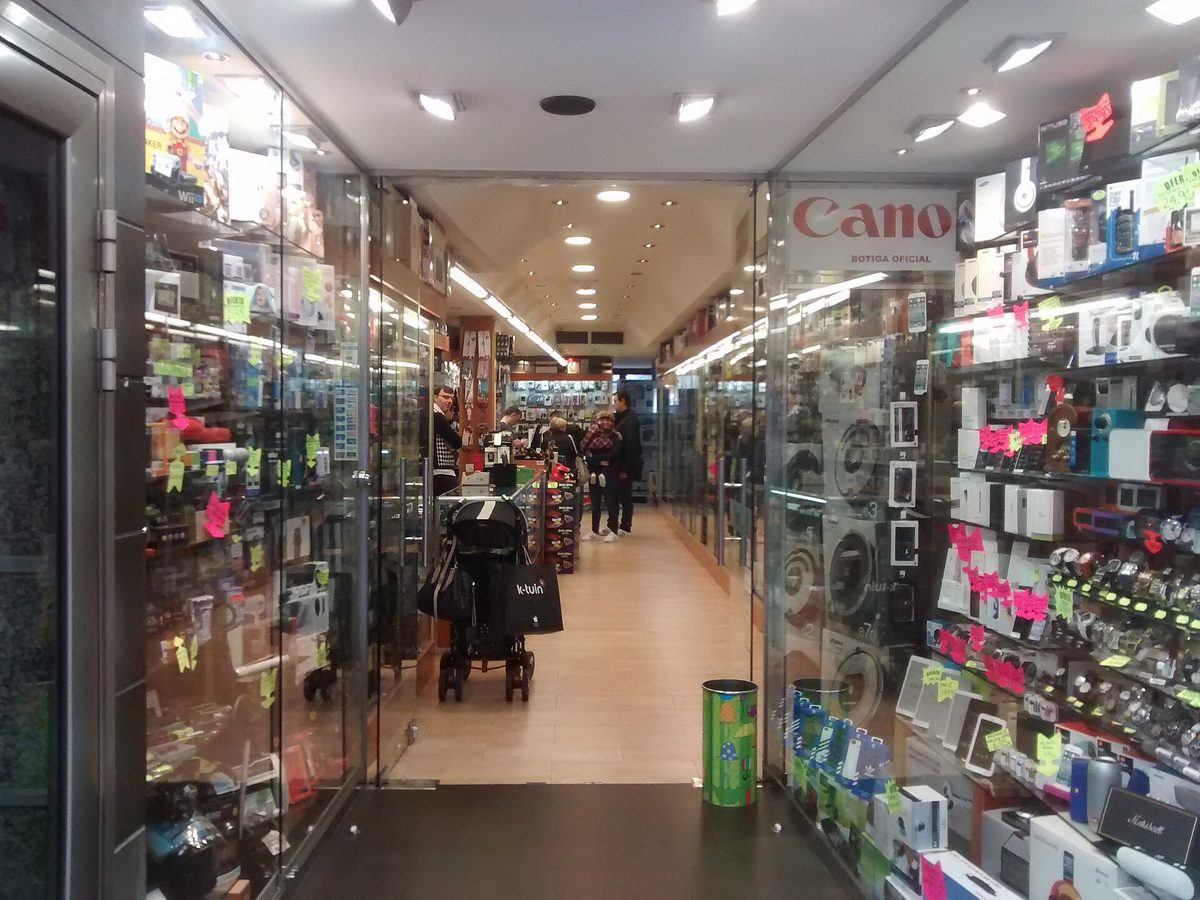
Phones, laptops, cameras, headphones and watches-of-the-smart-variety run 10–20% under Spanish retail. That’s worthwhile money on a €1,200 phone — with three asterisks I’d want a friend to read before handing over a card. One: the €900-per-adult customs allowance means a flagship iPhone technically exceeds what you can carry into Spain or France without declaring; a couple can’t legally “split” one €1,050 item between two allowances either, because single items aren’t divisible. Two: warranty. Ask explicitly for an EU/European warranty rather than a shop or Andorra-only guarantee, and keep the invoice — consumer law here is Andorran, not EU, and your home country’s consumer protections don’t follow you. Three: compare against online prices, not your home high street. The gap that looks decisive against a Madrid shop window sometimes evaporates against a Prime Day price. Buy here when the number genuinely wins, not because the mountain air feels lucky.
Fuel, pharmacy and groceries: the locals’ basket
Petrol and diesel run meaningfully under Spanish prices (typically 10–20 cents a litre, more against France) — there’s a dedicated section on the fill-up ritual below. Pharmacies sell many medicines cheaper than in Spain and stock some products that need prescriptions elsewhere; if that matters to you, bring your paperwork and ask the pharmacist rather than improvising. And branded groceries — chocolate, coffee capsules, spirits-adjacent treats — are 30–50% cheaper in the hypermarkets, which is why you’ll see Catalan families wheeling trolleys that are 40% Milka by volume. Fresh food, on the other hand, costs the same or more than in Spain; nobody drives up a mountain for lettuce.
What’s not worth your boot space
Chain fashion is the big disappointment for first-timers: Zara, H&M, Mango and friends price-match their Spanish stores almost to the cent, so the 1.5 km of fashion windows is about choice, not savings. Books and school supplies — same or pricier. Luxury watches and fine jewellery look tempting in the Meritxell vitrines, but the deltas are small once you compare seriously, and the €900 allowance makes the legal math awkward anyway. Ski hardware is a genuinely good buy — but mostly in the right week, which I’ll get to.
The Shopping Mile, metre by metre
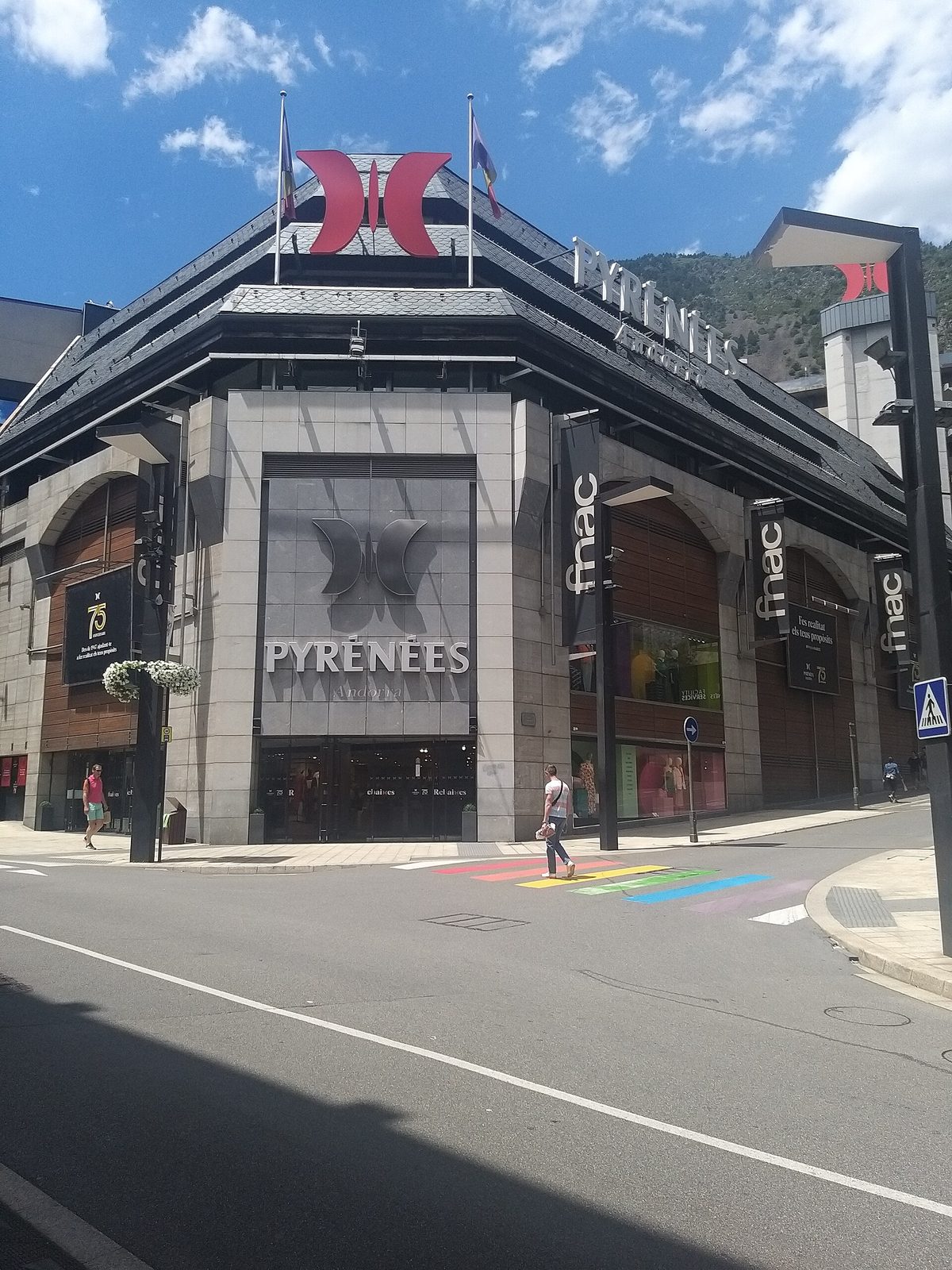
Almost everything that matters happens along one valley-floor axis: the Shopping Mile, a 1.5-kilometre chain of streets running through the capital and into its Siamese-twin town next door. If you’ve read my Andorra la Vella guide, you know the trick: somewhere along this walk you cross an invisible parish line and Andorra la Vella becomes Escaldes-Engordany without telling you. The shops don’t care, and neither will you.
Start at the bottom of Avinguda Meritxell, the most famous shopping street in the country. The lower stretch is pedestrianised and carries the heavyweight names: the big perfumery flagships, sports superstores, jewellers, phone and camera dealers, plus the international fashion chains. This is comparison-shopping territory — perfume in particular rewards checking two or three competing chains before you commit, because they fight each other on exactly the bottles tourists come for. The street is at its best on winter evenings, when the lights are on, the crowd is half ski-jacketed, and the whole valley smells faintly of roasted chestnuts and eau de toilette.
Fener Boulevard picks up where pedestrian Meritxell ends — a glassier, more modern block linking through toward the river — and then the mile crosses the parish line and becomes Vivand, the fully pedestrianised stretch of Avinguda Carlemany in Escaldes-Engordany. I’ll admit Vivand is my favourite half of the mile: completely car-free, broader, calmer, punctuated with benches and sculpture, and home to a slightly more local mix — Escaldes’ own perfumeries and boutiques alongside the chains, with the thermal spa’s glass spire rising at the far end as a finish line. If your legs are good you can walk the entire mile, window to window, in twenty minutes; with actual shopping intent, budget a half day.
Two detours worth knowing. The old town of Andorra la Vella, two minutes uphill from Meritxell, mixes souvenir and craft shops into the stone quarter — better for gifts with a story than for bargains. And Riberaygua i Travesseres, the grid of streets on the river side of the avenue, is where the locals’ shops live: hardware, haberdashery, family-run food stores, the unglamorous Andorra that doesn’t advertise in four languages. A wander there is the antidote if the mile starts feeling like one long airport terminal.
Department stores, malls and the border megastores
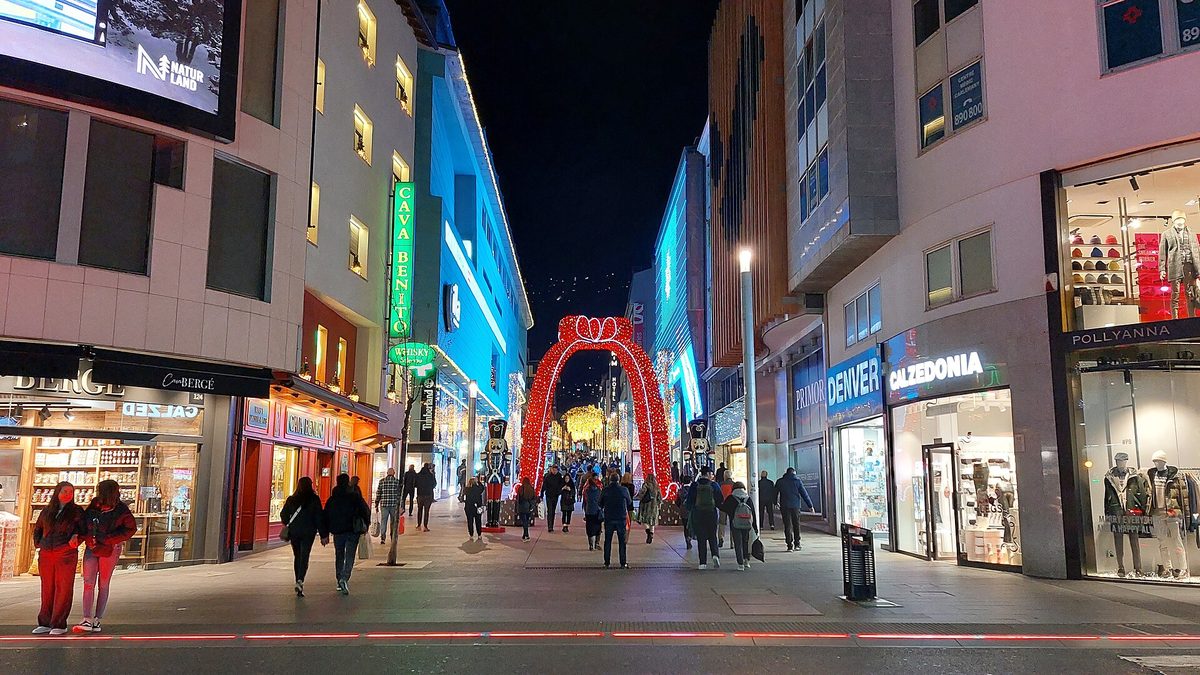
Pyrénées (Avinguda Meritxell 11, daily 9:30–20:00) is Andorra’s only true department store and a national institution — the kind of place where you can buy a Longines, a raclette set, a drone and a leg of jamón under one roof, then have the car park validate your ticket. Floors run from beauty and fashion up through electronics and sport to a gourmet hall that’s dangerously good at separating you from your allowance budget. Prices aren’t always the lowest on the street, but the selection is the deepest, the staff actually know their stock, and when something goes wrong, a big established house is where you want your receipt to be from.
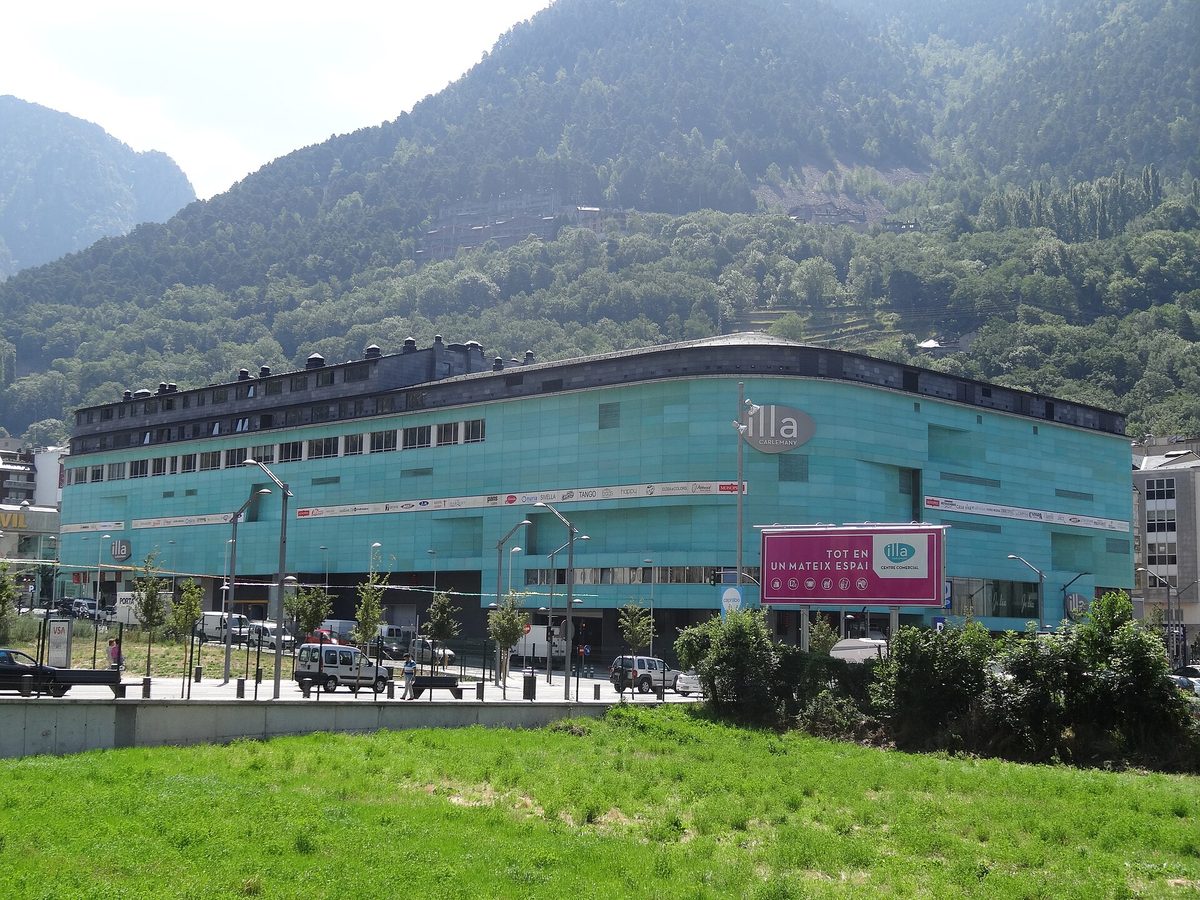
illa Carlemany in Escaldes-Engordany is the city-centre mall: four floors of mostly fashion and lifestyle chains, a supermarket, food court and the country’s main cinema, dropped right onto the Vivand pedestrian axis. It’s the wet-weather and teenagers option — when a storm kills the mountain plans, half of Andorra has the same idea, and it shows.
Epizen, in Sant Julià de Lòria three minutes’ drive from the Spanish border, is the one that surprises people who haven’t visited since the pandemic. This is the site of the old Punt de Trobada — the legendary border megastore where generations of Catalans did their tobacco runs — rebuilt by the Pyrénées group into a six-floor, 60,000 m² retail box that opened in late 2022. The anchor is a roughly 8,000 m² Carrefour hypermarket (the cheap-groceries-and-spirits mothership), topped with chain stores like Lefties, Sprinter, Tezenis and the IO Electro&Home electronics floor, a terrace with legitimately spectacular valley views, and over a thousand free parking spaces. Open daily 9:00–21:00. It is not charming. It is extremely efficient. If you’re day-tripping from Spain purely for the shopping, you could honestly park here, do everything in ninety minutes, and skip the capital’s traffic entirely — the L1 city bus even stops at the door if you’ve come up by coach. Closer still to the crossing sits the River shopping centre, the last big stop before Spanish customs, fulfilling the same last-chance-tobacco role it always has.
My honest routing advice: if you want the experience — the mile, the lights, the lunch, the spa afterwards — shop in the capital and make a proper day of it with everything else the country offers. If you want the savings with minimum time-cost, Epizen plus a petrol station covers 90% of the typical shopping list.
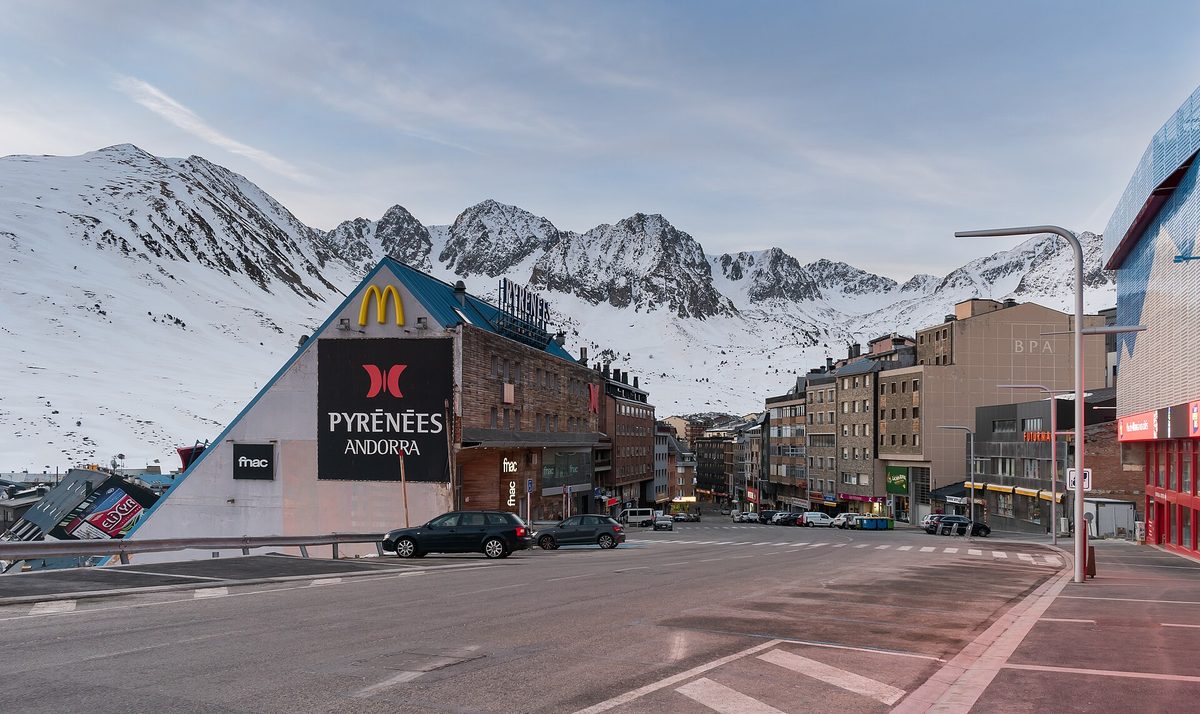
Pas de la Casa: the French-border bargain town
At 2,050 m on the French frontier, Pas de la Casa is what happens when you build a town with two purposes — skiing and selling — and skip the beautification committee entirely. I’ve called its architecture ugly in print before and I stand by it; the concrete does nothing for the mountain. But for French visitors it’s the duty-free shop of national reference: streets of perfumeries, alcohol-and-tobacco supermarkets and sports stores, all calibrated to French prices, which makes the discounts look even better than they do from the Spanish side. Tobacco at a quarter of the French price and €12-cheaper bottles of cognac explain the Toulouse and Ariège plates filling every car park.
Two practical notes. In winter, Pas de la Casa doubles as a major Grandvalira ski base, so you can genuinely combine a morning on the pistes with an afternoon allowance-run — my skiing guide covers the sector. And in big snow, the Envalira pass above town is the one bit of Andorran driving that demands respect: there’s a toll tunnel under the worst of it, and chains-or-winter-tyres rules apply. Check conditions before you commit to a January bargain mission; more on routes in the getting-here guide.
Beyond duty-free: five scenes worth knowing
Sports gear. A country that lives off skiing sells a lot of ski kit, and sells it well. The Meritxell-area sports superstores — Viladomat is the historic name — carry deep ranges of hardware and clothing, with two golden windows: October–November, when new-season stock arrives and pre-season promotions run, and late spring, when leftover winter inventory gets cleared at 30–50% off. Summer hikers and cyclists are equally well served; the bike scene clusters down-valley in Sant Julià de Lòria.
Perfumery as heritage. Perfume isn’t just a product line here — it’s practically the founding industry of Andorran retail, and home-grown chains like Júlia have grown from a single shop into institutions with flagship stores on the mile. The staff in the big perfumeries are mostly career specialists rather than seasonal hires; if you half-remember a discontinued scent your mother wore in 1995, this is the place to ask.
Pharmacy and parapharmacy. Cheaper medicines and a broader over-the-counter range pull a steady cross-border trade of its own. Sunscreen, contact-lens supplies, baby formula and dermo-cosmetics are the quiet bargains; for anything serious, bring your prescription and speak to the pharmacist properly.
The gourmet run. Hypermarket aisles aside, look for Andorran and Pyrenean produce — mountain cheeses, charcuterie, local honey, wines from the country’s improbably steep vineyards — sold in the old-town delis and the Pyrénées gourmet hall. It’s the one shopping category where you go home with something that couldn’t have come from anywhere else.
Cars and motors. Santa Coloma, on the capital’s southern edge, concentrates the car, motorbike and accessories trade — a local-facing scene, but useful to know if you’re into gear, tyres or just like wandering showrooms of vehicles taxed differently than at home.
The customs limits that catch people at the border
Here’s the section to screenshot. Andorra sits outside the EU, so when you cross back into Spain or France you pass a real customs border with real allowances — and because a special bilateral arrangement applies, the numbers are higher than the generic “arriving from outside the EU” limits you’ll find on most websites. Plenty of blogs (including some otherwise excellent local ones) quote 200 cigarettes and €300; the Spanish tax agency’s own leaflet for travellers arriving from Andorra, and Andorran customs at duana.ad, print the figures below. They apply per adult traveller (tobacco and alcohol: 17 or over), and they’re what the officers at la Farga de Moles work from.
| Category | Allowance per adult (Spain/France) |
|---|---|
| Cigarettes | 300 (= 1.5 cartons), or 150 cigarillos (<3 g), or 75 cigars, or 400 g smoking tobacco |
| Spirits over 22° | 1.5 litres — or 3 litres of drinks under 22° (fortified, sparkling, aperitifs) |
| Still wine | 5 litres (on top of the spirits line) |
| Beer | 16 litres — the allowance almost nobody knows exists |
| Perfume | 75 g of perfume + 375 ml of eau de toilette |
| Coffee / tea | 1 kg coffee (or 400 g extract); 200 g tea (or 80 g extract) |
| Food products | Up to €300 per adult (€150 under-15) with per-item caps: 4 kg cheese, 5 kg meat, 1 kg butter, 5 kg sugar/sweets… |
| Everything else (electronics, fashion, etc.) | Up to €900 per adult, €450 under-15 |
| Fuel | A full normal tank + up to 10 litres in a portable container |
| Cash | €10,000 or more must be declared when crossing |
The fine print that does the catching, learned partly from watching it happen to others at the green channel:
Allowances are individual and not poolable. Four adults in a car = four full allowances, and splitting the trolley across travellers is legitimate. But a single item’s value can’t be divided: a €1,050 phone exceeds €900 even with two of you, full stop. Children’s allowances don’t cover tobacco or alcohol at all. Under-17s have zero tobacco and alcohol franchise — the family-of-five maths only works on the €450-per-child goods line. Quantity limits ignore value. Three hundred cheap cigarettes and three hundred premium ones are equally over at 301. Keep every receipt — when an officer asks you to demonstrate you’re inside €900, a folder of tickets turns a twenty-minute unpacking into a two-minute wave-through. And if you’re over, use the red channel and declare: you’ll pay import VAT and duties on the excess and drive on. Getting caught in the green channel with undeclared excess means seizure of the goods and a fine that can reach double their value — Spanish enforcement on tobacco specifically is energetic, well-practised, and entirely unmoved by claims of arithmetic confusion.
One myth to retire: there is no tourist tax-refund scheme in Andorra. Nothing to stamp, no forms at the exit. The IGI you pay is already the discount. (The DIVA kiosk you may spot at the Spanish border works the other direction — it’s for Andorra residents reclaiming Spanish IVA on purchases made in Spain.)
Border reality: queues, checks and timing
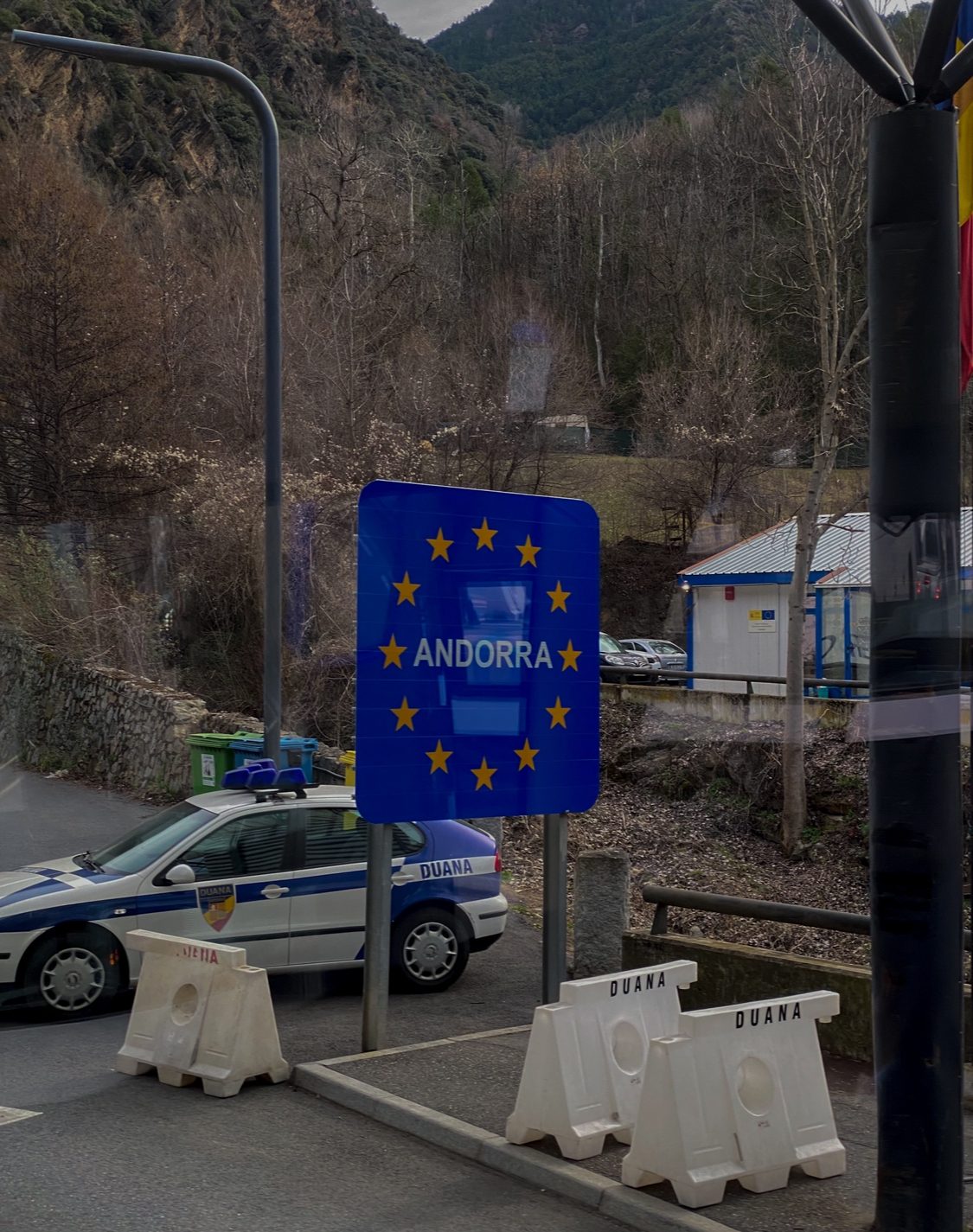
The borders never close — both crossings run 24/7, every day of the year, and the customs posts staff the same hours. What varies wildly is the queue. The Spanish exit at la Farga de Moles backs up on Saturday and Sunday late afternoons year-round, swells painfully on Spanish and French holiday weekends and through August (when waits of an hour or two aren’t rare), and reaches its annual worst around the Christmas bridge weekends and the Reyes sales. The French side at Pas de la Casa has the same rhythm tuned to French school holidays, plus weather drama in midwinter.
The patterns that actually help: cross back before 16:00 on a weekend day and you’ll usually roll through; aim for a Tuesday–Thursday trip and the whole exercise feels like a different country. Checks intensify exactly when you’d expect — weekends, holidays, the festival weeks — and tobacco is what they’re looking for. The officers have seen every hiding place a Renault Scénic offers. Buy your allowance, keep the tickets on the passenger seat, and the border is a formality; the people idling in the inspection bay almost always bet otherwise.
If you’re crossing by coach, customs boards the bus or waves it through — the allowances are identical, and yes, they do sometimes check coach luggage holds. Full route-by-route logistics, including the bus operators and the no-airport reality, live in the getting-to-Andorra guide.
Fill the tank while you’re at it
The cheapest souvenir in Andorra is in the ground. Fuel runs structurally below neighbouring prices — typically 10–20 cents a litre under Spain and 30–50 under France, which on a 50-litre tank means €5–10 saved for thirty seconds of nozzle time on your way out. As I write this in June 2026, the country’s average pump prices sit around the high-€1.50s for unleaded 95 (cheaper stations meaningfully under that), but pump prices move weekly everywhere — the reliable part is the gap, not the number. The rules even bless the habit: your allowance covers a full standard tank plus up to 10 litres in a jerrican.
The country runs around forty stations for its 468 km², most open 24 hours, with convenient clusters on the CG-1 between the capital and the Spanish border and on the climb to Pas de la Casa. Locals from La Seu d’Urgell and the Ariège time their tanks to Andorra runs as a matter of course; do as they do and fill up last, after the shopping, on the way to the crossing.
When to shop: hours, sales and the crowd calendar
Andorra’s retail calendar is built for visitors in a way that still startles first-timers from Spain or France: shops open every Sunday, generally until 20:00 Sunday–Thursday and 21:00 on Friday and Saturday, and the whole country closes for retail just four dates a year — January 1, March 14 (Constitution Day — though shops open anyway when it falls on a weekend, as it did in 2026), September 8 (the national day) and December 25. That makes 362 shopping days in 2026. The asterisk: the big stores and malls trade straight through the day, but small old-town and neighbourhood shops still keep the Pyrenean lunch sacred, closing roughly 13:00–15:00. Plan the boutique errands for morning or late afternoon and use the middle of the day the way locals do — at a long lunch.
The discount calendar stacks three layers on the structural tax savings. The rebaixes (sales) run twice a year, January into February and July into August, exactly as in Spain — January is the sweet spot, when sale prices compound the duty-free discount on winter stock. Each November, the Shop in Andorra Festival takes over the capital, Escaldes and Pas de la Casa with extended promotions, live music, tastings and prize draws — recent editions ran roughly the first three weeks of November (the 2025 edition was November 7–23; 2026 dates weren’t announced as I updated this). And the pre-season sports promotions in October–November are when ski gear is at its keenest. For how all this overlays the weather and the crowd peaks — December bridges, February half-terms, August — see the month-by-month guide.
If pure shopping comfort is the goal, my pick is a Tuesday or Wednesday in late June, September or early October: full stock, no queues at the border or the fitting rooms, terrace weather for the lunch break, and hotel prices at their season-gap lowest.
The shopping day-trip, with or without a car
The classic version is the drive: Barcelona is about 200 km and three hours via the C-14/N-145, Toulouse around 185 km over the Envalira side, La Seu d’Urgell a ten-minute hop. Park once and walk — the capital’s communal car parks are plentiful and the mile is entirely walkable — or do the Epizen-and-fuel blitz near the border if time is the constraint. Either way, remember the golden sequence: shop, lunch, fuel, border before 16:00.
Carless is easier than people assume. Direct coaches run from Barcelona city and El Prat airport (about €35 one-way, sixteen-odd departures a day) and from Toulouse, landing you at the national bus station ten minutes’ walk from Meritxell; full operator details here. Within the country, the L1 city bus runs down-valley from the capital and stops at Epizen’s door for €1.90, which makes even the border-hypermarket run feasible on foot-passenger logistics. The one thing the bus can’t carry for you is the weight — 16 litres of beer is a workout — so carless shoppers sensibly skew toward perfume, electronics and clothing rather than the liquid categories.
And a gentle pitch from someone who’s watched ten thousand day-trippers do the U-turn: the 82.5% of you who come only to shop are leaving the best of the country unopened. Stay one night and the trip transforms — old-town wander, a long borda dinner, three hours in the thermal lagoons, maybe a cable car up a mountain before the drive home. The shopping is better as the dessert than the meal. The capital guide has the where-to-base details.
Shopping in Andorra: your questions, answered
Is shopping in Andorra really cheaper?
Selectively, yes. Tobacco saves 40–50% versus Spain (far more versus France), spirits 30–44%, perfume and cosmetics 25–35%, electronics 10–20%. Chain fashion, books and fresh food save you essentially nothing. The 4.5% IGI versus 20–21% EU VAT is the engine; margins and online competition decide how much of it reaches your receipt.
Is Andorra completely tax-free?
No — “duty-free” is shorthand. Everything carries the 4.5% IGI, plus low local excise on tobacco, alcohol and fuel. It’s not zero tax; it’s a fraction of EU tax. There are no special tax-free stores and no refund paperwork: the price on the tag is simply the price.
What is most worth buying in Andorra?
In order of percentage saved: tobacco, spirits, perfume and branded cosmetics, branded groceries (chocolate, coffee), fuel on the way out, then electronics — with ski and sports gear a special case that peaks during October–November promotions and spring clearances.
How much can I take back into Spain or France?
Per adult: 300 cigarettes (or 75 cigars or 400 g tobacco), 1.5 litres of spirits over 22° (or 3 litres under), plus 5 litres of still wine, plus 16 litres of beer, plus €900 of other goods (€450 per child under 15) and food up to €300. These Andorra-specific allowances — higher than the generic non-EU ones many sites quote — are published by Andorran customs (duana.ad) and the Spanish tax agency.
What happens if I exceed the limits?
Declare the excess in the red channel and you simply pay the import VAT and duties on it. Get caught not declaring and the goods can be seized with a fine of up to roughly twice their value — and tobacco is precisely what the frequent weekend checks are hunting. Keep receipts; they’re your fastest exit from any inspection.
What’s the best shopping street in Andorra?
Avinguda Meritxell in Andorra la Vella for the flagship density, flowing via Fener Boulevard into Vivand (Avinguda Carlemany) in Escaldes-Engordany — together the 1.5 km Shopping Mile. Pyrénées at Meritxell 11 is the landmark department store; illa Carlemany the central mall; Epizen by the Spanish border the efficiency option.
Are shops open on Sundays?
Yes — every Sunday, normally until 20:00. Retail closes only four dates a year (January 1, March 14 when it falls on a weekday, September 8, December 25), giving 362 shopping days in 2026. Small family shops still close for lunch around 13:00–15:00; malls and department stores don’t.
When are the sales?
January–February and July–August (the rebaixes), with the Shop in Andorra Festival adding promotions and street events through early-to-mid November. January sales on top of duty-free pricing is the deepest-discount window of the year.
Is it worth buying an iPhone or laptop in Andorra?
Often, at 10–20% below Spanish retail — but check the live online price first, insist on an EU-valid warranty with a proper invoice, and remember a flagship phone alone can exceed the €900 personal allowance, which legally should be declared. The €249 saved on a €1,299 phone is real; the fine print is realer.
Can I pay in euros, and do shops take cards?
The euro is Andorra’s official currency (by agreement — it’s not an EU member), and cards are accepted practically everywhere, including the border megastores. Carry some cash for tiny old-town shops and keep all receipts visible-side-up for the drive home.
Why do French shoppers go to Pas de la Casa?
It’s the first town across the French border at 2,050 m, dense with perfumeries and alcohol-tobacco supermarkets, and the savings calculated against French prices are the steepest in the country — a French-priced €125 carton of cigarettes costs about €35 there. In winter it’s also a Grandvalira ski base, so the bargain run and the ski day combine neatly.
Is there anywhere to shop without the crowds?
Midweek, any season, the whole country shops calmly. Failing that: Riberaygua i Travesseres for local-facing streets two minutes from the mile, the old town for crafts and delis, Sant Julià de Lòria for the cycling and shopping-centre scene — or simply go at 10:00 on a Tuesday and have Avinguda Meritxell nearly to yourself.
Before you load up, it’s worth skimming my Andorra travel tips: the customs limits at the French and Spanish borders are real and enforced.
Shopping & Duty-Free: the in-depth guides
The detail behind the savings, category by category:
- Alcohol and Cigarette Prices in Andorra — Why the Border Queues Exist
- Andorra Duty-Free Allowances — What You Can Legally Take Home
- Perfume Shopping in Andorra — The Best Deal in the Country
- Buying Electronics in Andorra — Real Savings or Tourist Myth?
- Is Andorra Cheap for Shopping? Honest Price Comparison vs Spain and France
- Andorra’s Shopping Centres — Pyrenees, illa Carlemany and the Big Names
- What to Buy in Andorra — Souvenirs That Aren’t Junk
- Planning an Andorra Shopping Trip — Timing, Sales and Border Strategy
Related Andorra travel guides
Keep planning your trip with my other in-depth Andorra guides — including Andorra’s villages, Andorran food, a day-by-day itinerary, hiking in Andorra, the Caldea thermal spa, the full range of activities, the history of Andorra, visiting with kids, and where to stay.
Photo credits
All images via Wikimedia Commons: Avinguda Meritxell by FrankAndProust (CC0); Pyrénées department store by Lks.poch (CC BY-SA 4.0); Avinguda Carlemany/Vivand at Christmas by FrankAndProust (CC0); Pas de la Casa by Krzysztof Golik (CC BY-SA 4.0); Andorra–Spain border post by Jaakko.kulta (CC0).

3 comments
Comments are closed.