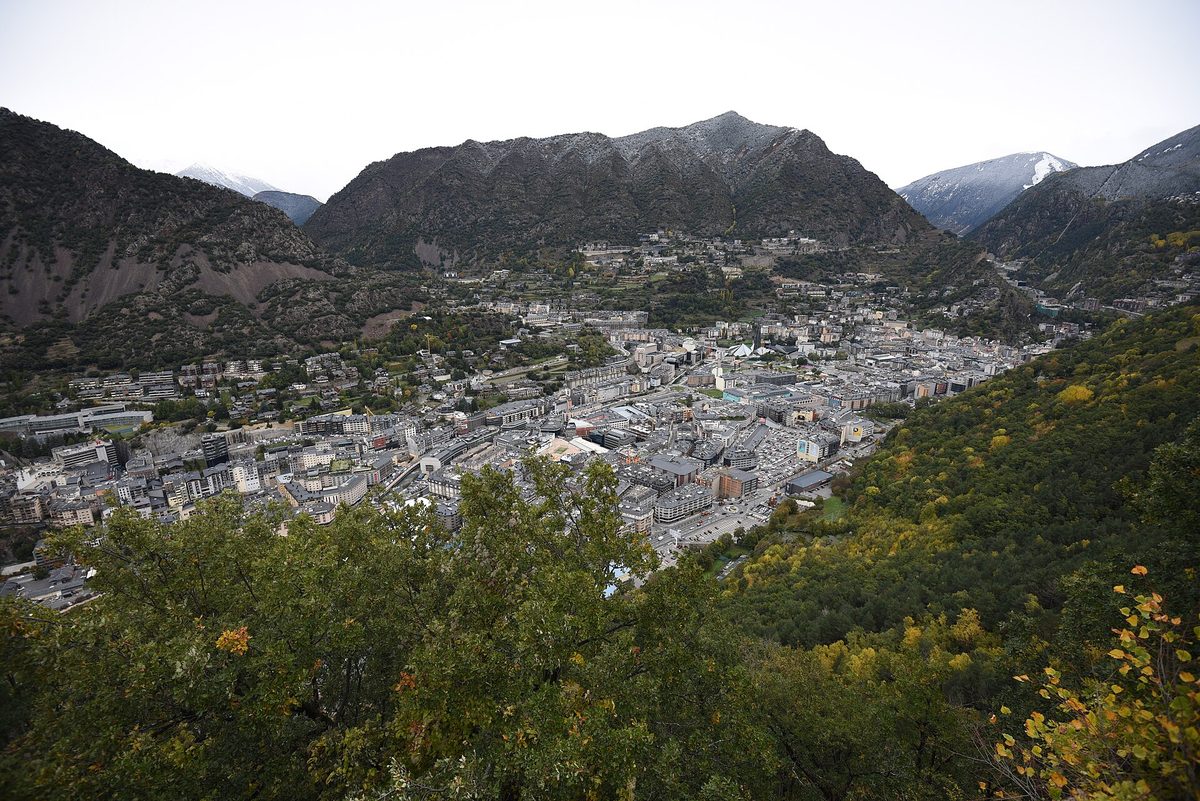
Here’s the honest version up front: Andorra la Vella is Europe’s highest capital — 1,023 m up a Pyrenean valley — and its most misunderstood. It’s a two-hour old town welded to a 1.5 km duty-free shopping mile, with seriously good mountains on every side. Treat it as a destination and it underwhelms; treat it as a base and it quietly over-delivers.
I’ve spent more hours in this little capital than in some cities fifty times its size, and I’ve watched first-time visitors make the same two mistakes in both directions. Half arrive expecting a miniature Prague and leave muttering about perfume shops. The other half write it off as “just shopping,” speed through to the ski lifts, and miss a genuinely lovely stone quarter, the best thermal spa in southern Europe, and an eating scene that’s far better than a tax haven has any right to have.
This guide is my attempt to fix both mistakes at once. It covers what the city actually is (including where it secretly becomes a different town called Escaldes-Engordany), what’s worth your euros in 2026 — with prices I’ve checked against the official sources this month, plus two big closures the older guides haven’t caught up with — where to eat real Andorran food, which walks get you above the rooftops in twenty minutes, and how to use the capital as a base for everything else in the country. Day-trippers, this concerns you too: official surveys say 82.5% of you come to shop, and I’d like to show you what you’re walking past while you do.
Last updated: June 2026. Prices and opening hours below were re-verified against official sites (turismeandorralavella.com, visitandorra.com, caldea.com, museus.ad, bus.ad) in June 2026.
Andorra la Vella at a glance
| Essential | The facts |
|---|---|
| What it is | Capital of Andorra, a 468 km² microstate between Spain and France |
| Altitude | 1,023 m — the highest capital city in Europe |
| Population | About 25,000 in the parish; about 89,000 in the whole country |
| Languages | Catalan (official); Spanish everywhere, French and English in shops and hotels |
| Currency | Euro (Andorra isn’t in the EU, but uses it officially) |
| Time you need | Old town: 2-3 hours. City properly: 1 full day. As a base: 2-4 nights |
| Famous for | Duty-free shopping, Caldea spa, being the gateway to 300+ km of pistes |
| Nearest airports | Barcelona (~200 km, ~3 h by bus), Toulouse (~185 km, ~3.5 h) |
| Getting around | On foot; national buses €1.90 a ride for everything beyond |
| Shops open | 363-364 days a year, Sundays included — closed only Jan 1, Mar 14*, Sep 8 and Dec 25 |
*Constitution Day (March 14) is a trading holiday only when it falls on a weekday; in 2026 it lands on a Saturday, so the tills keep ringing.
Orientation: one valley, two towns, one very long street
The geography explains almost everything about this city, so give me three paragraphs on it.
Andorra la Vella sits at the bottom of a Y-shaped valley system where the country’s two rivers — the Valira del Nord and the Valira d’Orient — meet and become the Gran Valira. Every road in Andorra eventually funnels down here, which is why a town of 25,000 people can feel like Barcelona’s Diagonal on a Saturday in December. The valley floor is narrow enough that the city is essentially one long ribbon: you can walk every part of it that matters without ever being more than 400 m from the river.
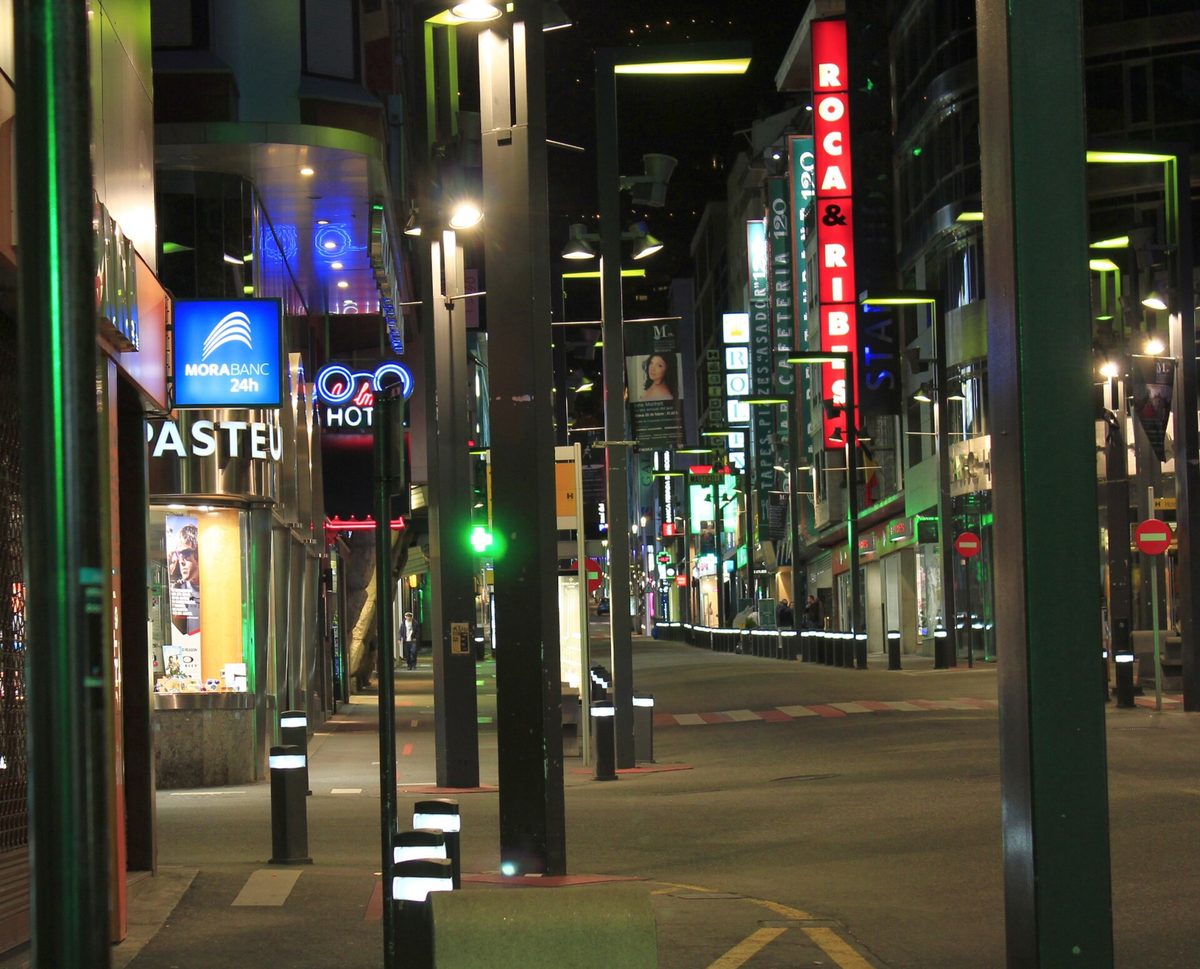
That ribbon has three distinct personalities. At the south-western end, on a slight rise, sits the Barri Antic — the old quarter, a knot of stone lanes around Casa de la Vall where the whole country was governed for three centuries. From there, Avinguda Meritxell runs north-east: first as a normal high street, then as a pedestrianised retail canyon that is the densest concentration of shops in the Pyrenees. Keep walking and — without crossing anything more dramatic than a street sign — you’ll find the avenue has changed its name to Carlemany and you’ve changed municipalities entirely. This is Escaldes-Engordany, a separate parish with its own government, its own pride, and the country’s hot springs. The locals know exactly where the line is. Visitors never do, and honestly it doesn’t matter: functionally it’s one city, and this guide treats it that way.
Walkability is total. The bus station to Caldea — one end of the visitor city to the other — is a 25-minute stroll, dead flat, most of it pedestrianised or riverside. You do not need a car to enjoy the capital; you need one to escape it, and even then the national bus network does the escaping for €1.90-€4.80 a ride.
Is Andorra la Vella worth visiting? Let’s settle it honestly
Yes — with calibrated expectations. I’ll give you both sides, because the internet won’t.
The case against, stated fairly: this is a working commercial capital, not a museum piece. The valley’s tight, so the 20th century built upward in concrete and glass; the through-traffic on a winter Saturday is real; and the historic core you came for can genuinely be seen in a morning. If you’ve allocated three days to the city itself — the city, not the country — you’ve over-allocated. Anyone who tells you otherwise is selling hotel nights.
Now the case for, which I find more interesting. First, the setting is absurd: 2,000 m ridgelines rise straight from the rooftops, and from the middle of the shopping mile you can see snow six months of the year. Second, the old quarter is small but it’s real — a 1580 parliament house, a 12th-century church, lanes that still follow medieval property lines — and at 8 a.m., before the coaches arrive, it’s yours alone. Third, the city earns its keep as infrastructure: the country’s best restaurants, its thermal water, its bus hub and its cheapest decent hotel beds are all here, within a 25-minute walk of each other. And fourth — the part day-trippers miss — the surrounding parish climbs to 2,334 m, with balcony paths above the rooftops that cost nothing and take twenty minutes to reach.
My verdict, the one I give friends: give the capital one full day and sleep here two or three nights while you do the rest of the country. That ratio — city as base camp, mountains as the show — is the trip that works. If you only have one day total in Andorra, spend the morning in the old town and the shops, and the afternoon up a mountain, not in a third perfume shop. The full menu of what to do in Andorra beyond the city limits is a separate, much longer conversation.
The Barri Antic: old Andorra in a handful of stone streets
The old quarter occupies maybe four hectares on a rise above the river, and it rewards slowness far more than coverage. Here’s what deserves your attention, in the order a natural walk strings them together.
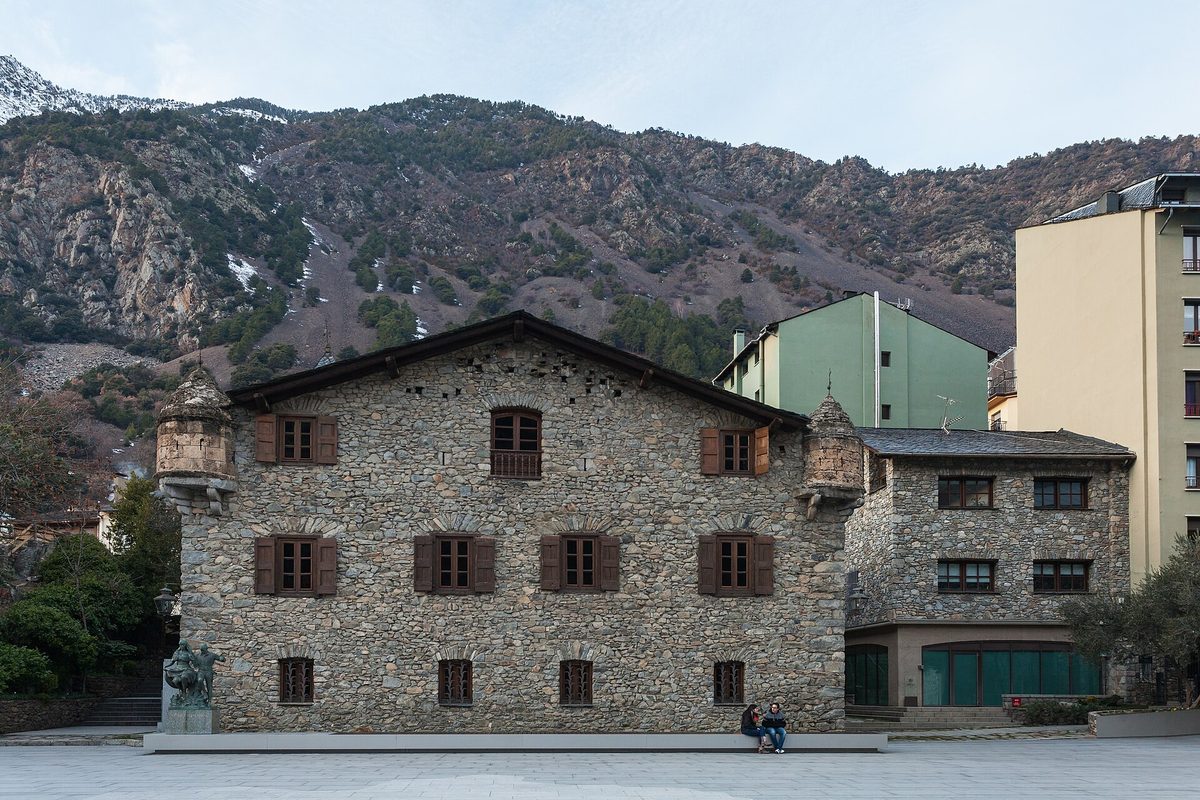
Casa de la Vall
Casa de la Vall is the building Andorra would grab first in a fire. A fortified manor house built in 1580 for the Busquets family, it became the seat of the Consell General — the parliament of one of Europe’s oddest states — in 1702 and stayed in the job until 2011. Inside you get the council chamber with its famous cupboard of seven locks (one key per parish; the national archives could only be opened with all seven parishes present — government by physical multi-factor authentication), the old kitchen, and the tiny courtroom where, until remarkably recently, the whole country’s justice was dispensed.
Visits cost €5 (€2.50 concessions), self-guided with an audio guide, or €1.50 extra for a guided tour — worth it, the guides are excellent and the booking is a phone call or email away (+376 829 129, [email protected]). Open Tuesday to Saturday, 10:00-14:00 and 15:00-18:00; closed Sundays, Mondays and a handful of national days. Budget 45 minutes to an hour. The sober glass box next door is the parliament’s 2011 replacement — the contrast between the two buildings is the whole story of modern Andorra in one glance.
Església de Sant Esteve
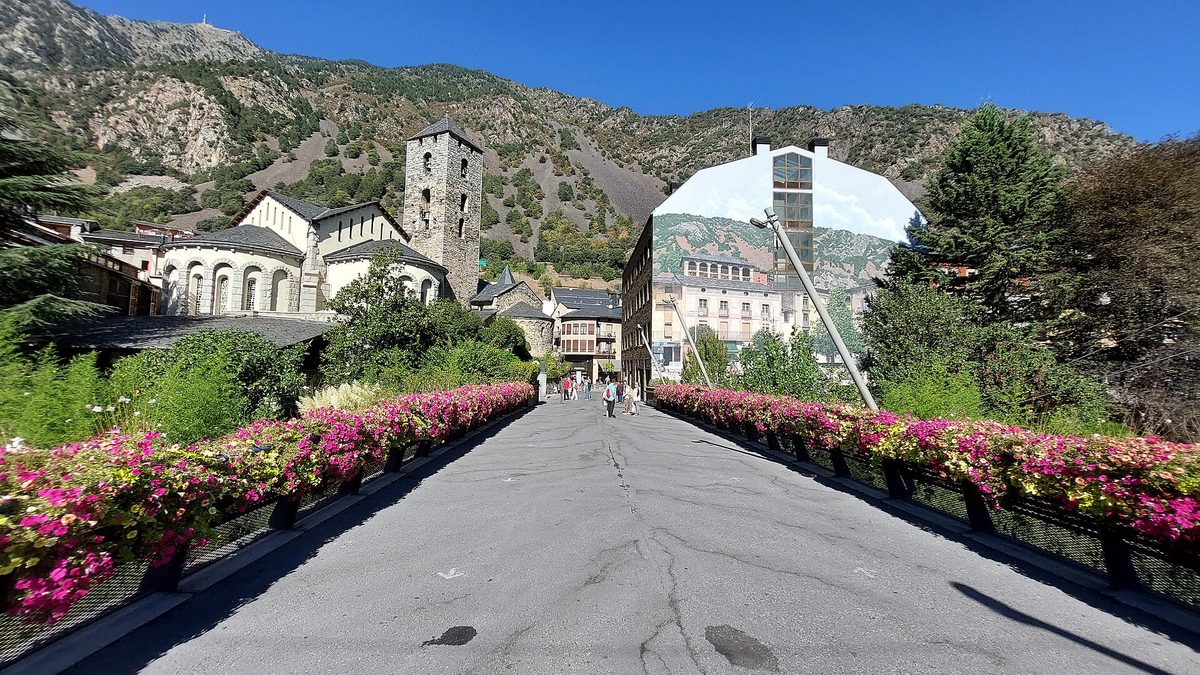
Down the lane, the parish church of Sant Esteve has been here since the 12th century, and its apse — the largest Romanesque apse in Andorra — still shows it. The rest is more complicated: the church was heavily reworked over the centuries, and the 1940 restoration that gave it its current face was directed by Josep Puig i Cadafalch, the great Catalan modernista architect (Casa Amatller in Barcelona is his). So you’re looking at a genuine Romanesque core wearing early-20th-century tailoring. The original murals left long ago — most ended up in the MNAC in Barcelona, a sentence you’ll hear about several Andorran churches. Entry is free; it’s an active parish church, so slip in around services rather than through them.
The squares, the poets and the view from the roof
Three more stops knit the quarter together. Plaça Lídia Armengol holds 7 Poetes, Jaume Plensa’s seven white human figures perched on tall poles — one for each parish of Andorra, glowing after dark, and to my eye the best piece of public art in the country (yes, including the Dalí we’ll get to shortly). Plaça del Poble is the city’s odd, brilliant living room: a 16,500 m² public square built on the roof of the government administrative building, with the Congress Centre underneath and panoramic lifts dropping you back down to Prat de la Creu street. Locals cross it on their commute; in December it hosts the Christmas village; on a clear evening the light on the eastern ridges is worth the detour alone. And on Carrer Prat de la Creu below, Bici Lab Andorra — the national bicycle museum, €5, closed Mondays — is a far better hour than “bicycle museum” suggests, especially if you’ve ever watched the Tour climb these valleys and wondered why a microstate is so cycling-mad.
Beyond the named sights, the Barri Antic’s real pleasure is texture: door lintels carved with dates from the 1600s, the contrast of rough granite and geranium pots, café tables on Plaça Príncep Benlloch where a tallat costs €1.80 and nobody hurries you. Two to three hours covers all of it generously. That brevity isn’t a flaw — it’s the honest size of the thing, and it’s exactly why the city works best stitched into a bigger Andorran day.
Shopping in Andorra la Vella: the 1.5 km mile
Shopping is the single biggest reason people come to this city — the government’s own surveys say 82.5% of day visitors come primarily to shop — so let’s treat it with respect and honesty in equal measure.
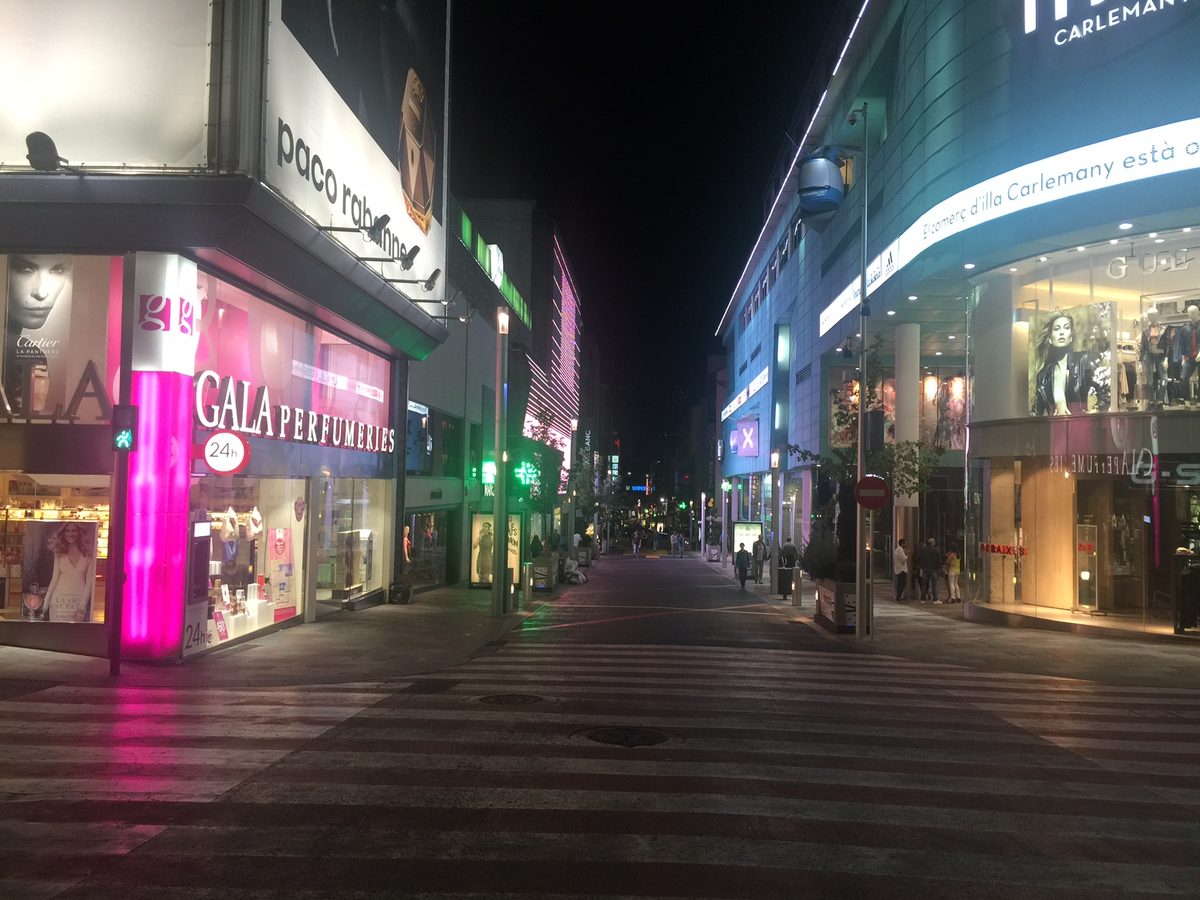
The geography first. What the tourist board calls the Shopping Mile is a continuous 1.5 km retail ribbon: Avinguda Meritxell and the Fener Boulevard in Andorra la Vella, flowing seamlessly into Vivand — the fully pedestrianised Avinguda Carlemany — once you cross into Escaldes. Over a thousand shops line this walk and its tributaries: every Spanish high-street brand (Zara, Mango, Stradivarius), international fashion, the El Corte Inglés-style Pyrénées department store at Meritxell 11, and a frankly comical density of perfumeries, electronics dealers, opticians, and tobacco shops. The mile is open 363-364 days a year: Sundays are normal trading days here, hours run to 20:00 (21:00 Fridays and Saturdays), and the only full closures are January 1, September 8, December 25 and — weekday-only — March 14.
Now the honesty. Andorra’s low taxes (IGI, the local VAT, is 4.5% against Spain’s 21%) make some things meaningfully cheaper and some things barely cheaper at all. The reliable wins are perfume and cosmetics (typically 25-30% below Spanish or French high-street prices), spirits and tobacco (dramatically cheaper — which is why the border checks exist), and sunglasses and skincare. Electronics are a more modest 10-20% game, and on cameras and phones you should know your home price to the euro before assuming the sticker is a deal; I’ve seen Barcelona beat Meritxell on identical models during sale season. Clothing from the chains costs roughly what it costs in Spain. The January and July sales, though, stack discounts on top of the tax gap and get genuinely silly.
Two practical notes the duty-free brochures skip. First, allowances: Andorra isn’t in the EU customs union, so there are limits on what you can carry out without declaring — the headline figures are 300 cigarettes, 1.5 litres of spirits, and €900 of general goods per adult, checked with real enthusiasm at the Spanish border on busy Sundays. Second, timing: the mile on a December or sale-season Saturday is shoulder-to-shoulder; the same shops on a Tuesday morning are a pleasure. If shopping is your main event, sleep in the city, shop at opening time, and you’ll be done before the coaches from Barcelona unload. In November, the Shop in Andorra Festival (the 2025 edition ran 7-23 November) adds street performances and extra discounts along the whole mile.
The river, the Dalí and the prettiest bridge in the country
The Gran Valira is the city’s spine, and the ten-minute stretch where the shopping mile meets the river collects most of the modern landmarks.

On Plaça de la Rotonda, where Meritxell bends to meet the water, stands La Noblesse du Temps — a 4.9 m, 1,400 kg bronze Salvador Dalí: a melting clock draped over a tree, flanked by a veiled woman and an angel. It reached Andorra in 1999 as a gift from Enric Sabater, Dalí’s former secretary and business manager, spent years migrating around the city, and settled here in 2010. It is, I’d argue, the most photographed object in the country after the ski lifts — go at night when the floodlights do it justice, or before 9 a.m. if you want it to yourself.
Thirty metres away, the Pont de París vaults the river in a single white gesture — a cable-stayed footbridge with its deck hung from two steel spheres on raked masts, opened in January 2006. It’s the city’s favourite photo frame (the big ANDORRA LA VELLA letters stand at its foot), and the riverside walk it anchors will carry you, pleasantly and traffic-free, all the way into Escaldes. En route you’ll pass the older, lovelier Pont d’Engordany, a humpbacked stone crossing that’s been carrying Andorrans over the water since long before anyone here sold a duty-free camera.
Caldea, hot water and the Escaldes end of town
Escaldes-Engordany exists because hot water comes out of the ground here — up to 70°C, the hottest springs in the Pyrenees — and the town’s name, its old wash-houses and its one unmissable building all flow from that fact.

Caldea is the building: an 80 m glass spire by the river holding the largest thermal spa complex in southern Europe — indoor-outdoor lagoons at 32-34°C, hydromassage everything, saunas, ice baths, and grapefruit and Indo-Roman pools that sound like marketing and turn out to be excellent. I’ve sent every kind of traveller here, from teenagers to grandmothers, and the failure rate is close to zero. The classic three-hour adult ticket runs €43-46 depending on time slot (early-bird online deals from €30.50); the adults-only Premium wing — quieter pools, included robe and towel, minimum age 16 — runs €71-82 for the long sessions. Children under 5 can’t enter the main spa (there’s a Likids splash zone for ages 3-4), and under-18s need an adult.
The 2026 caveat, and it’s a big one: Caldea’s main Classic (Thermoludic) zone is closed for major renovation works from 7 April until mid-July 2026 — the spa’s own ticket pages currently say July 17 — with the outdoor lagoon following for a shorter closure in late July. The Premium adults-only wing stays open throughout, as does Likids. If a Caldea afternoon is a pillar of your summer 2026 trip and you’re travelling before late July, either book Premium (16+) or check caldea.com for the live reopening date before you commit. Most of the guides currently on page one of Google haven’t noticed this; their readers are finding out at the ticket desk.
One more 2026 closure while we’re correcting the internet: the Museu Carmen Thyssen Andorra, the small but serious art museum that’s anchored Escaldes’ culture since 2017, closed its Hostal Valira premises on 4 January 2026 and spends this year moving into the Node building nearby. Until the new space opens, the capital’s best art fix is the Plensa sculpture group and the CAEE exhibition hall on Vivand. Older articles still selling you a Thyssen visit are running on cached information.
Escaldes itself deserves a wander beyond its spa: Vivand’s café terraces, the old corner around the Sant Pere Màrtir church where the pre-shopping village survives, and — my favourite free thing in the whole city — the Font del Roc del Metge, just below the Carlemany bridge on the Camí del Barri. This is the spring itself: water surfaces here at 68-71°C, among the hottest in Europe, feeds Caldea by underground pipe, and you can warm your hands on stone that’s been heating Escaldes’ wash-houses for centuries.
Eating in the capital: better than a tax haven deserves
Andorran food is mountain Catalan — pork, cabbage, snails, river trout, things that make sense at 1,000 m in January — and the capital is the easiest place in the country to eat it well. A field guide:
The dishes to order. Escudella is the national dish: a broth-stew of veal, pork, chicken, white beans and giant pasta shells, traditionally a winter Sunday affair and properly a whole meal. Trinxat is mashed potato and savoy cabbage fried with pork belly into a crisp-edged cake — Andorra’s answer to bubble and squeak and, done right, the best €12 in the country. Beyond those: grilled snails (cargols a la llauna), duck with winter pears, river trout with mountain ham, and in autumn enough wild mushrooms to justify the trip alone.
Where to eat them. The classic move is a borda — a converted stone barn doing mountain cooking over wood fire. Borda Estevet (Ctra. de la Comella 2, a 10-minute walk from the old town) is the capital’s standard-bearer: carts of vegetables at the door, lamb chops a la brasa, and a dining room that hasn’t changed its mind in forty years. It’s not cheap — count €40-55 a head with wine — but it’s the real article. In the Barri Antic itself, the lanes around Plaça Príncep Benlloch hide a clutch of small dining rooms doing serious Catalan-French cooking; quality is high and turnover low, so book anything with fewer than ten tables.
The budget play. Andorra runs on the menú del dia — three courses with wine at lunch for €15-20 — and the capital’s versions are honest. Look for the chalkboards a street or two off Meritxell (the mile itself charges a shopping-traffic premium), or join the locals at the long-standing cheap stalwarts near the bus station end of town, where €15 still buys soup, trinxat and crema andorrana. Lunch is the value meal here; the same kitchens charge half as much again at dinner.
What to drink. Andorran wine exists, it’s good, and almost nobody knows it: high-altitude whites and reds from terraced vineyards at 1,000-1,200 m. Look for Borda Sabaté’s Torb or Escol on serious wine lists. Local craft beer (Alfa, Boris) has colonised most bar taps. And a cafè amb llet on a terrace still costs under €2.50 — one of the small ways the city reminds you it isn’t Switzerland.
Set your evening expectations correctly, though: this is an early town. Kitchens mostly close by 22:30-23:00, the bar scene is compact (the lanes off the old town and a few rooms along the river do the heavy lifting), and proper nightlife only really exists in winter when the ski crowd descends. Caldea’s late Friday and Saturday sessions — the spa runs to midnight those nights — are, no joke, the capital’s best after-dark entertainment.
Green escapes: above the rooftops in twenty minutes
The city’s least-sold virtue: you can walk out of a perfume shop and be on a silent mountain balcony path before your parking ticket needs renewing. The parish climbs from 1,023 m at the river to 2,334 m at Pic de Carroi, and the network in between is free, signed, and weirdly empty even in August.

Rec del Solà is the one everyone should do. It’s a flat path along an 1880s irrigation canal that contours the sunny side of the valley about 100 m above the rooftops — roughly 4-5 km out and back, effectively zero gain, benches and oak shade the whole way, with the entire city laid out below you like a model railway. Pick it up from Carrer de les Canals at the old-town end (the connector path from Plaça Príncep Benlloch is signed) and walk as much as you like; it peters out near Santa Coloma. Sunset is the hour. Its shadier mirror on the opposite slope, the Rec de l’Obac, gives you the reverse angle and morning sun.
One step up in effort: the Comella road miradors. The switchback road behind the city (Ctra. de la Comella) passes a signed viewpoint at its bend — drivable, but the walk up through the woods from the Serradells side earns it better — and the Roc de Senders viewpoint off the Rec de l’Obac path frames the whole Y of the valleys. For a proper summit, Pic de Carroi (2,334 m), the rock pyramid that looms over the city’s western sky, is a strenuous, partly unmarked 1,300 m ascent best left to experienced walkers — but you don’t need the top; even the first hour of any uphill path here transforms your sense of where you actually are: a small stone city in a very large mountain range.
In town itself, Parc Central fills the river bend with lawns, playgrounds and cherry blossom in April — the obvious decompression stop if you’re travelling with children who’ve hit their retail limit. For the bigger green agenda — the lakes, the UNESCO Madriu valley, the 2,900 m summits — see my full guide to things to do in Andorra; nearly all of it stages comfortably from a bed in the capital.
Using the city as a base: skiing and day trips without a car
Here’s the structural argument for sleeping in the capital: it’s the country’s transport hub, its beds cost less than the ski villages’, and nothing in Andorra is more than about 40 minutes away.
Skiing from Andorra la Vella works better than most people expect. The move: city bus L2 to Encamp (every 12-15 minutes on weekdays, €1.90), then the Funicamp — a 6 km gondola, the longest of its kind in Europe — straight up to Grandvalira’s Solanelles sector at 2,300 m. Door to piste in well under an hour without touching a car; the Funicamp ride is included in winter lift passes. The L3 and L4 buses run the valley road to Soldeu and Pas de la Casa for the other Grandvalira doors, L5 heads for Pal Arinsal, and in season extra ski services thicken the timetable. Is it as convenient as sleeping slope-side in Soldeu? No. Is the trade — city restaurants, Caldea après, cheaper beds, shops for the blizzard day — worth 40 minutes of bus? For plenty of trips, yes. The full calculus lives in my skiing in Andorra guide.
Summer and shoulder-season day trips stage just as easily. The same €1.90-€4.80 bus network reaches Ordino (prettiest village in the country, gateway to the Sorteny botanical valley), Encamp for the Romanesque circuit, La Massana for the bike park, and Sant Julià for Naturland’s 5.3 km Tobotronc — all covered in my country-wide guide. Two specific recommendations from me: the pre-Romanesque Santa Coloma church with its odd round tower — a 30-minute walk from the city along the river path, or one bus stop — and Engolasters lake above Escaldes, a forested reservoir loop that’s the locals’ standard Sunday leg-stretch. Cross-border, La Seu d’Urgell (Spain) is 25 minutes south for a proper Catalan old town and a Romanesque cathedral that outguns anything in Andorra.
Where to sleep: pick your end of town
The capital’s hotel stock is large, mostly mid-range, and meaningfully cheaper than the ski resorts in winter. The decision is really about which end of the ribbon you want:
Old town and centre (Andorra la Vella proper): best for first visits — you’re between the Barri Antic and the shops, the bus station is walkable for day trips, and the restaurant lanes are on your doorstep. Decent three-star doubles run €70-110 most of the year; the grand old Andorra Park and a few four-stars push €150-250 with pools and parking. Escaldes end: book here if Caldea is the point — several hotels stand within five minutes of the spa, Vivand’s terraces are calmer than Meritxell, and the thermal heritage means a cluster of hotels with their own hot-water spas (the historic thermal hotels around the Roc del Metge source have been in the soaking business for over a century). Near the bus station: the practical pick for car-free ski trips — L2/L3/L4 on your doorstep — at the cost of nightly charm. Budget travellers should know the capital keeps a stock of plain, clean one- and two-star rooms from about €45-60 a double that the resort villages simply don’t bother offering.
The one mistake to avoid: booking far up the through-road “because it was €15 cheaper” and discovering your evening walk to dinner runs along a traffic artery. Stay within the river-to-Meritxell ribbon and the whole city stays on foot.
The city by season: what 2026 looks like
The capital is a year-round machine — shops and spa never stop — but its personality swings hard with the calendar. The short version by season; the full national picture is in my best time to visit Andorra guide.
the city at its busiest and most atmospheric — ski-season crowds, Christmas lights down the whole mile, and the Poblet de Nadal Christmas village filling Plaça del Poble with stalls, skating and mulled wine from late November to January 5. Shopping Saturdays are intense; book restaurants. Spring (April-May): the honest low season. Mountains between seasons, some attractions resting — in 2026, remember, Caldea’s main zone is closed for works until mid-July — but hotel prices at their floor and the old town at its quietest. Fine for a cheap shopping-and-eating break; don’t build the trip of a lifetime around it. Summer (June-September): my favourite city season. Valley days at 21-26°C, every trail open, café terraces full until late, and the events stack up: the Festa Major d’Andorra la Vella runs 30 July-3 August in 2026 with free concerts on Plaça Guillemó, and Cirque du Soleil’s summer residency (July into early August) plants its show ten minutes from the Dalí. Autumn (October-November): golden larch light on the ridges, the Shop in Andorra Festival in November, and the city quietly inhaling before ski season. November itself is the dead month — and the cheapest beds of the year.
Getting there and getting around
No airport, no railway — every visitor arrives by road, and the capital is where all the roads end up. The complete door-by-door comparison (both gateway cities, the Paris sleeper, the tiny La Seu airport, driving) is in my how to get to Andorra guide; here’s what matters for the city itself.
direct coaches run from Barcelona (Sants and both airport terminals; ~3 hours, about €35 one-way with Direct Bus, 16 departures a day) and from Toulouse (station and airport; ~3.5 hours, €36 with Andbus). Every one of them terminates at the Estació Nacional d’Autobusos on Avinguda Tarragona — which sits, conveniently, a flat ten-minute walk from both the old town and the foot of Meritxell. By car: from Spain on the N-145 via La Seu d’Urgell, from France over the 2,408 m Envalira pass or through its toll tunnel. Two warnings: winter-equipment rules (tyres or chains) apply November to mid-May on the approach roads, and Sunday-evening border queues leaving for Spain are a genuine phenomenon — leave before 15:00 or after 20:00.
the city runs 13 public car parks with 3,000+ spaces — Centre Ciutat on Prat de la Creu (24 h, under the Plaça del Poble) is the flagship and the easiest first-timer target. Rates run about €2.90/hour, with a €12.30 overnight flat rate and roughly €28 for 24 hours; surface lots give the first 30 minutes free. On December and sale-season Saturdays the central decks fill by 11 a.m. — arrive early or park a ring out. Getting around: your feet, overwhelmingly. For everything else, the national bus lines radiate from the capital on a zone fare of €1.90-€4.80 (a shareable T-10 carnet cuts Zone 1 rides to €1.24); taxis exist but are pricey, and — despite what at least one page-one article claims — there is no Uber, Bolt or any ride-hailing in Andorra. The bus app and timetables live at bus.ad.
What things cost in Andorra la Vella (2026)
Every price on this table was checked against the official source in June 2026. Where 2026 figures weren’t yet published, I’ve used the latest confirmed price and said so.
| Item | Price | Notes |
|---|---|---|
| Caldea Classic, 3 h adult | €43-46 | Early-bird online from €30.50; main zone closed for works until ~17 Jul 2026 |
| Caldea Premium (16+), 3-4 h | €71-82 | Open right through the 2026 works |
| Casa de la Vall | €5 | €2.50 concessions; guided tour +€1.50; closed Sun-Mon |
| Bici Lab Andorra | €5 | Closed Mondays; free under-10s |
| Sant Esteve church, Plensa’s 7 Poetes, both Recs, Roc del Metge fountain | Free | The whole open-air city, in fact |
| National bus, any Zone 1 ride | €1.90 | T-10 carnet €12.40, shareable; Zone 3 (Pas de la Casa) €4.80 |
| Bus from Barcelona | ~€35 one-way | Direct Bus, ~3 h, 16/day; Andbus from BCN airport €33 |
| Bus from Toulouse | €36 one-way | Andbus, ~3.5 h, 4/day; €64 return |
| Central parking | ~€2.90/h | Night flat €12.30, 24 h ~€28; first 30 min free in surface lots |
| Menú del dia lunch | €15-20 | Three courses with wine; the capital’s best-value meal |
| Borda dinner | €40-55/head | The full wood-fire experience with wine |
| Three-star double | €70-110 | Winter ski weekends and August push higher; November is the floor |
Andorra la Vella FAQ
Is Andorra la Vella worth visiting?
Yes, for a day — and as a base, for several. The old quarter, the Dalí, a Caldea session and the shopping mile fill a satisfying day; the city’s real value is as a cheap, central, well-fed base for the mountains around it. It’s not a three-day sightseeing city, and pretending otherwise sets you up for disappointment.
How many days do you need in Andorra la Vella?
One full day covers the city itself without rushing: old town in the morning, shops or Caldea in the afternoon, borda dinner. Sleep here two to four nights if you’re using it as a base for skiing, hiking or the rest of the country — which is exactly how I’d use it.
Can you do Andorra la Vella as a day trip from Barcelona?
You can — buses leave Sants and the airport from early morning, take about 3 hours, and cost around €35 each way (all the routes compared here) — but you’ll spend six-plus hours of your day on a coach for roughly five hours in town. It works as a shopping run; as sightseeing it’s rushed. An overnight transforms the trip.
Is Andorra la Vella walkable?
Completely. The visitor city — old town, shopping mile, river walk, Caldea — is one flat 25-minute ribbon, much of it pedestrianised. You only need wheels (the €1.90 national buses do fine) to reach the villages, trailheads and ski lifts beyond.
Is Andorra la Vella expensive?
By Western European capital standards, no. Lunch menus run €15-20, decent doubles €70-110, coffee under €2.50, and the 4.5% IGI keeps shop prices down. Caldea’s €43+ tickets and borda dinners are the splurges. It’s pricier than small-town Spain, far cheaper than Alpine resort towns.
Is shopping really cheaper in Andorra?
Selectively. Perfume and cosmetics run 25-30% below Spanish high-street prices, spirits and tobacco much more, electronics a thinner 10-20% — check your home price first. Chain clothing costs about the same as in Spain. Remember the customs limits on the way out: 300 cigarettes, 1.5 L of spirits, €900 of goods per adult.
What is Andorra la Vella famous for?
Being Europe’s highest capital (1,023 m), duty-free shopping along the 1.5 km Meritxell-Vivand mile, the Caldea thermal spa’s glass spire, Casa de la Vall — the 1580 manor that was parliament for three centuries — and serving as base camp for the Pyrenees’ biggest ski area.
Can you ski from Andorra la Vella?
Yes, without a car: bus L2 to Encamp (€1.90, every 12-15 minutes) connects with the 6 km Funicamp gondola into Grandvalira’s 2,300 m sector — door to piste in under an hour. Soldeu, Pas de la Casa and Pal Arinsal are 25-40 minutes away by bus or ski shuttle.
What language do they speak, and what money is used?
Catalan is the official language, but Spanish works everywhere and French and English are routine in shops, hotels and restaurants. The currency is the euro, even though Andorra isn’t in the EU. Cards are accepted near-universally; the country’s outside the EU roaming zone, so check your phone plan.
Is Andorra la Vella safe?
Exceptionally. Andorra posts one of Europe’s lowest crime rates, and the capital’s streets feel relaxed at any hour they’re actually awake (which, fair warning, ends around 23:00 outside ski season). Normal big-city pickpocket caution on packed shopping Saturdays is all the vigilance required.
What’s the best time of year to visit?
For the city itself: June to September for terrace weather and festivals, or December for lights, skating and the Christmas village — accepting the crowds. In 2026 specifically, note Caldea’s main zone is shut until mid-July. September is the connoisseur’s pick: summer weather, no queues, pre-season prices — the month-by-month breakdown is here.
The capital is also the country’s retail heart, and the full breakdown of what’s genuinely cheaper — and what isn’t — is in my guide to shopping in Andorra.
Andorra la Vella: the in-depth guides
The capital, neighbourhood by neighbourhood and question by question:
- Escaldes-Engordany — The Thermal Town Glued to the Capital
- Casa de la Vall and the Barri Antic — Old Andorra in an Hour
- Where to Eat in Andorra la Vella — Restaurants Worth Your Euros
- Shopping in Andorra la Vella — Avinguda Meritxell and Beyond
- Where to Stay in Andorra la Vella — Best Hotels and Areas
- Nightlife in Andorra la Vella — Bars, Pubs and Late Rounds
- One Day in Andorra la Vella — A Walkable Itinerary
- Is Andorra la Vella Worth Visiting? What It Is – and Isn’t
Related Andorra travel guides
Keep planning your trip with my other in-depth Andorra guides — including a day-by-day itinerary, hiking in Andorra, practical travel tips, the full range of activities, and visiting with kids.
Photo credits
All images via Wikimedia Commons: Andorra la Vella panorama by Fernando Prada Sanromán (public domain); Casa de la Vall by Diego Delso (CC BY-SA 3.0); Avinguda Meritxell at night by Rauletemunoz (CC BY-SA 4.0); La Noblesse du Temps by Tomaszhanarz (CC0); Caldea by FrankAndProust (CC0); Rec del Solà path by Tiia Monto (CC BY-SA 3.0).
1 comment
Comments are closed.