The first time I looked for the Roc del Metge I walked past it twice. It is a low granite spout on a busy Escaldes avenue, and in warm weather it passes for an ordinary municipal fountain. I went back in February at eight in the morning and it was rolling a metre of steam into the cold.
That is the honest shape of Andorra hot springs: real, extraordinarily hot, and almost entirely piped. This guide is for anyone who has gone looking for a wild pool in the Pyrenees and wants to know where the water comes from, what is in it, where you can genuinely soak, and which free soaks lie over the borders.
I put a finger into the run-off spilling onto the pavement that morning and pulled it straight back out. Seventy degrees is not a figure of speech.
Last updated: September 2026. Opening hours and prices move — check official sites before you go.
Everything here sits inside one parish, and it all funnels into one building. If you only read one companion piece, make it the complete guide to Caldea, Andorra’s thermal spa, because that is where 35 cubic metres an hour of this water ends up.
Where the water actually comes from
Andorra sits on the eastern flank of the Pyrenees, a range built by the Iberian plate grinding into Europe. That collision left a lattice of deep faults in the granite, and one of them runs directly under Escaldes-Engordany. Rainwater and snowmelt sink into that fracture system, travel down far enough to be heated by the earth’s own gradient, and are pushed back up the same fault. By the time it reaches the pavement it has been underground long enough to dissolve a great deal of the rock it passed through.
This is geothermal heating, not volcanic. There is no magma chamber under the Valira valley. The water is hot for the boring, reliable reason that anything buried a couple of kilometres down is hot, and the fault gives it a fast lane back to the surface before it can cool.
The practical consequence is that the springs are astonishingly consistent. The Roc del Metge is quoted at 68–71 °C, dropping to perhaps 55–60 °C in the depths of winter when the recharge is colder. That range barely moves. It does not surge in spring melt or fail in a dry August. A thermal resource you can plan a 45,000 m² building around is a rare thing, and Escaldes has had one for as long as anyone has lived there.
What is actually in the water
Caldea publishes its analysis, which saves everyone a lot of guessing. Per litre, the headline numbers are roughly:
- Sodium around 36 mg/l — this is a sodic water, and you can feel it on the skin
- Silica around 36 mg/l — the silicates are what give it that faintly slippery, soft-textured quality
- Sulphates around 21 mg/l, plus free sulphur compounds, which is where the faint eggy note comes from
- Chlorides around 6 mg/l, calcium around 4 mg/l, fluoride around 3.8 mg/l, potassium around 2 mg/l
- Iron and ammonium around 0.1 mg/l; magnesium and aluminium at trace level
Read that list and you will notice how weak it is by spa-marketing standards. This is not a heavily mineralised brine. It is a hot, soft, sulphur-and-sodium water, and the traditional claims made for it — analgesic, decongestant, good for skin and joints — are the standard claims made for sulphurous waters across the Pyrenees. I would treat them as plausible rather than proven. What is not in doubt is that lying in 36 °C water for an hour after a day on skis makes you feel considerably better, and I have never needed a chemistry paper to justify that.
One more thing worth knowing: the sulphur smell is mild here. If you have been to Rotorua or Iceland and are bracing yourself, don’t. In the Caldea lagoons you barely notice it. Standing over the raw spring on a cold morning, you catch it properly for about two seconds.
Escaldes: the parish named after its own hot water
The name gives the whole game away. Escaldes comes from the Catalan for scalding — the same root as caldes, hot waters. The parish is called, more or less, “the hot baths and Engordany”, and it is the only settlement in Andorra built deliberately on the shaded, north-facing side of the valley. Every other village in the country chased the sun. Escaldes chased the water.
That single decision explains an enormous amount about the place, including why the thermal town glued to the capital feels denser, older and more urban than anywhere else in the country.
Wool, dye and the only heated wash-houses in Andorra
Before it was a spa town it was a laundry and a dyehouse. Escaldes had the only public wash-houses in Andorra with hot water on tap, which in a mountain principality where winter runs from November to April is not a small advantage. Women washed here from villages that had no business being in Escaldes at all.
The bigger industry was wool. Hot water is what you need to scour raw fleece and to fix dye, and by the seventeenth and eighteenth centuries the Barri quarter of Escaldes had a genuine cloth-making trade — weavers, dyers, fullers, guilds. For a country whose economy was otherwise sheep, tobacco and smuggling, this was the closest thing Andorra had to an industrial class. Catalan mechanised mills killed it during the nineteenth century, but the money and the craftsmen stayed, and the parish went into the twentieth century already used to the idea that the water was worth something.
You can see the same logic in Andorra’s wider history: a country that survived by quietly monetising whatever geography handed it, whether that was a customs anomaly, a mountain pass or a fault line full of hot water.
The first bathers, and the government that said no
Here is my favourite detail. In the 1800s there were proposals to build proper baths at Escaldes and exploit the springs commercially, and the local authorities resisted — by one account out of a fear that bathers would import disease into the valleys. Andorra spent a century saying no to the thing it is now best known for.
It relented in the early twentieth century, when a certain kind of romantic, well-off traveller started arriving in the Pyrenees looking for mountain scenery and mineral cures. The Hotel Pla on Plaça Santa Anna was the first to offer guests the thermal water properly, delivered to zinc bathtubs in the rooms. It built a following among Catalan and English bathers, was substantially enlarged in the early 1930s by Xavier Pla — the first qualified Andorran architect — and survived until 2010, when it was demolished as unsafe. Among its stranger guests was Boris Skossyreff, the adventurer who declared himself Boris I, King of Andorra, for about a week in 1934.
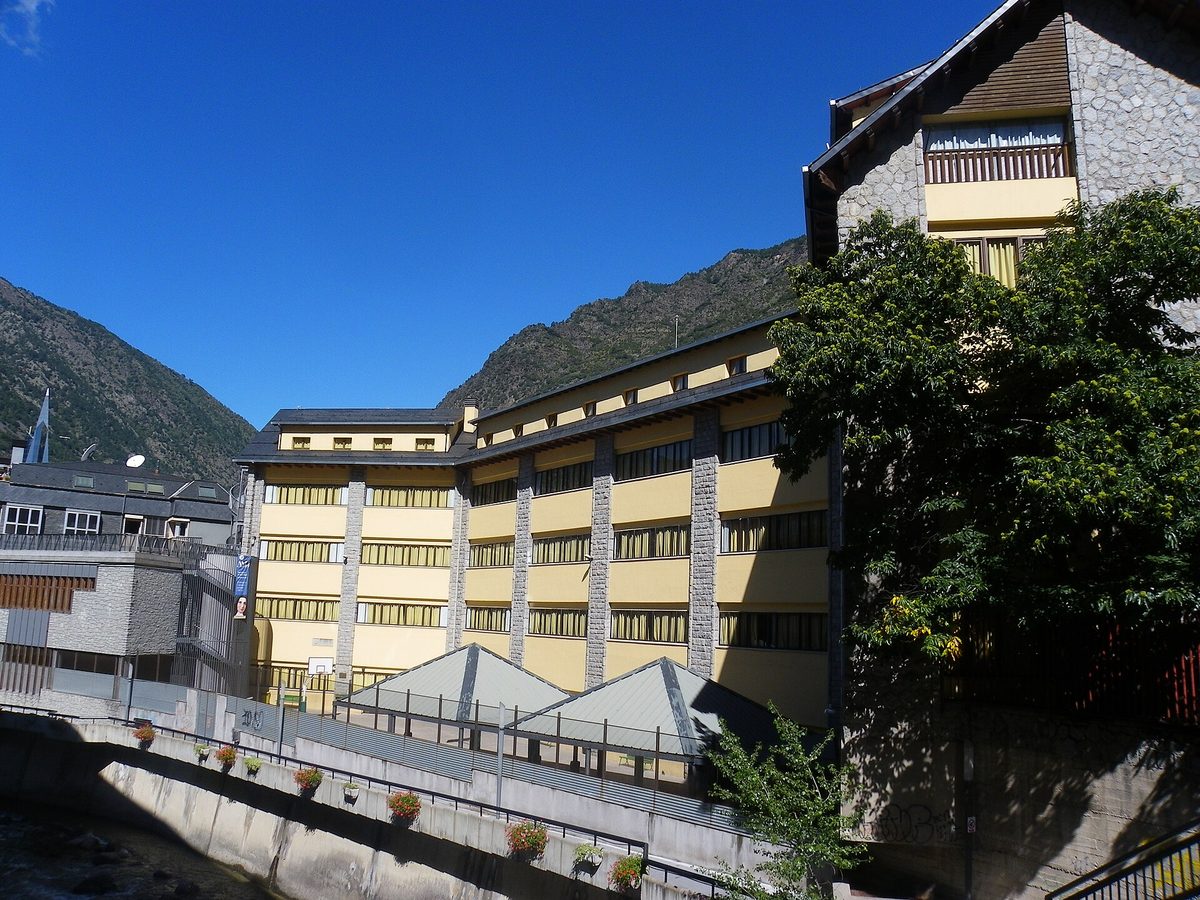
Then came the granite. Between roughly 1930 and 1960 Escaldes filled up with buildings faced in hewn granite blocks laid in honeycomb patterns, a local style born directly out of thermal tourism money. The Hostal Valira, opened in October 1933, is the emblematic one: five storeys, honeycomb granite, red-painted woodwork, built by the monks of Montserrat in partnership with the local Quart, who traded schooling for the parish’s children against a concession on the thermal water. Its architect, Celestí Gusí, was a Benedictine monk who had worked in Gaudí’s orbit.
Andorra hot springs you can see for free: the Water Route
The parish museum service maps all of this into an official self-guided walk, the Itinerari de l’Aigua — the Water Route. Seventeen stops, free, no booking, no guide, and it takes about ninety minutes at a slow pace. It is the single best thing to do in Escaldes that costs nothing, and it belongs on any list of genuinely free things to do in Andorra.
Do it in the morning in winter and the steam does half the work for you.
Font del Roc del Metge
Start here, on Avinguda Miquel Mateu near the Pont de la Tosca. This is the spring — 68–71 °C, sulphurous, sodic, and the central thermal reservoir for the whole parish. Caldea is its largest customer at around 35 m³ an hour; the rest goes to hotels, the outdoor pool and residential buildings.
The name means “the doctor’s rock”. A French physician bought the plot from the Quart of Escaldes intending to build himself a chalet, discovered the rock was essentially undemolishable, and gave up. The Quart bought it back in 1953 and the name stuck.
Two warnings, because the site is at street level with no serious barrier. Do not put your hand in the flow — 70 °C is scalding, not “hot tap”. And watch children closely, because nothing about the appearance of the water signals danger. Touch the far edge of the run-off if you must, briefly, the way you would test a kettle.
Pont de la Tosca and Pont d’Engordany
Two stone bridges, two rivers, two very different dates. The Pont de la Tosca of 1820 crosses the Madriu just before it meets the Valira d’Orient, and it is named for the porous tufa stone in its arch. It appears on the parish coat of arms, which tells you what the locals think of it. Upstream is the mouth of the Madriu-Perafita-Claror UNESCO valley — the wildest place in the country begins, absurdly, about four hundred metres from a shopping street.
The Pont d’Engordany of 1785 spans the Valira d’Orient in granite and tufa, in a Romanesque tradition already six centuries out of date when it was built. Look beside it for the stub of an earlier bridge that a flood took out.
Plaça Santa Anna, Cal Molines and the granite houses
Plaça Santa Anna was the centre of village life: the first hotels, the first bars, the first cinema screenings. The granite fountain here dates from 1951 and has two taps — one cold, one hot. It was originally fixed to the wall of the Hotel Pla. A public fountain that runs hot is not a normal thing, and it is the clearest single illustration of what living on top of this water meant.
Across the river is Cal Molines, an old mill that used the river as a motor for grinding wheat and later for a sawmill. Along Avinguda Carlemany, between the phone shops, look up: Casa Agustí Vidal (1921) and Casa Felícia (1932) carry sgraffito and glazed art-deco ceramic, and Casa Fusilé on Avinguda Pont de la Tosca has one of the very few surviving sgraffito façades in the country, dated 1935. Casa Lacruz on Plaça Coprínceps was designed by Josep Puig i Cadafalch, of Catalan modernisme fame, and hides a small relief of Saint George and the dragon on a corner.
Almost nobody looks at any of this. They are all in the shopping centres two minutes away.
The Art Centre, the park and the glass tower
The Escaldes-Engordany Art Centre occupies a 1930s granite building that has been, in order, a garage, a school, one of the country’s first cinemas, and a bank. The Montserrat monks got the concession for the Hostal Valira’s thermal water in exchange for teaching the parish’s children in it — which is as neat a summary of how this place worked as you will find.
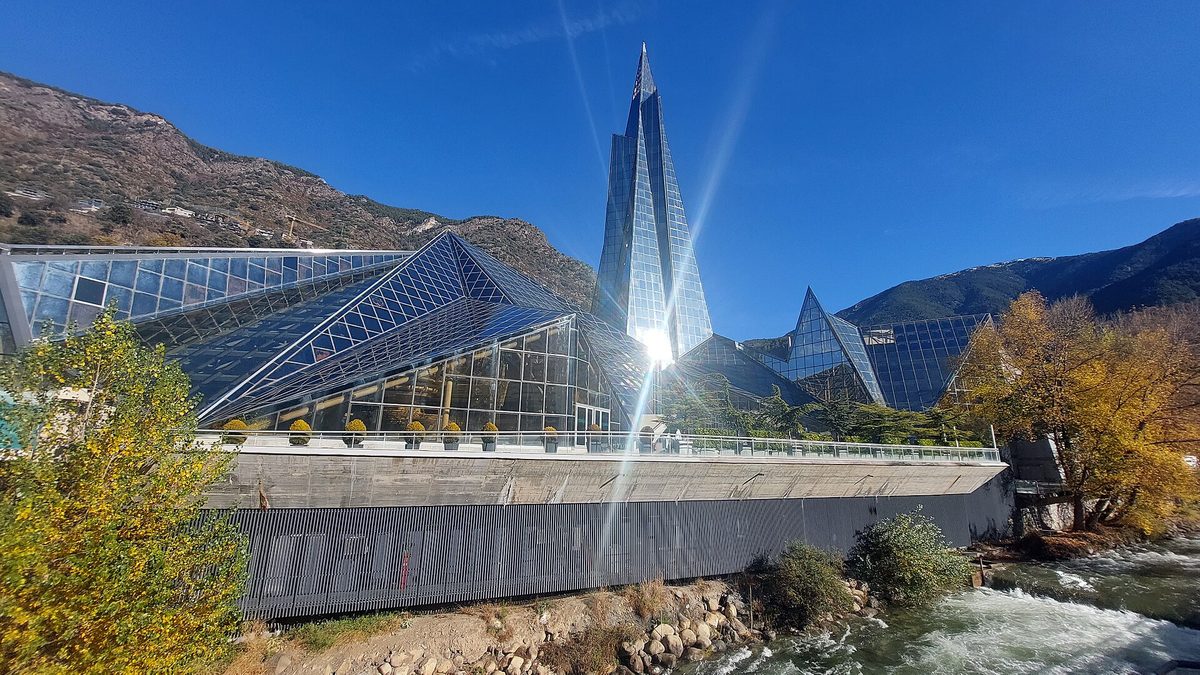
Finish in the Parc de la Mola, one of Andorra’s oldest parks, with big trees, water channels and a scatter of sculpture, and then look up at the 80-metre glass tower of Caldea. Andorra’s tallest structure is, in the end, a monument to a hole in the ground that leaks hot water.
Where you can actually get in the water
Four realistic options, in descending order of scale.
Caldea
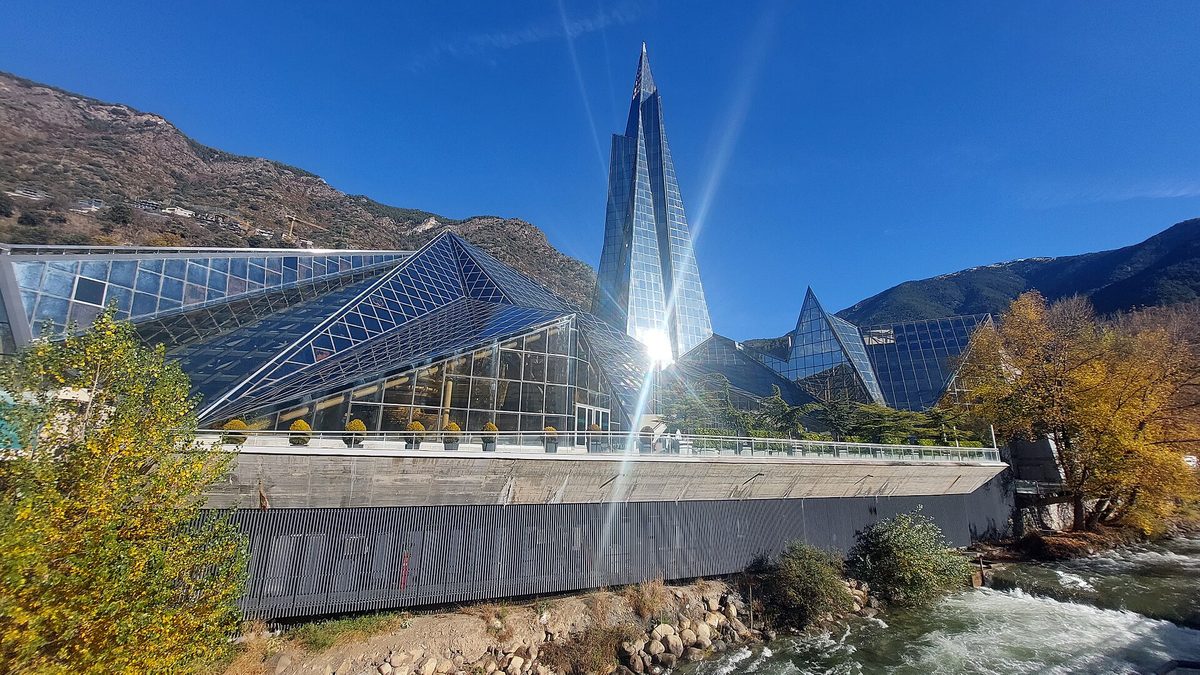
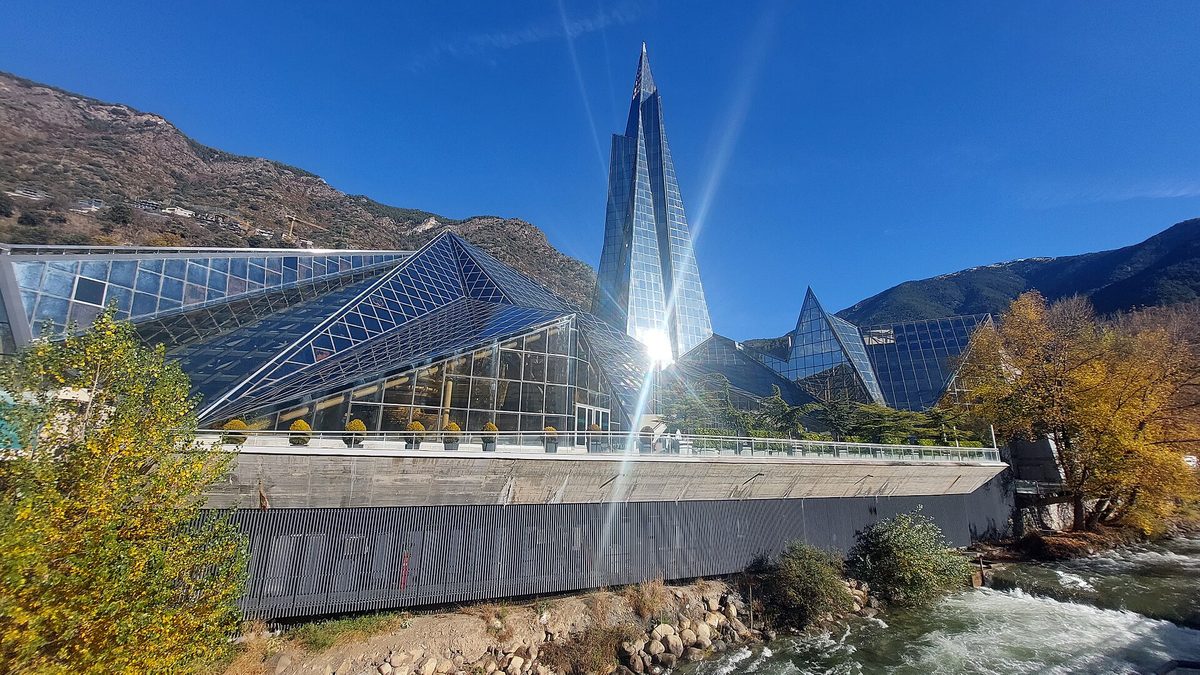
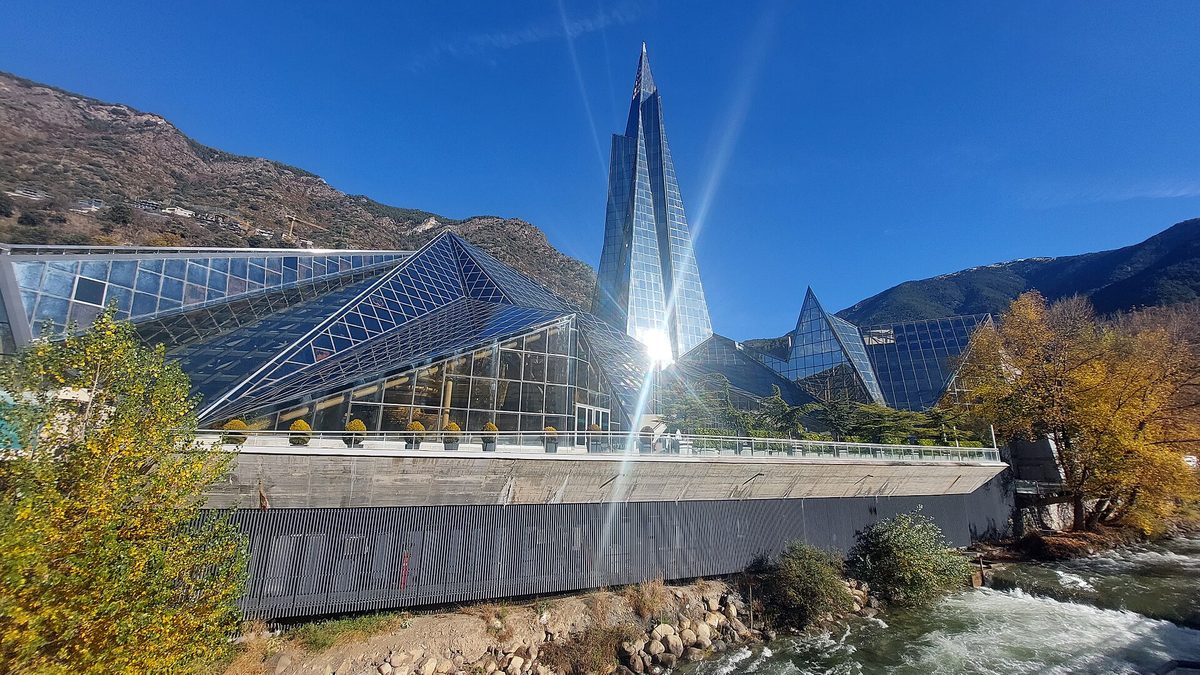
Opened in March 1994 after the parish council decided in 1987 to build something around the springs, Caldea is the largest thermal spa complex in southern Europe. The French architect Jean-Michel Ruols — nicknamed the water architect — resolved it as a stack of triangles under nearly 10,000 m² of glass, and it has been Andorra’s most-visited attraction ever since.
What matters for this article is what the water does before it reaches you. It arrives at around 70 °C, is filtered, and is cooled to roughly 34–37 °C for the lagoons. It is not diluted with municipal water to make up volume; the site holds a thermal-water certification that is audited, and Caldea gets through something like 700 m³ a day. So yes — you are bathing in the actual Escaldes thermal water, at a temperature that will not injure you.
The main indoor-outdoor lagoon is the centrepiece, along with a panoramic pool added in 2020 that projects out over the Valira on a transparent floor five metres above the river. For the full breakdown of zones, queues and how long to stay, read my honest verdict on whether Caldea is worth it, and check the current ticket options and ways to pay less before you book anything.
Inúu
Built in 2013 as an adults-only annexe, Inúu is the quiet half of the complex: 16 and over, fewer people, softer lighting, its own lagoon inspired by the terraces of Pamukkale. Same water, entirely different atmosphere. It costs considerably more and it is worth it if noise is what you are escaping. I have written a longer honest review of Inúu elsewhere.
If you are arriving with a three-year-old rather than escaping one, the family zones are a separate conversation — see Caldea with kids for the age rules, which are stricter than people expect.
Piscina Termal Muntanya — the outdoor one
This is the option almost no visitor knows about, and the closest thing in the country to bathing outdoors in thermal water under the sky. It is the only outdoor pool in Andorra fed from the natural springs, about 300 metres from the Roc del Metge, and it takes the same source water and regulates it down to around 27–28 °C.
Be clear about that number. Twenty-seven degrees is a warm swimming pool, not a hot spring. Anyone arriving expecting a steaming Icelandic lagoon will be disappointed within thirty seconds. Set your expectations at “pleasant outdoor swim in mineral water on a hot day” and it is lovely: adult and children’s pools, real grass, sun loungers, a restaurant, and mountains on every side.
It runs summer only, roughly from the third week of June to the end of August, typically about 10:00 to 20:00, and it closes when it rains because there is nowhere to shelter. Guests of the adjacent Hotel Termes Carlemany usually get a discount, but you do not need to be staying anywhere to use it. On a 30 °C August afternoon in the capital it is a much better idea than Caldea, and it costs a fraction as much. It is the best-value hour of water in the country.
Hotel thermal circuits
Several hotels in Escaldes draw the same water. The Roc Blanc on Plaça Coprínceps was the first in the area to pipe thermal water for guests and still runs an indoor thermal pool alongside a hammam and sauna; the Termes Carlemany is fed from the same system. Others in the parish and up the valley have spa circuits that use ordinary heated water, which is a perfectly good thing to soak in but is not the same product — if the thermal source matters to you, ask before you book, because hotel websites are vague about it on purpose.
I have compared the realistic candidates in the best spa hotels in Andorra, where the thermal-source question is the first thing I check.
Are there wild hot springs in Andorra? The honest answer
No. Not in any sense a hot-spring hunter would accept, and any page implying otherwise is selling you something.
The Andorra hot springs are all captured. That is the beginning and the end of it.
This is the answer people do not want, so let me set out why it is true. The springs of Escaldes emerge in the middle of a built-up parish, at a temperature that would cause serious burns, and the flow was captured and plumbed decades ago. There is no rock pool. There is no clearing in the pines with a stone basin in it. The water goes into a distribution network and comes out inside a spa. You can stand at the source, watch it steam and photograph it, and that is the whole of the free experience.
Nor is there a second, undeveloped valley somewhere with a soakable pool in it. I have hiked a great deal of this country in every month from May to November and I have never found one, and neither has anyone I have asked in Escaldes. The occasional forum post claiming a secret pool above Encamp or in the Madriu is, as far as I can establish, wishful thinking. Andorra is 468 km² and extremely well-walked; a soakable wild spring here would not stay secret for a week.
So if the reason you searched for Andorra hot springs was a free outdoor soak, you have two rational choices. Accept a paid one — Caldea in bad weather, the Muntanya pool in good — or drive twenty-five to seventy kilometres and cross a border. The second option is genuinely good, and almost no English-language guide to Andorra mentions it.
Free and wild soaks over the border, within two hours
Andorra is wedged between two French and Spanish valleys that are full of the thing it does not have. All of the following are day-trip range, and none of them requires more than a passport and a car. Both borders are open around the clock, and you will pass through customs on the way back with whatever you bought.
Mérens-les-Vals, France — the free wild pools
This is the real thing, and it is startlingly close. Mérens-les-Vals sits on the N20 in the Ariège, about 10 km south of Ax-les-Thermes, on the French approach that most people drive without noticing. From the village you follow the GR10 uphill for roughly 20 to 30 minutes — call it 1.5 km and around 200 m of ascent — to a set of stone basins fed by sulphurous water at somewhere near 37–40 °C, at about 1,300 m altitude. No buildings, no ticket, no changing room.
Two honest caveats. First, the pools sit on private land, access has historically been tolerated rather than granted, and there have been reports of bathing being prohibited and of fines. Check locally before you commit to the walk — the tourist office in Ax-les-Thermes will tell you the current position. Second, it is clothing-optional in practice and can be busy at weekends, which some people love and others very much do not.
Driving time from Andorra la Vella is roughly an hour and a quarter over the Port d’Envalira, or a little more through the Envalira tunnel. In winter, check the pass — see the driving guide for winter tyre and chain rules, which are enforced.
Ax-les-Thermes — the free bassin in the town square
Twenty minutes further down the same road, in the middle of Ax-les-Thermes, there is an open-air stone basin you can sit at and dangle your legs in for nothing, at any hour. The Bassin des Ladres is fed from a spring that surfaces around 77–78 °C and is cooled before it reaches the pool, where it sits somewhere in the 35–38 °C band.
The name means “the lepers’ basin”. A hospital was founded here in 1260 by Roger IV, Count of Foix, to take in crusading soldiers who came home with leprosy, and the basin has carried the name for seven and a half centuries. It is a foot bath rather than a swim, and it is one of the more affecting free things in the Pyrenees. The town also has a full modern spa complex if you want to get properly in.
Bains de Dorres — outdoor granite pools at altitude
Over in French Cerdagne, about 60 km and a little over an hour from Andorra la Vella, Dorres has two outdoor pools built among the trees on a hillside, held at 38 °C whatever the weather, plus two antique baths cut into granite blocks under a three-sided shelter. In January, with snow on the ground and the eastern Pyrenees laid out in front of you, it is the best hot-water experience within reach of Andorra and it costs a fraction of a Caldea ticket.
Go early or late. It is small, it is well known locally, and it fills.
Bains de Llo and Bains de Saint-Thomas
Llo is about half an hour on from Dorres, built around a natural spring in the Gorges du Segre, with an indoor section (sauna, hammam, jacuzzi, jet pool) and an outdoor jacuzzi area. It is more developed and more comfortable than Dorres, and correspondingly less atmospheric.
Saint-Thomas, at Fontpedrouse at 1,156 m, is the biggest of the three: three pools in a stone amphitheatre fed by a source producing around 500 litres a minute at 58 °C, cooled by heat exchanger rather than by mixing with cold water, and run at roughly 36 °C in summer and 38 °C in winter. It is the one I would take a family to. All three pair naturally with the other day trips out of Andorra, particularly if you are already heading for La Seu d’Urgell or the French valleys.
Planning a thermal day in Andorra
When to go
Thermal water is a cold-weather product and Andorra prices it accordingly. December to March is when a spa evening after a day on the slopes makes perfect sense, and it is also when the Roc del Metge steams properly. It is the busiest and most expensive season — book Caldea slots ahead, especially over the Christmas and February half-term weeks. See what winter in Andorra is really like for the wider picture.
July and August are the sleeper season for this. Caldea is quieter, the Muntanya outdoor pool is open, and the cross-border baths at Dorres and Saint-Thomas are at their best in the long evenings. Late spring and autumn are the cheapest of all, though the outdoor pool is shut and some hotel spas cut their hours.
A wet day changes everything. When cloud fills the valley and the tops disappear, this is the single best thing to do in the country — I have said as much in the rainy-day guide.
Getting there
Escaldes-Engordany is walkable from central Andorra la Vella in about fifteen minutes along Avinguda Carlemany, so if you are staying in the capital you do not need transport at all. Local buses run frequently along the same axis; the stop nearest the Roc del Metge is served by the main urban lines. If you are based up-valley in Soldeu, Encamp or La Massana, the inter-parish buses take you to the capital in roughly 20 to 45 minutes depending on where you start. The full mechanics are in getting around Andorra without a car.
Parking in Escaldes is paid and tight. Caldea has its own car park, which is the simplest answer if you are driving down from a ski base.
What to bring
- Swimwear and flip-flops. Towels are usually rentable but bringing your own saves money at every venue.
- A swimming cap is not generally required at Caldea, but the cross-border French baths sometimes ask for one — pack a cheap one if you are driving to Dorres or Llo.
- Coins or a small padlock for lockers at the simpler venues.
- Silver and cheap jewellery will tarnish in sulphurous water. Leave it in the room.
- Water to drink. An hour in 36 °C water dehydrates you more than you expect, particularly at 1,050 m.
How long, and how to sequence the day
Three hours is the sweet spot at Caldea. Beyond that most people are simply tired, and the ticket structure rarely rewards you for staying. At the Muntanya pool, half a day with a book and a long lunch is the right shape. At Dorres, an hour in the water is plenty; the French baths often sell exactly that.
My preferred version of the day: walk the Water Route in the morning while it is cold enough to see the steam, have lunch in the old quarter, do an easy afternoon walk such as the Rec del Solà irrigation channel above the capital — a flat 1880s canal path with big views and almost no effort — and go into the water at six. Lake Engolasters, up the road above Escaldes, works just as well if you would rather be higher up.
If you are travelling with children, budget for the fact that Andorra’s thermal venues have firm age rules and that the free spring is a burn hazard. The free spring at street level is a genuine burn hazard rather than a theoretical one.
Andorra hot springs: frequently asked questions
Are there natural hot springs in Andorra you can bathe in for free?
No. Andorra’s springs are captured at source and piped to the spa and to hotels, and the water emerges at 68–71 °C, which would scald you. The Font del Roc del Metge in Escaldes-Engordany is free to visit and see, but bathing is not possible or safe. Every soakable thermal pool in the country charges admission.
How hot is the thermal water in Escaldes?
The main source, the Roc del Metge, runs at roughly 68–71 °C, falling to around 55–60 °C on the coldest days. Other sources in the parish are cooler, and figures from 22 °C upwards are quoted for the wider group. These are among the hottest thermal springs anywhere in the Pyrenees, and among the hottest freely accessible springs in Europe.
Does Caldea use real thermal water?
Yes. Caldea draws around 35 cubic metres an hour directly from the Escaldes-Engordany sources, filters it and cools it from about 70 °C to 34–37 °C for the lagoons. It holds an audited thermal-water certification confirming the water retains the properties of the source. What it is not is a traditional therapeutic spa — the concept is deliberately leisure-first.
Why is it called Escaldes-Engordany?
Escaldes comes from the Catalan for scalding, after the hot springs, which were known and used in Roman times. Engordany is the neighbouring settlement it was joined with when the two became Andorra’s seventh and newest parish in 1978. Escaldes is the only village in Andorra built on the shaded side of its valley, because the water mattered more than the sun.
What minerals are in the escaldes thermal water?
It is a sodic, sulphurous water. Published figures put sodium at around 36 mg/l and silica at around 36 mg/l, with sulphates near 21 mg/l, plus chlorides, calcium, fluoride and potassium, and traces of iron, magnesium and aluminium. It is soft rather than heavily mineralised, which is why it feels slippery rather than briny on the skin.
Where are the nearest wild hot springs to Andorra?
Mérens-les-Vals in the French Ariège, roughly an hour and a quarter by car over the Port d’Envalira, then a 20–30 minute walk up the GR10 to stone basins at about 1,300 m and 37–40 °C. Access has been contested, so check locally first. Ax-les-Thermes, a little further, has a free open-air basin in the town centre at around 35–38 °C.
Is the Piscina Termal Muntanya actually hot?
Not really — it is regulated to about 27–28 °C, which is a warm outdoor swimming pool rather than a hot soak. It is fed from the same 70 °C source as Caldea, cooled a long way down. Open roughly late June to the end of August, daily until early evening, and closed in rain. On a hot summer afternoon it is excellent value; in October it is shut.
Is Andorra’s thermal water good for you?
Sulphurous, sodic waters have been used across the Pyrenees for centuries for skin complaints, joints and respiratory problems, and Andorran sources are described as analgesic, decongestant and anti-allergic. Treat those claims as traditional rather than clinically settled. What is reliable is that warm water plus an hour off your feet does measurable good after a day of skiing or walking.
Related guides
The andorra hot springs story runs through half of Escaldes, so give the rest of the parish some time too.
For the town next door there is Andorra la Vella through local eyes. If a spa day is one item on a longer list, things to do in Andorra besides skiing and 25 things to know before you go will fill in the rest.
Photo credits
All photographs are from Wikimedia Commons under their stated licences, with thanks to the photographers: