The first time I clipped into a pair of skis, I fell over in the lift queue, before going anywhere at all. A ten-year-old glided past and asked, kindly, if I was okay. I was not okay. I was a grown adult lying in the snow outside a cafe in Andorra, about to have one of the best weeks of my life. If that sounds familiar, or you are booking it for a nervous partner or a pack of kids, this guide is for you.
Here is the short version. Andorra skiing for beginners is, pound for pound, about the best-value way to learn to ski in Europe: high-altitude nursery zones on reliable snow, ski schools with decades of experience and armies of native English-speaking instructors, gentle wide-open terrain, and lesson and lift prices well under the French and Swiss Alps. It suits never-skied-before adults and families with young children especially well. This is the honest, complete version of why — and how to actually do it.
Last updated: July 2026. Prices, ages and dates reference the 2025/26 season; Grandvalira and Pal-Arinsal publish 2026/27 rates and opening dates in autumn, so treat every number here as a close guide and check the official resort and ski-school sites before you book.

Andorra’s beginner bases at a glance
You do not need to read the whole guide before narrowing things down. Every one of these bases sits on modern lifts with a well-run school and dedicated learning terrain, so there is no wrong answer, only a best-fit one.
| Resort | Beginner / nursery area | Ski school | Best for |
|---|---|---|---|
| Soldeu (Grandvalira) | Espiolets plateau up the gondola — a high, sunny beginner campus | Grandvalira school; famous reputation, many British instructors | First-timers wanting polish, comfort and a balanced evening |
| El Tarter (Grandvalira) | Large dedicated plateau at the top of the gondola | Same Grandvalira school; top instructors, quieter classes | Families and couples wanting Soldeu’s teaching, calmer nights |
| Pas de la Casa (Grandvalira) | Roped snow gardens at the top of town, plus the Piso beginner zone | Busy Grandvalira school with plenty of English speakers | Groups who want doorstep snow, budget beds and nightlife |
| Pal-Arinsal (near La Massana) | Snow gardens and gentle plateaus; a whole mountain built for learning | Arinsal school — arguably the most beginner-renowned in Andorra | Absolute first-timers and young families; the classic learn-here choice |
Why Andorra is Europe’s best-value place to learn
Plenty of countries will teach you to ski. Andorra has spent about forty years quietly getting very good at teaching one particular person: the British beginner who has never strapped a plank to their foot. That focus shows up in everything.
Start with the schools, and the reason is language. A huge share of the instructors are native English speakers — many British and Irish seasonaires who come back year after year — so your first, most anxious hours on snow are spent with someone explaining a snow plough in your own tongue, with your own sense of humour. The Grandvalira school alone fields hundreds of instructors; the Pal-Arinsal school is famous specifically as the place many people try the sport for the first time. If you have ever sat through a lesson in half-understood French, you will appreciate how much this matters.
Then there is the terrain. The nursery zones sit high — Espiolets above Soldeu is effectively a ski-school village at over 2,200 m — so learners get the same reliable, cold snow as the experts, not the tired slush lower resorts serve up in a warm spell. The runs are wide, forgiving and, blissfully for a beginner, rarely crowded. And the greens and easy blues do not go on forever, which sounds like a downside and is actually perfect: short, repeatable, confidence-building pitches you can lap all morning.
And then the money. Lift passes are cheaper than the marquee Alpine resorts, but the bigger savings for a learner are on the things you actually use as a beginner — lessons, rental and food, all noticeably below French or Swiss prices thanks to Andorra’s low-tax status. You will barely touch the top of the mountain in week one, so much of what you pay the Alps for is terrain you cannot yet use. Andorra lets you skip that bill. For the whole-country picture, the parent guide to skiing in Andorra is the place to start, and is Andorra good for skiing answers the bigger question head-on.
The best Andorra resorts to learn in
Because every base runs a proper school and its own learning zone, choosing a resort is really choosing an atmosphere, a price bracket and how far you walk with cold feet. Here are the four I would send a beginner to, and who each suits.
Soldeu — the polished default
If you asked me to pick one base for a first-timer with no follow-up questions, I would say Soldeu. It is the centre of gravity of Grandvalira, and its ski school carries the biggest reputation in the country. The learning happens up the gondola at the Espiolets plateau — a wide, sunny shelf of beginner terrain well above the village, so you are on good snow from day one rather than trudging along a valley floor. Around it are the gentle greens and blues you graduate onto, and the village below has comfortable, genuinely ski-in ski-out hotels and an evening scene that is lively without being rowdy. It is the safe, do-it-properly choice, and the one I recommend by default. The full picture is in the guide to Soldeu.
El Tarter — Soldeu’s quieter, better-value twin
El Tarter shares the exact same mountainside as Soldeu — same school, same instructors, the same top-of-the-gondola beginner plateau — but the village sits lower down the valley and runs quieter and a touch cheaper. This is where I would sleep with young children or a nervous partner: you get the flagship teaching and the big beginner area, but calmer evenings and a gentler bill. It is the sensible family pick that does not commit you to a silent village.
Pal-Arinsal — the classic learn-to-ski mountain
On the western side of the country, above the town of La Massana, sits the resort that a lot of British skiers cut their teeth on. Pal-Arinsal is smaller and less glamorous than Grandvalira, and that is precisely the point: it is a friendly, human-scale mountain built around beginners and families, with a network of gentle plateaus, snow gardens for the little ones, and an Arinsal ski school with a reputation for first-timers that is second to none in Andorra. If your entire trip is about learning — no expert in the group straining to reach the steep stuff elsewhere — this is arguably the single best base in the country. The full guide to Pal-Arinsal lays out the whole mountain.
Pas de la Casa — the higher, livelier option
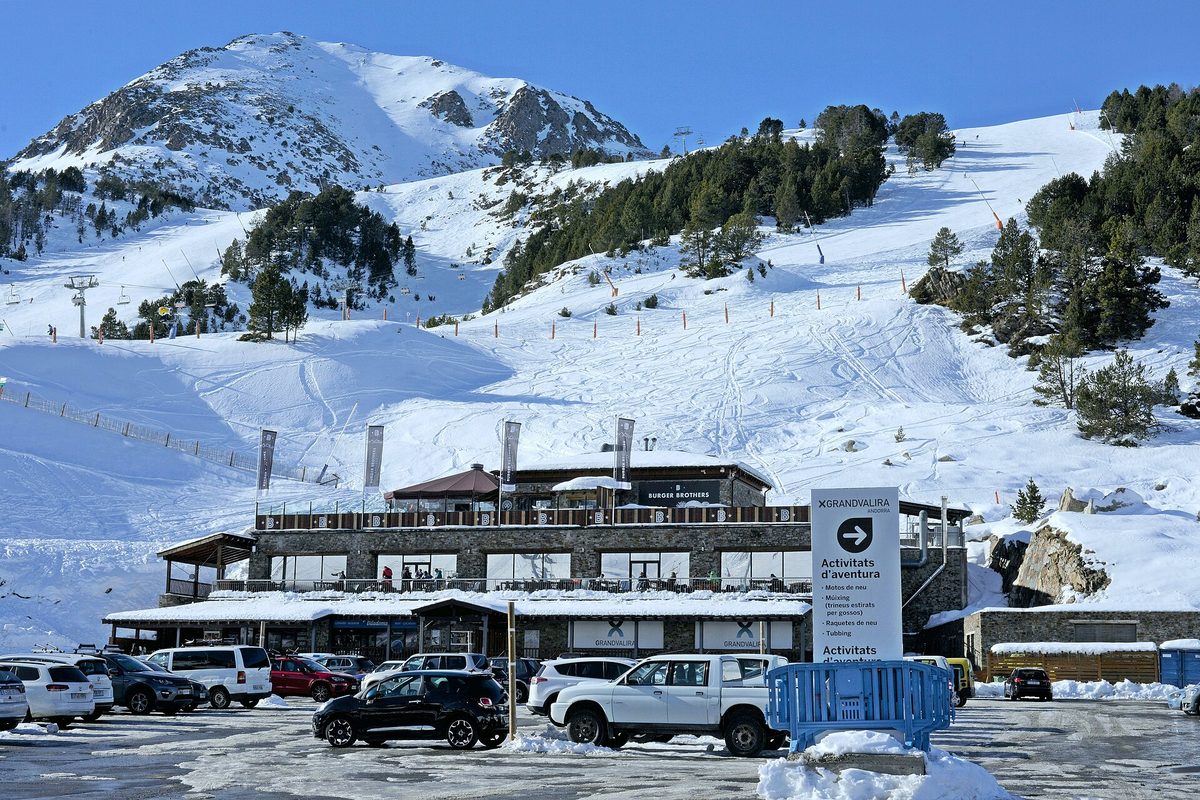
Pas de la Casa is not the obvious beginner choice — it is best known as the highest, snow-surest and rowdiest town in Andorra — but do not write it off. It has three roped-off snow gardens at the top of the main street on excellent high-altitude snow and the same English-heavy Grandvalira school. The town is almost entirely ski-in ski-out, which for a knackered first-timer is a real gift: short, flat walks home rather than a bus. Base here if you are a group wanting doorstep snow, budget beds and a proper night out, and do not mind concrete over charm. It is all in the guide to Pas de la Casa. One aside, since people ask: little Canillo, further down the valley, is the other genuinely gentle family base — gondola-served, with a children’s park up top.
How ski school actually works — and what to book
The single most important sentence in this article: book your lessons before anything else, and book them for the first morning of your trip. I will die on this hill. Every hour of tuition on day one earns compound interest across the week; a lesson missed mid-holiday because the class was full is a day of bad habits to unlearn. Sort the school first.
You have two formats. Group lessons are the sociable, cost-effective default — you learn alongside four to ten others at roughly your level, usually in three-hour morning sessions across several days, and make friends to commiserate with over hot chocolate. They are excellent value and completely fine for a standing-start beginner. Private lessons cost more per hour but buy you the instructor’s full attention, a pace set by you, and a guaranteed English-speaking instructor at times you choose. If you are especially nervous, short on days, or a family wanting to learn together, private is money well spent. Plenty of people do both: a private on day one to launch, group sessions to consolidate.
A few practicalities that trip first-timers up. Lift passes are almost never included in the lesson price — you buy the pass separately, though as a pure beginner you may only need the cheapest practice-lift or beginner pass for the first day or two, not the full mountain ticket. Group-lesson start days can vary by resort (some let you start any day, others run set weekly courses), so check when you book rather than assuming. And children are catered for beautifully: most Andorran schools take kids into snow gardens from about age three, with dedicated kids’ programmes for roughly ages three to eleven, and a supervised nursery for the very youngest (around ages one to three) at several bases so parents can grab their own runs. The exact age bands vary a little by resort, so check when you book — and if you are travelling as a family, the section below is written for you.
What a beginner week actually costs
Let me put rough numbers on it, because “cheaper than the Alps” is not much help when you are trying to budget. These are 2025/26-season ballparks, per adult; check current rates before booking, and expect a modest bump for 2026/27.
- Group lessons: from roughly €25 an hour per person, with a full-week block (around 15 hours across the week) commonly from about €180. This is the beginner sweet spot.
- Private lessons: from around €45 an hour, shareable among a small family or group — so per head it can rival a group class if there are a few of you.
- Equipment rental: roughly €20–35 a day for a decent adult ski, boot and pole package, less online or on a multi-day rate. Always take the basic package — you do not need performance skis to fall over on.
- Lift pass: a full Grandvalira adult day pass ran roughly €50 booked ahead to about €67 for a peak walk-up in 2025/26; Pal-Arinsal is a little cheaper. As a first-timer you may spend the first day or two on a much cheaper beginner pass and only buy the full ticket once you can use it.
- Mountain lunch: budget €15–25 up top, or eat cheaper down in the valley towns.
The headline: a learner’s week in Andorra lands well below the equivalent in Val d’Isere or Verbier, with the gap widest on exactly what a beginner uses most — lessons, rental and food. Shave it further by booking the lift pass online and early, since Grandvalira uses airline-style dynamic pricing where the February walk-up window is the expensive way to do it. The full breakdown, tiers and money-saving tactics are in the guide to Andorra ski pass prices.
What to pack and wear
You need less specialist kit than the shops would like you to believe. Rent the skis, boots and poles at the resort — never buy hardware for a first trip. But a few things are worth sorting before you fly, because getting them wrong makes a cold day miserable.
- Layers, not bulk. A thermal base layer, a fleece mid-layer, and a waterproof ski jacket and salopettes (trousers) — hire or borrow the outer shell if you would rather not buy it. Jeans and a wool coat will end your day by 11am, soaked and freezing.
- Warm gloves or mittens (mittens are warmer), plus thin liner gloves. Cold hands ruin more first days than anything else.
- Ski socks — one thin technical pair per day. Not thick woolly ones bunched inside a rigid boot; those cause pressure points and, counter-intuitively, cold feet.
- Goggles, sunglasses, high-factor sun cream and lip balm. The sun at altitude, bouncing off white snow, burns faces fast even when it is cold. This catches everyone out.
- A helmet — rentable with your skis, non-negotiable for kids. Just wear one.
- A small backpack for water, snacks, sun cream and a spare layer.

Your first few days, realistically
Nobody skis down a mountain on day one, and anyone who tells you they did is either lying or was four years old at the time. Here is what an honest progression actually looks like for a fit adult starting from zero, so you arrive with the right expectations rather than a fantasy.
Day one is undignified and essential. You spend it on the flat nursery area learning to walk in boots that feel like concrete, to stand up after falling (a skill in itself), to slide, to stop with a snow plough — that pizza-slice wedge — and to ride the magic-carpet conveyor lift. You will feel like a newborn giraffe. Everyone does. By the end you will make it down the gentlest slope in a wobbly wedge, and that is a genuine triumph.
Day two is where it starts to click: the snow plough becomes muscle memory, you begin to link basic turns, and you graduate to a slightly steeper pitch and your first button or chair lift. This is often the day people privately decide whether they love skiing. Most do. Day three is the confidence day — turns start to flow, you can control your speed, and your instructor points you at your first green or gentle blue run off the main lifts: a real piste, with a real view, descended under your own control. The grin is involuntary.
Days four and five are mileage and consolidation. You lap the greens and easy blues, tidy up your turns, maybe venture onto a longer blue, and start to feel like a skier rather than someone impersonating one. By the end of the week most able adults can confidently ski blue runs and get happily around the beginner and lower-intermediate mountain. That is the goal, and Andorra’s terrain is laid out precisely to deliver it.
Two rules make all of this go better. Stop before you are exhausted — tired legs on the last run of the day are how beginners hurt themselves, and the afternoon home stretch is exactly where it happens. And repeat what you enjoyed rather than grimly ticking off new runs. Skiing is a sport you improve at by having fun, not by suffering.
Kids and families
If there is one thing Andorra does even better than teaching adults, it is teaching children — and putting the parents at ease while it happens. The snow gardens are genuinely brilliant: fenced, gentle play areas with conveyor lifts, cartoon characters, obstacle courses and instructors who are essentially professional fun-havers, where kids from about three learn to ski without realising they are in a lesson. Older children slot into age-banded programmes, typically to about eleven, that combine tuition with supervised lunch so you can go and ski yourself.
For the very youngest, several bases run a supervised nursery (roughly ages one to three) where non-skiing toddlers are looked after in the warm while parents and older siblings ski. The upshot is that a family with a three-year-old, a seven-year-old and two never-skied-before adults can all be usefully occupied at once, at the same base, for a fraction of Alpine prices. Canillo and Pal-Arinsal are especially family-geared. The full age-by-age plan is in the guide to Andorra with kids — worth reading before you book so you slot each child into the right band first time.
Common first-timer mistakes to avoid
I have made most of these, or watched friends make them. None is fatal, all are avoidable, and dodging them makes the difference between a week you repeat every year and one you never mention again.
- Skipping lessons to “save money” or teach yourself. The big one. Self-taught beginners bake in bad habits, scare themselves on terrain they cannot control, and often end the week sorer and further behind than someone who took three group mornings. Book the school.
- Booking lessons for mid-week instead of day one. You lose the compounding benefit and spend the early days practising mistakes. First morning, always.
- Over-buying kit. Rent the hardware. Do not spend hundreds on skis you may use for four days, and do not wear cotton anything.
- Ignoring the sun. Altitude plus reflected snow equals a burnt face and streaming eyes. Cream, lip balm, goggles, sunglasses — every day, cloud or not.
- Skiing until you drop. Fatigue causes the falls. Call it a day with one good run left in the legs, not none.
- Under-estimating the transfer. Andorra has no airport or railway, so you fly to Barcelona or Toulouse and travel roughly three hours by road. Book lessons for the morning after you arrive, not the afternoon you land. The routes are in how to get to Andorra.
- Picking peak week by accident. The New Year fortnight and the late-February half-term crush pack the beginner areas and inflate every price. If you can flex your dates, the guide to the Andorra ski season shows which weeks are quiet and cheap — mid-January and mid-March are the learner’s friends.
The honest downsides
No place is perfect, and pretending otherwise helps nobody. Three things are worth knowing. First, the transfer: with no airport in the country, it is a three-hour road journey each way from Barcelona or Toulouse over serious winter passes — fine, but not door-to-door. Second, peak-week crowds: at New Year and half-term the nursery slopes and lift queues genuinely fill up, which is the last thing a wobbling beginner wants, so timing matters more here than the brochures admit. Third, the terrain ceiling: Andorra is a beginner and intermediate paradise, but strong skiers can exhaust the marked steeps in a few days — you will love it as an improving beginner, though committed experts eventually look elsewhere. For a first-timer, none of these is a dealbreaker, and the value more than pays for the inconvenience.
Where to stay while you learn
For a first trip, put convenience above everything: a short, flat, warm-footed walk between your bed, the ski school and the beginner lift, because after a day of falling over you will not want to wrestle skis onto a bus. That points you at ski-in ski-out or lift-adjacent accommodation in Soldeu, El Tarter, Pas de la Casa or the Arinsal side of Pal-Arinsal. Half-board hotels take the “what’s for dinner” decision off tired shoulders; self-catering apartments are cheaper for families. The full comparison of bases, styles and budgets is in the guide to where to stay in Andorra.
Andorra skiing for beginners: frequently asked questions
Is Andorra good for beginner skiers?
Yes — it is one of the best places in Europe to learn. Andorra has courted first-timers for decades, so you get high-altitude nursery zones on reliable snow, wide gentle runs, ski schools with strong reputations and many native English-speaking instructors, and prices well below the Alps. For a standing-start adult or a family, it is hard to beat on value and ease.
Which Andorra resort is best for beginners?
For an all-round first-timer, Soldeu is the polished default, with its high Espiolets learning plateau and celebrated school. Pal-Arinsal (near La Massana) is arguably the classic pure learn-to-ski mountain, especially for young families. El Tarter offers Soldeu’s teaching more quietly and cheaply, and Pas de la Casa suits groups wanting doorstep snow and nightlife.
How much does it cost to learn to ski in Andorra?
As a rough 2025/26 guide per adult: group lessons from about €25 an hour (a full-week block often from around €180), rental roughly €20–35 a day, and a lift pass from about €50 a day booked ahead — though beginners often need only a cheaper practice-lift pass at first. Overall a learner’s week lands well below the French or Swiss Alps. Always check current rates.
Do Andorra ski schools teach in English?
Very much so — it is one of the country’s biggest advantages. A large share of instructors are native English speakers, many British and Irish, who return season after season. Group lessons are grouped by language where possible; if you want a guaranteed English-speaking instructor and your own pace, book a private lesson, which lets you choose the language and the timing.
What age can children start ski school in Andorra?
Most Andorran schools take children into snow gardens from around age three, with dedicated kids’ programmes for roughly ages three to eleven. Several bases also run a supervised nursery for younger toddlers (around ages one to three) who are not yet skiing, so parents can ski while the youngest are looked after in the warm. Check each resort’s exact age bands when you book.
How many days does it take to learn to ski?
With daily lessons, most able adults starting from zero can confidently ski green and easy blue runs by the end of a five-to-six-day week. Day one is the nursery slope and snow plough; days two and three bring linked turns and your first real pistes; days four and five consolidate. Children often progress even faster. A week is the sweet spot.
Is Soldeu or Arinsal better for beginners?
Both are excellent; it depends on your priorities. Soldeu (in the big Grandvalira area) offers a more polished village, comfortable ski-in ski-out hotels and the option to progress onto a vast mountain. Pal-Arinsal is smaller, friendlier and famous specifically as a first-timers’ and families’ mountain. Choose Soldeu for comfort and room to grow, Arinsal for a gentle, human-scale learning trip.
Do I need lessons or can I teach myself?
Take lessons — this is the one corner not to cut. Self-taught beginners tend to develop bad habits, frighten themselves on terrain they cannot control, and progress more slowly than someone with even a few group mornings. Andorra’s schools are cheap by European standards and excellent, so the return on a first-week course is enormous. Book them for your first morning.
Planning the rest of your trip
Once the lessons are booked, the rest of the trip slots into place around them: pick your base, sort a lift pass and rental, time the week for quiet snow, and plan the road journey in from Barcelona or Toulouse. The companion guides linked throughout this article cover each of those in turn. Learn here once, and I suspect you will be back — most people are.


1 comment
Comments are closed.