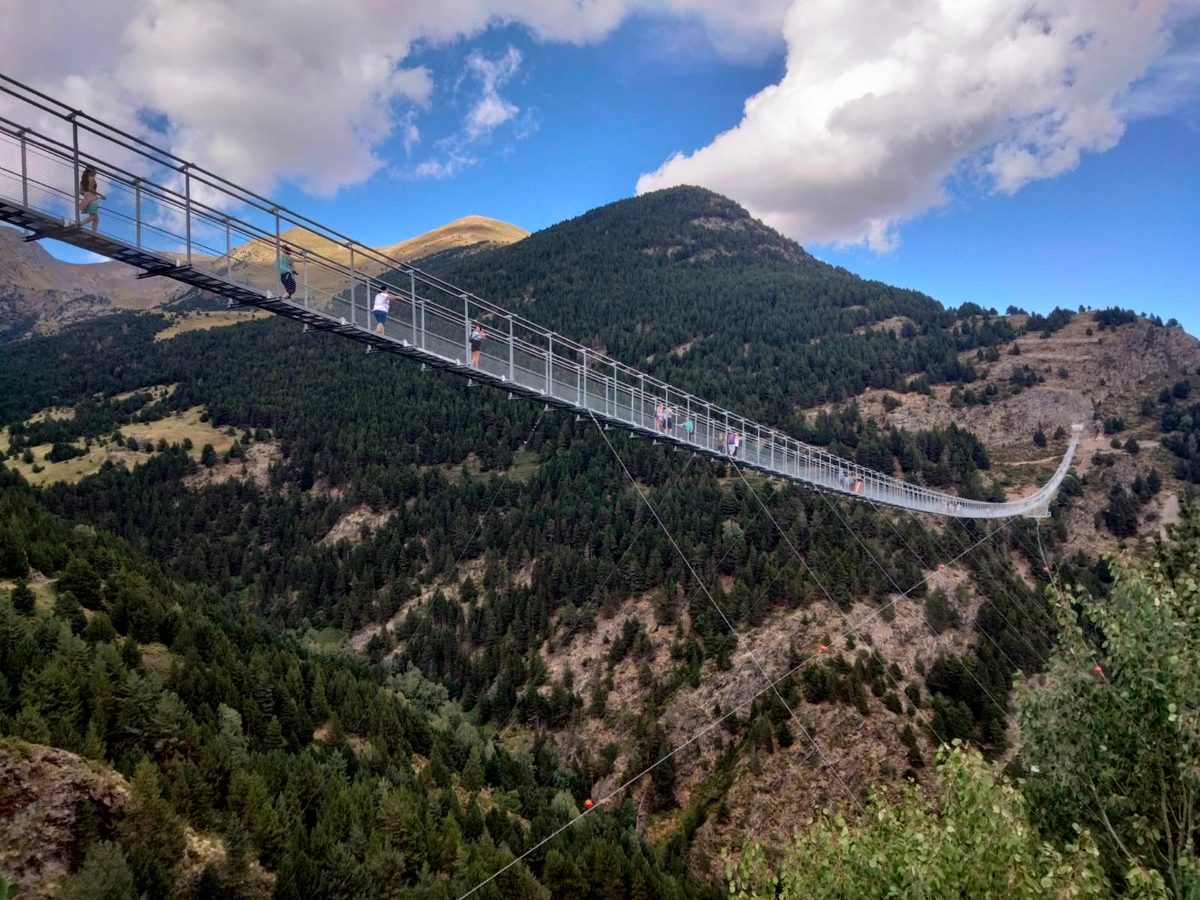
The first time I walked out onto the Tibetan Bridge of Canillo, I looked down through the mesh floor about fifty metres in, and my legs did a thing I did not authorise. There is 158 metres of nothing beneath the boards, the whole span sways underfoot, and the far side looks a long way off. I loved it, and I also gripped the handrail like it owed me money.
The Tibetan Bridge Andorra keeps in the mountains above Canillo is the most talked-about adrenaline attraction in the Pyrenees. The Pont Tibetà de Canillo is a 603-metre pedestrian suspension bridge hanging up to 158 metres above the Vall del Riu, at around 1,875 m altitude. It opened in June 2022 and is one of the longest footbridges of its kind in the world. Reach it by shuttle bus from Canillo, pay around €17–19, and cross in 15–20 minutes. It is for anyone who likes heights and hates being bored, and absolutely not for serious vertigo sufferers.
Last updated: July 2026. Prices, opening dates and bus times reference the 2026 season published by the Canillo tourist office; they are seasonal and weather-dependent, so treat every number here as a close guide and check the official Pont Tibetà site before you travel.
Tibetan Bridge Andorra: the crossing at a glance
Here is the shape of the thing before we get into the detail. If you read one section, read this and the honest-verdict part further down.
| Pont Tibetà de Canillo | |
|---|---|
| Length | 603 m — one of the longest footbridges of its kind in the world |
| Maximum height | 158 m above the valley floor |
| Width | 1 m deck; railings about 1.7 m high |
| Altitude | 1,875 m (Armiana side) to 1,884 m (Coll de la Cauba side) |
| Opened | June 2022, after about 18 months of construction |
| Where | Vall del Riu, above the village of Canillo, eastern Andorra |
| How to get there | Shuttle bus only, from Canillo village or the Roc del Quer car park, then a 900 m walk |
| Price | Around €17 adult / €14 child (roughly €19 / €16 in peak summer); under 5 free |
| Time to cross | 15–20 minutes at a relaxed pace; allow 2–3 hours for the whole outing |
| Season | Roughly late March to late November, weather permitting |
| Not for | Serious vertigo sufferers; there are no bikes, strollers, wheelchairs or pets |
What a Tibetan bridge actually is (and why this one is a big deal)
Quick vocabulary, because the name confuses people. A “Tibetan bridge” is a style of suspension footbridge, not a bridge that is in any way from Tibet. The design gets its name from the simple rope crossings historically used in the Himalayas — traditionally two ropes to hold and one to walk on, strung across a gorge because building anything sturdier was impossible. Modern versions like this one are “Tibet-style”: really they are a proper engineered Andorra suspension bridge, with steel cables, a mesh-and-timber deck, tall handrails, and none of the terrifying improvisation of the originals. The look survives; the death-wish does not.
What makes the Canillo one notable is the raw scale. At 603 metres it is, depending on exactly how you count and who is doing the counting, somewhere around the third or fourth longest footbridge span on the planet, and one of the very longest in Europe. The official site markets it as “the second longest Tibetan bridge in the world”, which leans on that “Tibetan-style” qualifier; independent ranking sites such as HighestBridges.com put it fourth among all footbridge spans, behind the Sky Bridge 721 in the Czech Republic and a couple of others. The pedantry is fun, but the point stands either way: this is one of the biggest structures of its type anywhere, and Andorra — a country you can drive across in an afternoon — built it.
It is also genuinely new. It opened in June 2022 after about a year and a half of work, part of Canillo’s push to be Andorra’s headline destination for adventure that has nothing to do with a ski lift. If you have read our guide to things to do besides skiing, the bridge is exhibit A: proof that the country’s summer is now a serious draw in its own right, not a consolation prize for people who missed the snow.
What the crossing is actually like
Let me be honest about the experience, because the marketing photos flatten it into a serene stroll and it is not that.
You start from the Armiana side after the walk in. The first twenty or thirty metres feel almost normal — the deck is solid underfoot, the ground below is still close, and you think, right, this is fine, what was all the fuss about. Then the valley floor falls away beneath you and the bridge starts to do what long suspension spans do: it moves. Not alarmingly, but constantly. A gentle lateral sway, a soft bounce that other walkers transmit down the deck toward you, a bit of wind that reminds you how exposed 1,875 metres of Pyrenean mountainside really is. The deck is partly open mesh, so you get an uninterrupted view straight down to the Vall del Riu, which is either the best part or the worst part depending entirely on your relationship with heights.
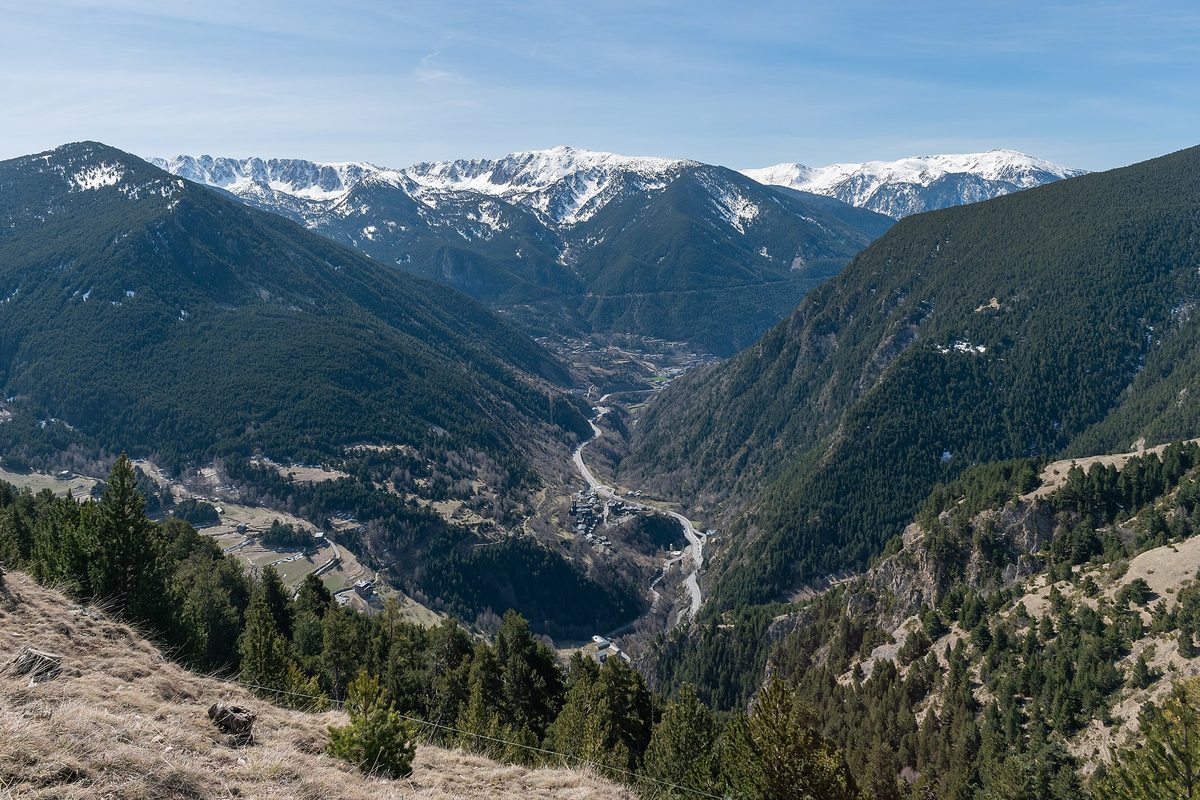
The middle is the crux. At the deepest point you are 158 metres up — taller than most of Europe’s cathedrals stacked on top of each other — with the mountainside sweeping down on both sides and the deck feeling narrow and alive. I have watched confident, heights-are-fine people go quiet and shuffle here. I have also watched a nine-year-old skip across chatting the whole way. It is very personal. What everybody agrees on is the view: the whole central valley of Canillo opens up, the Grandvalira slopes rise across the way, and for once “panoramic” is the literal, un-inflated truth.
One practical thing that surprises people: it is a two-way bridge. There is no one-way loop. You walk out to the far side and then you turn around and walk back along the same span, passing everyone coming the other way on a deck that is one metre wide. In quiet periods this is fine. On a busy August afternoon it means the occasional polite shuffle-past, the whole bridge wobbling a bit more as people bunch up. Go early and you may get long stretches nearly to yourself, which is when the place is at its best.
Time-wise, budget 15 to 20 minutes to cross one way at an unhurried pace, longer if you stop for photos every ten steps, which you will. Round trip on the bridge itself is comfortably under an hour. Add the walk in and out and the bus, and the whole outing eats two to three hours.
The wider Canillo adventure circuit
The bridge is the headline, but it sits in the middle of what is quietly Andorra’s best cluster of high-adrenaline activities, and if you have driven all the way up here it would be a waste to do only one thing.
The Roc del Quer viewpoint
The obvious pairing, and the operators know it — the bridge and the viewpoint are sold as a combined pack. The Roc del Quer is a 20-metre steel walkway that juts straight out over the void, with the last 12 metres cantilevered into thin air over the valley and much of the floor made of clear glass. It is a completely different flavour of vertigo from the bridge: no walking involved, just a short stroll to the edge of a platform that makes you feel like you are standing on nothing. It is far gentler than the bridge and takes ten minutes, which makes it the ideal warm-up or wind-down. Our full guide to the Roc del Quer viewpoint has the details, but the short version is: buy the combined ticket, do both.
Via ferrata above the valley
For people who want to properly earn their vertical metres, Canillo has one of Andorra’s best-known via ferratas, the Roc del Quer route (sometimes called the Directíssima). It is a graded, cable-protected climbing route up the cliffs of the same massif — roughly 330 metres of ascent, genuinely aerial in places, and rated at a level that rewards a decent head for heights and some fitness. You clip a harness onto a steel cable and haul yourself up rungs and rock with the valley dropping away below. It is not a casual add-on; expect the best part of a morning with the approach and descent, and go with a guide if you are new to the game. Note that via ferratas close for maintenance from time to time, so check it is open before you build a day around it. For the broader menu of guided climbing, canyoning and the like, see our roundup of Andorra’s adventure activities.
Ziplines, bungee and the big-air stuff
If the bridge did not sufficiently rattle you, there is a bungee jump operating in the same natural area — a free fall into the Vall del Riu that is exactly as unhinged as it sounds and runs seasonally alongside the bridge. Elsewhere in the parish, Canillo’s Mon(t) Magic family park above the village and the wider Grandvalira summer setup run ziplines (tirolines), so it is entirely possible to string together a bridge crossing, a glass-walkway wobble and a zipline into one properly adventurous day out. Prices and which activities are running vary by season, so cross-check the operators; I would not promise a specific zipline is open on a specific day without checking first.
Put it together and Canillo becomes a day, not a stop. That is exactly how I would treat it, and it is why the bridge shows up in our list of the more unusual things to do in the country.
Getting there, parking and how the bus works
This is the part people get wrong, so read it carefully, because turning up in your car expecting to drive to the bridge will ruin your morning.
You cannot drive to the bridge. Access is by official shuttle bus only. Parking on the access road is prohibited and enforced. The bus is not an optional extra you can skip — it is the only way in, and its cost is already bundled into your ticket. The bus runs from the village of Canillo itself and from the Roc del Quer car park, dropping you at Montaup, from where a walking path of about 900 metres takes you to the start of the bridge. That path is scenic and mostly gentle but it is a genuine mountain trail with some unfenced drop-offs, so it is proper-shoes territory, not flip-flops.
The mechanics matter: you generally need to board the bus from Canillo around 30 minutes before your chosen bridge slot, so build that buffer into your plan. Buses typically run every 30 minutes, with the first departure around 9:30 in the morning. Crucially, the last useful bus is earlier than you would expect — in recent seasons the final departure for the bridge has been around 2:30 pm, and earlier still (about 1:00 pm) if you want the combined bridge-plus-viewpoint pack, because you need time to do both. Miss those and you have driven up for nothing. Do not treat this as a late-afternoon activity.
Getting to Canillo village in the first place is easy. It sits on the main CG-2 road through eastern Andorra, roughly 15 minutes from the capital, Andorra la Vella, and on the direct route up toward Pas de la Casa and the French border. There is normal paid parking in the village. If you are basing yourself down in the capital and want a sense of how the whole country strings together, our things to do in Andorra guide maps out the distances; nothing here is more than an hour from anything else.
Tickets, prices and opening times
Prices shift with the season and get revised each year, so here are honest ballparks rather than promises. Buy online through the official Canillo Tibetan Bridge shop or at the Canillo tourist office — and note that tickets are not sold at the bridge itself, and there is no wifi or signal up there to buy on arrival, so sort it before you get on the bus.
In the 2026 season, a standard adult ticket for the bridge (bus included) has been running at around €17, with children up to 12 around €14 and under-5s free. In the peak summer window — roughly mid-July into mid-September — those rise to about €19 and €16. The combined Tibetan bridge Canillo price with the Roc del Quer viewpoint pack sits around €20, rising to about €22 in peak season, which is the best value if you are doing both. Andorra residents and youth-card holders get a reduced rate, but usually only if bought in person at the tourist office. The viewpoint on its own is cheaper still, around €6, but remember there is no bus for the viewpoint alone — that one is car-only.
For opening times, the season runs roughly from late March (recently from 28 March) to late November, weather permitting, and the bridge simply closes when conditions are unsafe. In high summer the operation runs longest; shoulder-season weekdays have reduced hours. Because the last bus is early and bad weather can shut it with no notice, my standard advice is: go in the morning, go on a clear day, and have a backup plan. If the forecast is grim, keep the bridge in your pocket and check our rainy-day plan instead — a high, wind-exposed suspension bridge is not a wet-weather activity.
When to go: season, weather and crowds
The bridge is a warm-season attraction, open roughly late March to late November, and closed all winter when the Vall del Riu is under snow. Within that window, timing changes the experience a lot.
Summer (July–August) is peak: longest opening hours, warmest weather, and the best odds of a clear crossing — but also the biggest crowds and the highest prices, and on a hot afternoon the two-way deck gets busy. Late spring and September are the sweet spot in my book: the weather is often still settled, the light is gorgeous, prices drop back to standard, and the bridge is noticeably quieter. October into November can be magnificent with autumn colour in the valley, but the weather is a coin-toss and closures get more common as the season winds down.
Whatever the month, weather up here is changeable and the bridge is fully exposed. Morning is almost always calmer and clearer than afternoon, and it is when you have the best shot at that near-empty crossing. For the bigger picture of how Andorra’s seasons behave, our guide to the best time to visit is worth a read, and if you are building a warm-weather trip around activities like this, so is our roundup of things to do in summer.
Safety and who really should not do this
Let me be straight, because “it is perfectly safe” and “you will be perfectly comfortable” are two completely different claims, and only the first one is true for everyone.
The bridge is structurally very safe. It is a modern engineered span with steel cables, tall railings (roughly 1.7 m, well above tipping height), a properly maintained deck, and staff on site. The sway and bounce you feel are normal behaviour for a suspension bridge of this length, not a sign anything is wrong. Nobody is falling off this thing by accident.
Whether you will enjoy it is another matter entirely. This is not a bridge for serious vertigo sufferers, full stop. The official rules say so plainly, and I would go further: even people who consider themselves fine with heights routinely report a heart-in-mouth moment in the middle, where the deck is narrowest, the drop is deepest, and the whole span is moving. If genuine height-panic is a thing for you — the kind that locks your legs and empties your head — do not talk yourself into this one to prove a point. There is no shortcut back; once you are halfway out, the only way off is to keep walking.
A few concrete rules worth knowing before you go, all set by the operator and subject to change, so confirm the current version:
- Children are welcome but must be accompanied by an adult across the bridge.
- No strollers, prams, wheelchairs or anything that would block a one-metre-wide, two-way deck — which unfortunately makes the bridge itself effectively inaccessible to wheelchair users, though the Roc del Quer viewpoint is a far easier alternative.
- No bikes, scooters, motorbikes or personal-mobility vehicles; no animals.
- You cannot sit on the deck, climb or lean over the railings, or throw anything off — there are people and a live valley below.
- Wear proper footwear and bring a layer; it is a high, exposed mountain environment and the weather turns fast.
What to skip? Honestly, nothing about the bridge itself — if you are up for it, do the whole crossing, out and back, and pair it with the viewpoint. The only thing I would skip is doing it in bad weather or late in the day. And if the bridge is a hard no for your group, that is completely fine; the Roc del Quer viewpoint delivers a big chunk of the drama with none of the walking or the wobble.
Is the Tibetan Bridge of Canillo worth it? My honest take
Yes, with an asterisk. If you like heights, or you like the feeling of doing something slightly ridiculous with a spectacular view, this is one of the most memorable single hours you can spend in Andorra, and it is unlike anything else in the Pyrenees. The scale is real, the sway is real, the view is genuinely superb, and there is a specific, giddy satisfaction to reaching the far side and turning around to see where you have just walked.
The asterisk is expectations. It is not a cheap, casual, drop-in attraction — it costs the better part of €20, it runs on a fussy bus timetable with an early last departure, and it can be shut by weather with no warning. Go in knowing all that, go in the morning, go on a clear day, pair it with the viewpoint, and it is worth every euro. Turn up on a whim at 3 pm in the rain and you will just be cross. Plan it properly and it is one of the best things Andorra does.
Frequently asked questions
How long is the Tibetan Bridge in Andorra?
The Pont Tibetà de Canillo is 603 metres long, which makes it one of the longest footbridges of its kind in the world and among the very longest in Europe. It is just one metre wide, with a mesh-and-timber deck and steel cables. The full out-and-back crossing covers a bit over 1.2 kilometres on foot, since the bridge is two-way and you return along the same span.
How high is the Tibetan Bridge of Canillo?
At its deepest point the deck hangs about 158 metres above the floor of the Vall del Riu — roughly the height of a 50-storey building. The bridge itself sits at high altitude too, spanning between about 1,875 metres on the Armiana side and 1,884 metres on the far Coll de la Cauba side, so you are already well up in the mountains before you factor in the drop.
How much does the Tibetan Bridge Canillo cost?
In 2026 a standard adult ticket is around €17 (about €19 in peak summer), with children up to 12 around €14–16 and under-5s free. The bus is included in that price. A combined pack with the Roc del Quer viewpoint runs roughly €20–22. Prices change each season and by date, so check the official Canillo Tibetan Bridge site before booking.
Can you drive to the Tibetan Bridge of Canillo?
No. Access is exclusively by the official shuttle bus, either from Canillo village or from the Roc del Quer car park, and parking on the access road is prohibited and enforced. The bus fare is bundled into your ticket. From the drop-off at Montaup, a walking path of about 900 metres leads to the start of the bridge, so wear proper footwear.
How long does it take to cross the Tibetan Bridge?
Crossing one way takes about 15 to 20 minutes at a relaxed pace, or longer if you stop constantly for photos, which most people do. Because the bridge is two-way, you then walk back along the same span, so allow roughly 40 minutes to an hour on the bridge itself. With the bus and the 900-metre walk in and out, the whole outing takes two to three hours.
Is the Tibetan Bridge of Canillo scary?
It can be. The deck sways and bounces, part of the floor is open mesh with a clear view straight down, and the drop reaches 158 metres. Plenty of people who are normally fine with heights report a nervous moment in the middle. It is completely safe structurally, with tall railings and staff on site, but it is genuinely not recommended for serious vertigo sufferers.
Is the Tibetan Bridge safe?
Structurally, yes — it is a modern engineered suspension bridge with steel cables, railings about 1.7 metres high, a maintained deck and staff present, and the movement you feel is normal for a span this long. The main rules exist to keep it safe: children must be with an adult, no leaning on or climbing the railings, and no throwing objects off. Vertigo sufferers are advised not to cross.
When is the Tibetan Bridge of Canillo open?
The season runs roughly from late March to late November, weather permitting, and it is closed through the winter. High summer has the longest hours; shoulder-season weekdays are reduced. The last bus is earlier than most people expect — recently around 2:30 pm for the bridge, earlier for the combined pack — so treat it as a morning activity and check the official timetable before you go.
Related guides
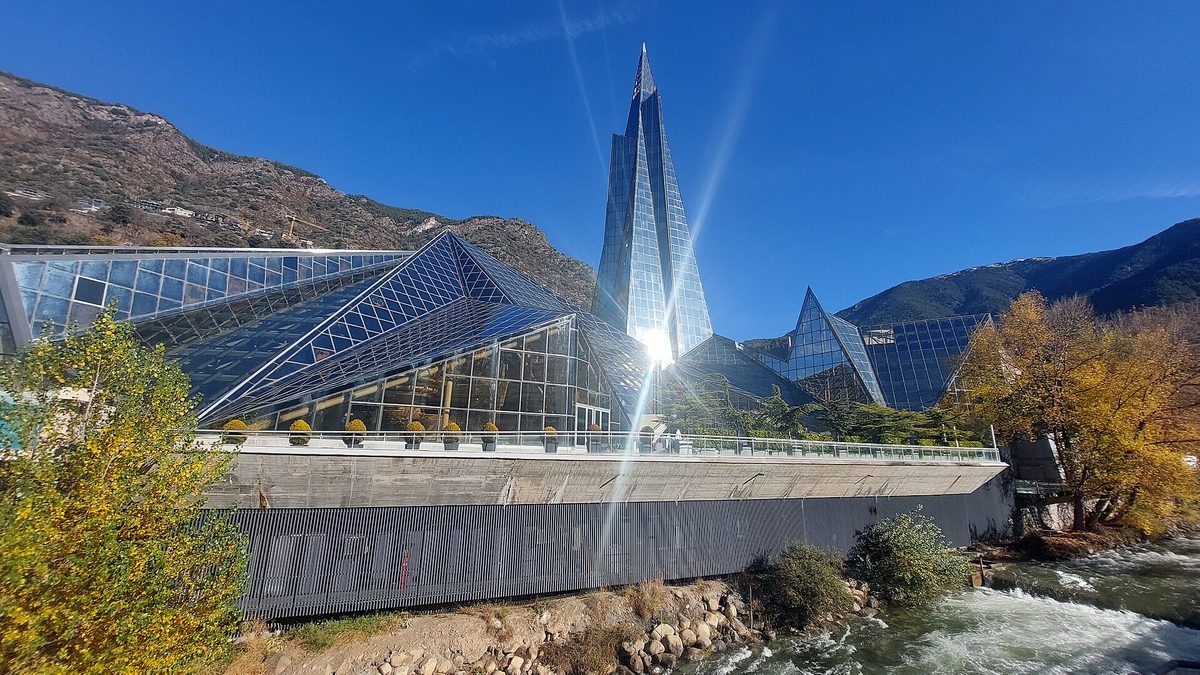
Make a proper day of Canillo by pairing the bridge with the Roc del Quer viewpoint next door, and if you have caught the vertigo bug, line up the Tristaina solar viewpoint over in Ordino too. For the bigger picture, start with things to do in Andorra and its warm-season companion, things to do in summer. Adventurous families should check Andorra with kids, walkers our guide to hiking in Andorra, and anyone here off-season the case for things to do besides skiing. Wind down afterwards at the Caldea thermal spa, and sort the logistics with our Andorra travel tips.
1 comment
Comments are closed.