About forty minutes up the Roc del Quer route, clipped to a cable on a wall with three hundred metres of nothing beneath my heels, I had a very clear thought: there is no way down from here. That is the thing about a via ferrata that nobody puts in the brochure. You do not turn round. You finish, or you have a genuinely bad afternoon.
Via ferrata Andorra-style means sixteen equipped routes — fourteen via ferratas and two cable routes — graded from K1 to K4+, all of them free, unsupervised and open to anyone with the right kit. This guide lists each of them, in order from first-timer to vertigo-proof, with grades, vertical, timings and whether there is a way out halfway up.
Last updated: September 2026. Grades and dimensions differ between topos and I have flagged the routes where sources genuinely disagree. Conditions change with weather and season; check meteo.ad and the panel at the start of every route before you commit.
Via ferrata Andorra: the sixteen routes at a glance
| Route | Parish | Grade | Vertical | On the route |
|---|---|---|---|---|
| Clots de l’Aspra | Encamp | K1/K2 | +70 m | 30 min – 1 hr. Two Tibetan bridges. Has an escape route |
| Creu del Noral | Ordino | K2 | +150 m | 1–1.5 hr. Best route for children |
| Segudet | Ordino | K2 | +75 m | 1–1.5 hr. Same start point as Creu del Noral |
| Canal de la Mora | Canillo | K2 | +200 m | 75 min. In a ravine — the rock gets slippery |
| Coll dels Isards | Pas de la Casa | K1/K2 | +50 m | 1 hr, but a 50-minute approach each way |
| Tossal Gran d’Aixovall | Sant Julià de Lòria | K3 (treated as easy) | ~40 m | 30 min. The classic short taster |
| Roc de la Coma d’Erts | La Massana | K2/K3 | +200 m | 1 hr 45. Overhang at the end. Has an escape route |
| Sant Vicenç d’Enclar | Santa Coloma | K3 | +190 m | 1 hr. Finishes at a 9th-century chapel. Nearest to the capital |
| Roc del Quer (La Directíssima) | Canillo | K3 | +350 m | 1 hr 30. The biggest vertical in Andorra. No escape |
| Canal del Grau | Canillo | K3 | +90 m, 350 m long | 1 hr 30. Hanging bridges, technical. No escape |
| Roc d’Esquers | Escaldes-Engordany | K3 | +250 m | 2 hr on the route, ~4 hr total. The longest day out |
| Bony d’Envalira | Grau Roig | K3 | +200 m | 1 hr 30. The alpine one. Summits at 2,685 m. Summer only |
| Racons | Canillo | K4 | +210 m | 75 min. Overhanging sections. Experienced only |
| Roc del Gos | Canillo | K4+ | +100 m | 30 min. The hardest in Andorra. Widely spaced staples |
| Vía Cable Torrent del Grau 1 | Canillo | V+ (climbing grade) | +60 m | 20 min. A cable route rather than a true ferrata |
| Vía Cable Torrent del Grau 2 | Canillo | 6a− | +50 m | 25 min. Halfway between climbing and via ferrata |
Seven of the sixteen are in Canillo, which makes that parish the obvious base. All of them are free.
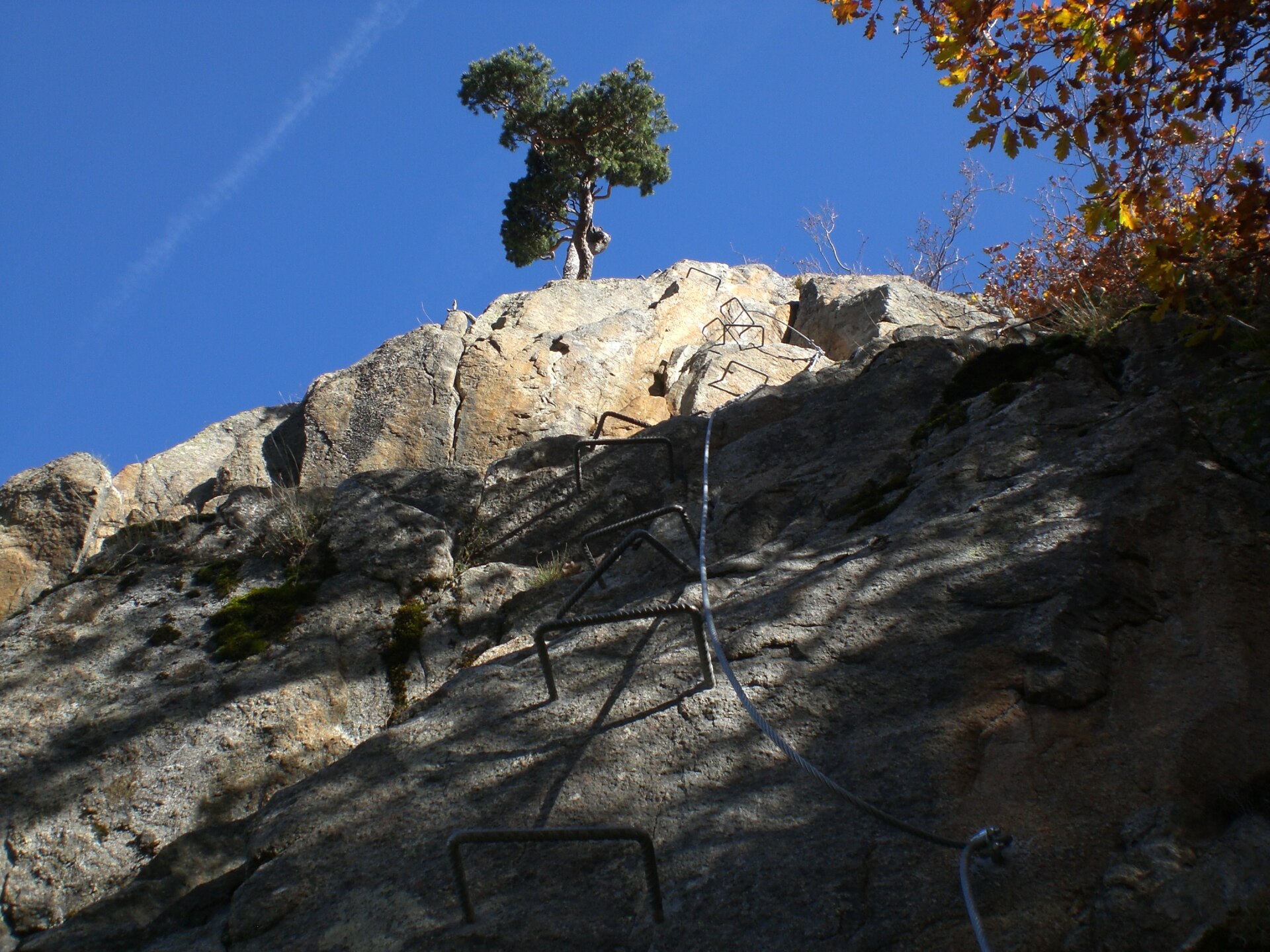
What a via ferrata actually is, and how the grades work
A via ferrata — Italian for “iron road” — is a climbing route permanently equipped with a steel cable bolted to the rock, plus rungs, staples, ladders and sometimes suspension bridges. You wear a harness with a Y-shaped lanyard, clip both carabiners onto the cable, and move them past each anchor one at a time so that one is always attached.
The important thing to understand: the cable will not stop you falling. It stops you falling far. If you come off, you drop to the last anchor point, and an energy absorber built into the lanyard takes the shock so the force does not break you or the gear. That is why a plain sling is not a substitute and why climbing a ferrata without a proper absorber is prohibited.
The Hüsler scale
There is no Andorran grading system. Everyone uses the Hüsler K scale, which runs from K1 to K6:
- K1 — easy. Walkable with a bit of scrambling.
- K2 — not very difficult. Vertical sections, plenty of rungs, no real strength needed.
- K3 — somewhat difficult. Sustained vertical, exposure, arms start to matter.
- K4 — difficult. Overhangs, athletic moves, prior experience assumed.
- K5 and K6 — very and extremely difficult. Not present in Andorra.
Andorran routes run K1 to K4+. The hardest in the country is Roc del Gos at K4+. You will see pages claiming Andorra has K5 routes; it does not.
Two warnings the grade does not tell you
Grades disagree between sources here. This is not me being pedantic — I found genuine conflicts on three routes while researching this. The Roc de la Coma d’Erts is K2 in one topo and K3 in another. The Tossal Gran d’Aixovall is labelled K3 by two databases while the official tourist board calls it low difficulty. Canal del Grau is K3 in the topos and “difficult” on the official page. Read the panel at the start and use your own judgement.
Most routes have no escape. A via ferrata goes one way. Once you are past the first section there is generally no down-climb and no bail-out path, and reversing a vertical cable with a queue behind you is unpleasant at best. Only two Andorran routes are confirmed to have an escape: Clots de l’Aspra, which has one between its two sections, and Roc de la Coma d’Erts, which has a signed escapatòria fàcil before the hard finish. Canal del Grau and Roc del Quer are confirmed to have none. For the rest, assume none.
Pick a grade you can definitely finish, not one you might.
Your first via ferrata in Andorra
Creu del Noral, Ordino — K2
If you have never done one, start here. It climbs out of a canyon above Ordino through pine forest with lovely views down the valley, gains 150 m, takes an hour to ninety minutes, and the walk back to the village is fifteen minutes. It sits inside an adventure park but is free to access. It is explicitly suitable for children.
One practical note: two routes start from the same point. Creu del Noral is the one on the left.
Segudet, Ordino — K2
And the one on the right. Seventy-five metres of vertical, an hour or so, ten minutes back. The natural pairing: do Creu del Noral, decide you liked it, do Segudet before lunch. Between them they make an excellent introductory morning.
Clots de l’Aspra, Encamp — K1/K2
Up at the Cortals d’Encamp at around 2,000 m in pine forest, and my pick for a nervous first-timer with children in tow. It is split into two sections, the second slightly harder than the first, with two Tibetan bridges and some vertical steps, and only 70 m of gain.
Crucially, there is an escape route between the two sections. If the first half is enough, you walk out. Very few routes in Andorra offer that, and it changes the psychology of a first attempt entirely.
You need a car. Park by the climbing wall, cross the large Tibetan bridge over the river and walk about ten minutes.
Tossal Gran d’Aixovall, Sant Julià de Lòria — the short classic
Near the village of Aixovall in Sant Julià de Lòria. Around 150 m long and 40 m high, five minutes from the car, thirty minutes on the route, ten minutes back. If Andorra has one classic beginner ferrata, this is it — it is the taster you do to find out whether you like the sensation before committing a day.
There is a harder variant with an athletic overhang if the standard line proves too easy. And it is five minutes’ drive from Sant Vicenç d’Enclar, which makes a natural half-day double.
Canal de la Mora, Canillo — K2
Two hundred metres of gain, seventy-five minutes, five minutes from the car. Set in a ravine with running water, which is atmospheric and also means the rock can be genuinely slippery. Not the one to do the morning after heavy rain.
The step up: Andorra’s K3 routes
Sant Vicenç d’Enclar, Santa Coloma — K3
The best route if you are staying in the capital without a car. It starts at Santa Coloma on the edge of Andorra la Vella, climbs 190 m through holm oak forest surrounded by cliffs with sweeping views over the valley, and takes about an hour with sections of varying difficulty and some surprising slab moves.
It finishes at the chapel of Sant Vicenç d’Enclar, which dates to the ninth century and is one of the oldest buildings in the country. Climbing a cable up a cliff and arriving at a thousand-year-old church is not a combination many places offer. The descent starts behind the chapel on the shady side.
It is also one of the first routes to come into condition — doable in early May in a normal year.
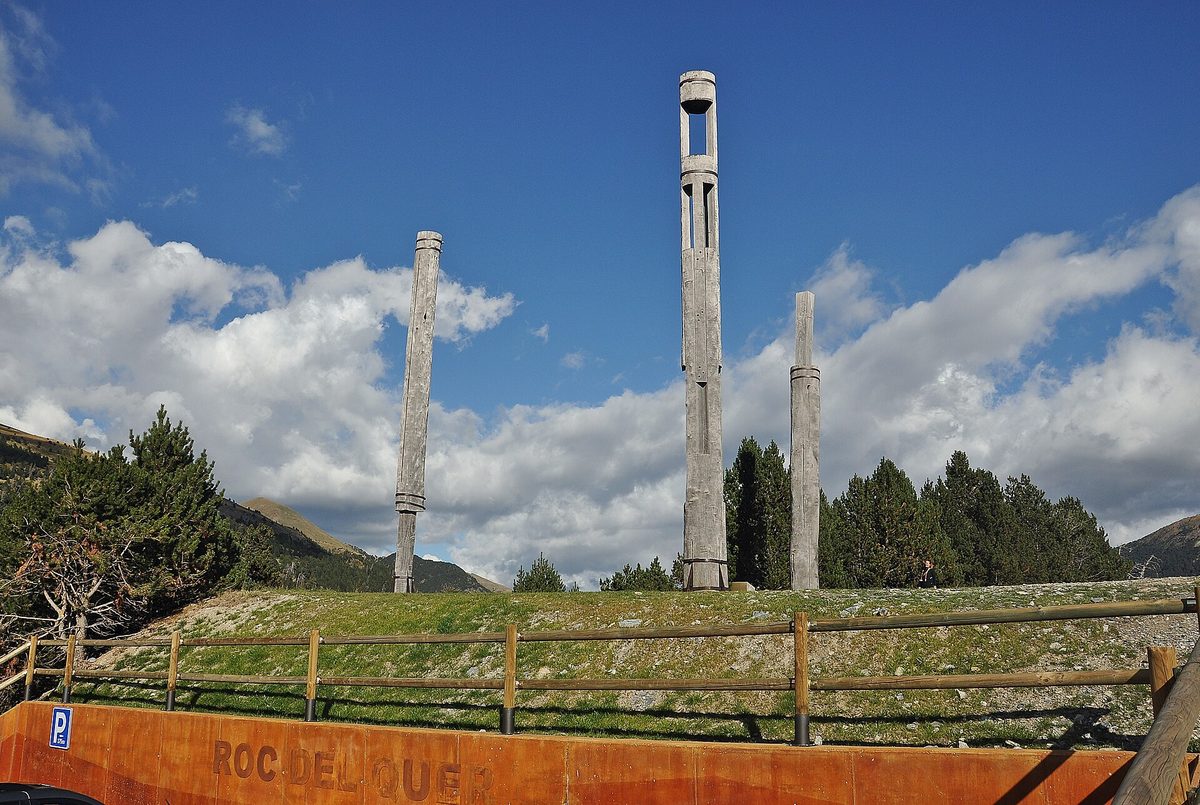
Roc del Quer / La Directíssima, Canillo — K3
The most famous via ferrata in Andorra, and the one with the biggest vertical: +350 m. The approach is two to five minutes from a roadside car park, the route takes about ninety minutes, and the walk back down takes forty-five.
It is a sustained, exposed, straight-up ascent with the village of Canillo shrinking underneath you the whole way, and it finishes at the Roc del Quer viewpoint — the cantilevered platform that everyone else reaches by car. Arriving there on a cable, past the people who drove, is a small and entirely undeserved pleasure.
No escape routes and no bridges. Best in the morning in spring and autumn, or the afternoon in summer, to keep the sun off the wall. Without a car, take the bus to Canillo and walk ten minutes.
Canal del Grau, Canillo — K3
Near the village of Prats, at 1,745 m, facing south-east. Around 350 m long with 90 m of gain, thirty minutes’ approach, ninety on the route, fifteen back.
This one is different in character: mainly a horizontal traverse rather than a vertical climb, with hanging bridges and the ascent of the agulla vermella, the red needle. It is less aerial and less physical than Racons next door, but there are plenty of technical passages, and the equipment is deliberately minimalist in places, which forces you to use the rock rather than the rungs. That is more satisfying and more demanding at the same time.
The official tourist board states plainly that there are no escape routes. Commit before you clip in.
Roc d’Esquers, Escaldes-Engordany — K3
The longest via ferrata in Andorra and the best full-day outing. It sits on the edge of the Madriu-Perafita-Claror valley, a UNESCO World Heritage site since 2004. Two hundred and fifty metres of gain, a couple of hours on the route, and roughly four hours all in.
You cross a suspension bridge, climb smooth walls with the aid of iron chains, and look out over Escaldes and the capital. Then the return is a proper hike: up to the Coll Jovell at 1,780 m, where there is a picnic table, and down along the Madriu river past shepherds’ huts.
Honest note from someone who has done it: the start is a little dull and it improves steadily. Stick with it.
Bony d’Envalira, Grau Roig — K3
The most alpine route in the country. It sits inside the Grandvalira ski area at Grau Roig, gains 200 m on the route, and summits the Bony d’Envalira at 2,685 m with a full 360-degree Pyrenean panorama.
What makes it different is that it relies heavily on natural hand- and footholds rather than rungs, so it feels much more like actual climbing than most equipped routes. It is also rarely busy.
Two warnings. The approach is a steep 350 m ascent over rocky ground that takes thirty minutes to an hour and is easy to get lost on — download a GPX. And it is summer only; there is snow on it for much of the year. Without a car, take the L4 bus to the Túnel d’Envalira stop and walk twenty minutes.
Roc de la Coma d’Erts, La Massana — K2/K3
Above the hamlet of Erts in La Massana parish. Two hundred metres of gain, an hour and three quarters, in two distinct halves: a vertical start out of the forest with views over Erts, then a traverse leftwards where the final two stretches turn exposed and athletic, including an overhang.
There is a signed escape route at the end of the easier section — escapatòria fàcil — so you can take the pleasant part and walk away from the hard finish with no shame at all. Not recommended in winter.
Coll dels Isards, Pas de la Casa — K1/K2
Only 50 m of vertical and an hour on the route, but a fifty-minute approach and an hour back, so budget three hours. High-mountain setting above Pas de la Casa with genuinely spectacular views — one of the prettiest in the country, and not difficult. The right-hand branch is K2, the left-hand descent K1.
The hard ones
Racons, Canillo — K4
Two hundred and ten metres of vertical, seventy-five minutes on the route, five minutes from the car. For experienced ferratistas only. A sequence of stepped ascents with genuinely overhanging wall sections, sustained right to the top, and it does not let up before the end. It is a scenic way up to the Roc del Quer viewpoint, and it can be combined with the other Canillo routes if you have the arms for it.
Roc del Gos, Canillo — K4+
The hardest via ferrata in Andorra, and it is barely 150 m long. A hundred metres of gain and thirty minutes on the route — but exposed, athletic and unforgiving. The specific problem is that the staples are widely spaced, which makes it noticeably harder if you are short. If you cannot comfortably do K4 elsewhere, this is not the place to find out.
The víes cable at Torrent del Grau
Two routes in Canillo that are not quite via ferratas: they are víes cable, graded on the climbing scale rather than the K scale, sitting somewhere between scrambling and roped climbing. Torrent del Grau 1 is about 80 m at V+, twenty minutes, and is an easy and safe way to get the feeling of climbing. Torrent del Grau 2 is around 65 m at 6a−, twenty-five minutes, and is properly a climb. Both come out towards Roc del Quer.
Kit: what you need and where to get it
The three non-negotiables
- Helmet. Not for falling — for rockfall from whoever is above you. Wear it.
- Harness. A climbing harness with adjustable leg loops, which is easier to fit over layers.
- A via ferrata set with an energy absorber. A Y-shaped lanyard with two carabiners and a built-in shock absorber. This is the part people try to improvise and must not: a plain sling transmits the whole force of a fall straight into you and can fail outright.
The strongly recommended
Gloves — the cable is steel and it will chew your hands within an hour. Stiff-soled footwear with good grip; trail shoes or light boots are ideal and you do not need climbing shoes. A charged phone, sun cream and sunglasses, because there is almost no shade. Experienced parties often add a third rest lanyard to hang off and shake the pump out of their arms, and carry a rope and belay device in case someone needs help.
Hiring
A full kit costs around €200 to buy, so for one or two routes hire it. Expect around €15 a day for lanyard, helmet and harness. The Catalan word to look for is lloguer. Esports Sensació in La Massana and Esports Roc Vertical in Canillo both rent, and Esports Elit in La Massana rents and sells.
Do you need a guide?
Legally, no. Not on any route in Andorra. These are free, unsupervised, unbooked, unwardened cables bolted to public mountains, and you can walk up and clip in with nobody checking anything.
Practically: yes for your first ever via ferrata, and yes for anything above K2 if you have no climbing background. A guide will teach you the clipping discipline properly, spot the bad habit you have already developed, and know which route actually suits you rather than which one you have read about.
Three operators work in Andorra. Esports Elit in La Massana runs graded packages — K1–K2 initiation, K3, and K4+ — including full kit, a qualified via ferrata guide and day insurance, with departures at 09:00 and 15:00 and a two-person minimum. Natura i Aventura covers trekking, hut-to-hut routes, via ferrata and climbing. Experiència Muntanya runs guided group activities. Several international booking platforms also sell guided Canillo trips.
The part nobody writes about: mountain rescue costs money
Read this bit even if you skip everything else.
Andorra charges for mountain rescue. If you need lifting off a cliff, you get the bill. A helicopter evacuation plus emergency care runs into thousands of euros, and there is no state that absorbs it for you.
Two further things people get wrong. First, Andorra is not in the EU, so a European health card is worth nothing here. Second, ski-pass insurance does not cover you — those €5 or €6 a day policies cover rescue inside the ski area boundary, and most via ferratas are outside it.
What you need is travel or mountain-sports insurance that explicitly names via ferrata and helicopter rescue. Check the policy wording before you travel, not after. It is the cheapest thing in this article and the only one that matters if something goes wrong. Emergency number is 112.
Season, weather and etiquette
The season runs roughly mid-May to early October. The lower routes — Sant Vicenç d’Enclar, Roc del Quer, Creu del Noral, Tossal Gran — come into condition first and Sant Vicenç is often doable in early May. The high ones, Bony d’Envalira and Coll dels Isards, are summer only. Everything is technically open all year and effectively impossible in winter.
Check the forecast on meteo.ad. Wet rock on a ferrata is dangerously slick, and a steel cable running to a summit is precisely where you do not want to be in a thunderstorm. Afternoon storms build fast over these mountains in July and August, so start early.
only one person per cable section between anchors, and leave a gap to the party above so that a slip does not take out the person below. If someone faster catches you, let them through at a comfortable stance rather than a hard move.
Where else to climb nearby
Andorra sits in the middle of one of the densest via ferrata regions in Europe. Catalonia has well over a hundred routes and the French Pyrenees around fifty, and the standard regional guidebook covers routes across all three countries.
From a Sant Julià de Lòria base, La Seu d’Urgell and the Alt Urgell are a short drive south on the N-145. From the north of the country, Ariège in France is over the Port d’Envalira. Both put dozens more routes within an hour or two — worth knowing if you have done the Andorran list and want more. See also day trips from Andorra.
If the exposure on the iron ways leaves you wanting more air under your feet, our page on seeing Andorra from above covers scenic helicopter flights from La Massana, listed at €360-€600 per flight for up to five people in November 2026, and where tandem paragliding happens over the border.
Frequently asked questions
How many via ferratas are there in Andorra?
This guide covers sixteen equipped routes: fourteen via ferratas plus two víes cable, which sit between scrambling and climbing. Andorra’s official 2025 visitor guide counts 18 via ferrata routes in all. All are free to access.
Which via ferrata in Andorra is best for beginners?
Creu del Noral in Ordino, a K2 route that is explicitly suitable for children, with a fifteen-minute walk back to the village. Clots de l’Aspra at Encamp is the other strong choice because it has an escape route between its two sections, and Tossal Gran d’Aixovall is the shortest taster at thirty minutes.
What is the hardest via ferrata in Andorra?
Roc del Gos in Canillo, graded K4+. It is only about 150 m long with 100 m of gain and takes thirty minutes, but it is exposed, athletic and has widely spaced staples that make it significantly harder for shorter climbers. Racons, also in Canillo, is the other expert route at K4 with overhanging sections.
Where is the Canal del Grau via ferrata?
Near the village of Prats in Canillo parish, at 1,745 m, facing south-east. It is a K3 route around 350 m long with 90 m of vertical, mainly horizontal in character, with hanging bridges and the climb of the red needle. It is free, takes about ninety minutes, and has no escape routes.
Do you need a guide for via ferrata in Andorra?
Not legally — every route is free and unsupervised. But a guide is strongly recommended for your first via ferrata and for anything above K2 without a climbing background. Esports Elit, Natura i Aventura and Experiència Muntanya all run guided trips including kit and insurance.
What equipment do you need?
A helmet, a climbing harness, and a via ferrata lanyard with a built-in energy absorber — that last one is mandatory and a plain sling is not a substitute. Gloves and stiff-soled shoes with good grip are strongly recommended. Hire in La Massana or Canillo runs around €15 a day; buying a set costs about €200.
Do you have to pay for mountain rescue in Andorra?
Yes. Andorra bills for rescue and evacuation, and a helicopter lift plus emergency care can run into thousands of euros. Andorra is not in the EU so a European health card does not apply, and ski-pass insurance only covers you inside the ski area. Take insurance that explicitly names via ferrata and helicopter rescue.
When is the via ferrata season in Andorra?
Roughly mid-May to early October. Lower routes such as Sant Vicenç d’Enclar and Roc del Quer come into condition first, sometimes by early May; high-altitude routes such as Bony d’Envalira at 2,685 m are summer only. Avoid wet rock, and get off the cable before afternoon thunderstorms.
More to do outdoors? The pillar guide to adventure activities in Andorra covers the whole menu, and the obvious pairings are canyoning, hiking in Andorra and road cycling. In Canillo, combine a route with the Tibetan Bridge and Mon(t) Magic.
Photo credits
All photographs are from Wikimedia Commons under their stated licences, with thanks to the photographers:
- Photo: OhRel, CC BY-SA 3.0, via Wikimedia Commons — source
- Photo: Alberto-g-rovi, CC BY 3.0, via Wikimedia Commons — source
- Photo: Ferran Llorens, CC BY-SA 2.0, via Wikimedia Commons — source
- Roc d’Esquers via ferrata: Via Ferrada Roc d’Esquers (novembre 2011) – panoramio (1) by EliziR, CC BY-SA 3.0, via Wikimedia Commons.