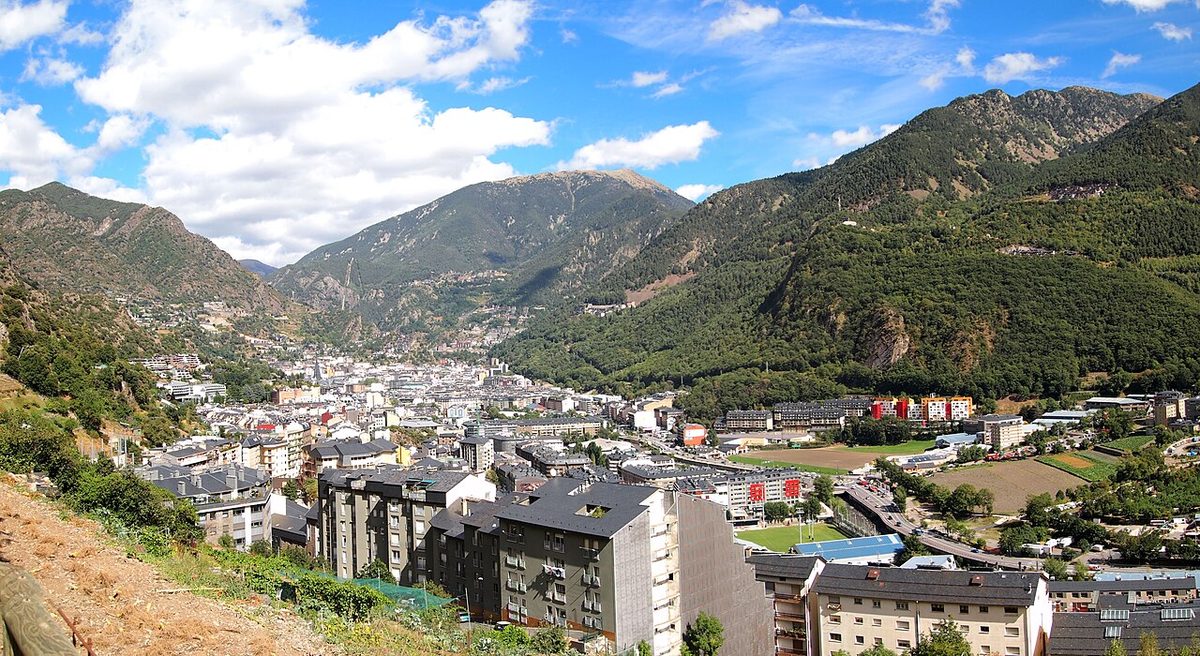
I have driven up the Valira del Nord more times than I can count, and the moment never wears off. You leave the last roundabout of the capital, climb eight kilometres of switchbacks past car showrooms and apartment blocks, and then the valley simply opens: hay meadows, slate roofs, a granite bell tower, mountains standing straight up off the back gardens. Andorra stops selling you things and starts being a country.
Ordino is the prettiest village in Andorra, and unusually for a claim like that, there is paperwork behind it. Sitting at 1,300 m about 15 minutes north of the capital, Ordino is a UNESCO Biosphere Reserve and a UN Tourism “Best Tourism Village”. This guide is for anyone deciding whether to give it an afternoon, a day or a whole base.
Last updated: September 2026. Museum prices, opening hours and bus details were checked against museus.ad, bus.ad, visitordino.com and ordinoarcalis.com this month. Hours in Andorra move with the season and the parish calendar, so check official sites before you travel.
Ordino at a glance
The quick version. Everything in this table gets unpacked, argued with and occasionally contradicted further down.
| Ordino | |
|---|---|
| What it is | Village and parish capital in the Valira del Nord, the northernmost of Andorra’s seven parishes |
| Altitude | 1,300 m (the parish climbs to 2,915 m at Pic de l’Estanyo) |
| Parish size | Around 85 km², roughly 5,700 residents across nine settlements |
| The official badges | UNESCO Biosphere Reserve (October 2020, the whole parish) and UN Tourism Best Tourism Village (2023) |
| Star attraction | Casa d’Areny-Plandolit, the manor house of Andorra’s only noble family — the country’s best museum |
| Best for | Slow half-days, Romanesque churches, family hikes, freeride skiing, mountain quiet |
| Not for | Shopping, nightlife, anyone who needs a lot of restaurants to choose from |
| Getting there | Bus L6 or L7 from Andorra la Vella, 15–20 min, around €2; free parking in the village |
| Time needed | Half a day for the village; two to three days for the whole valley |
| Ski area up the valley | Ordino Arcalis, 1,940–2,625 m, north-facing, the best snow in Andorra |
Is Ordino officially Andorra’s prettiest village?
Let me deal with this properly, because the internet is muddled about it and I would rather you heard the accurate version.
What is true: in October 2020 UNESCO added the entire parish of Ordino to its World Network of Biosphere Reserves — the only one in Andorra. Then in 2023, UN Tourism (the body formerly called the UNWTO) named Ordino one of its Best Tourism Villages, an award handed over at a gala in Samarkand in October that year. The citation praised the parish’s farming landscape, its two UNESCO-listed festival traditions and its approach to sustainable tourism. So there are two genuine, checkable international designations, and Ordino is the only place in the country holding either.
What is not true: Ordino is not a member of “Los Pueblos mas Bonitos de Espana” or “Les Plus Beaux Villages de France”. Those are national associations, open to Spanish and French municipalities respectively, and Andorra is neither. I have seen both claimed in English-language listicles and neither stands up. If you want the honest formulation, it is this: Ordino has no beauty-contest trophy, because no such contest exists for Andorran villages. What it has is two serious international recognitions for heritage and sustainability, plus the near-unanimous verdict of everyone who has driven both of Andorra’s valleys.
My own opinion, for what it is worth after a lot of driving: yes, Ordino is the prettiest. Pal and Llorts are arguably more perfectly preserved as single streets of stone, and there are corners of Canillo that will stop you dead. But Ordino combines a genuinely intact historic core with real civic life — a school run, a town hall, an auditorium, people buying bread — instead of feeling like a preserved specimen. That is the difference. For the full ranked field, my guide to Andorra’s villages takes all of them in turn.
The village itself: stone, slate and the Placa Major
Ordino’s historic core is small. You can walk it end to end in ten minutes, which is exactly why people underrate it and then spend two hours there anyway.
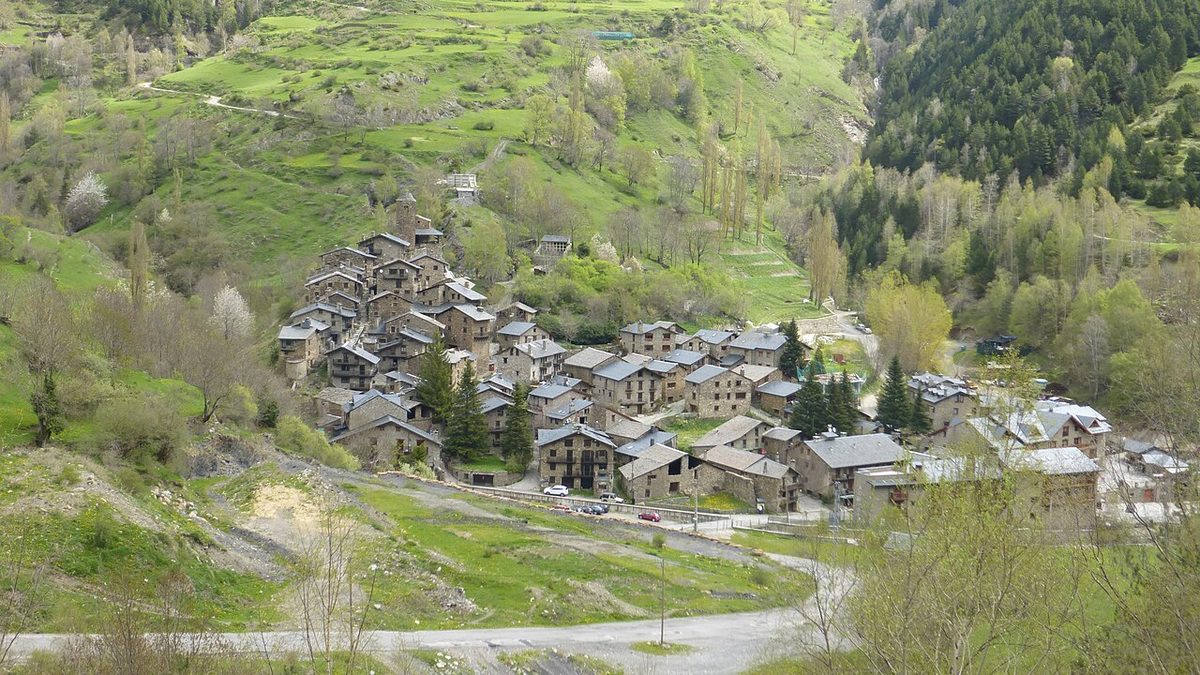
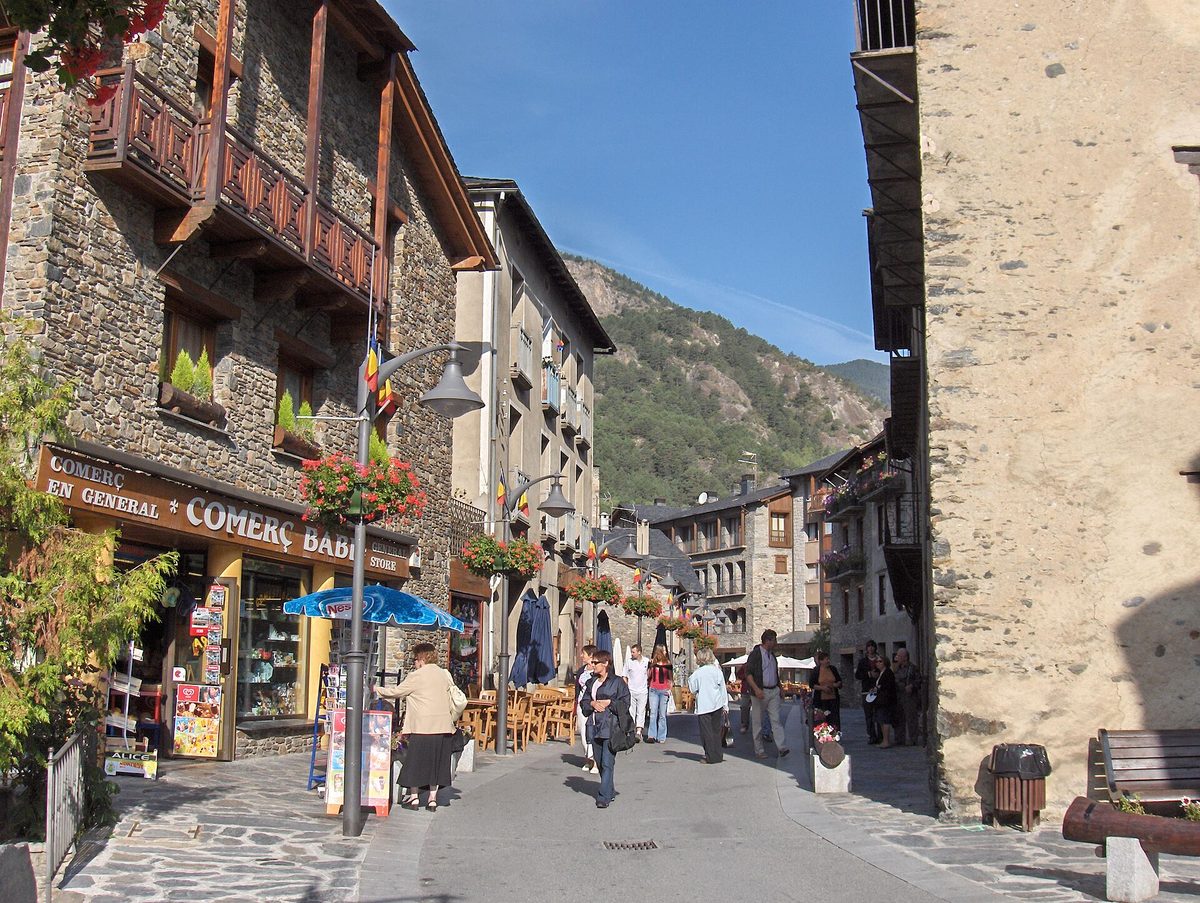
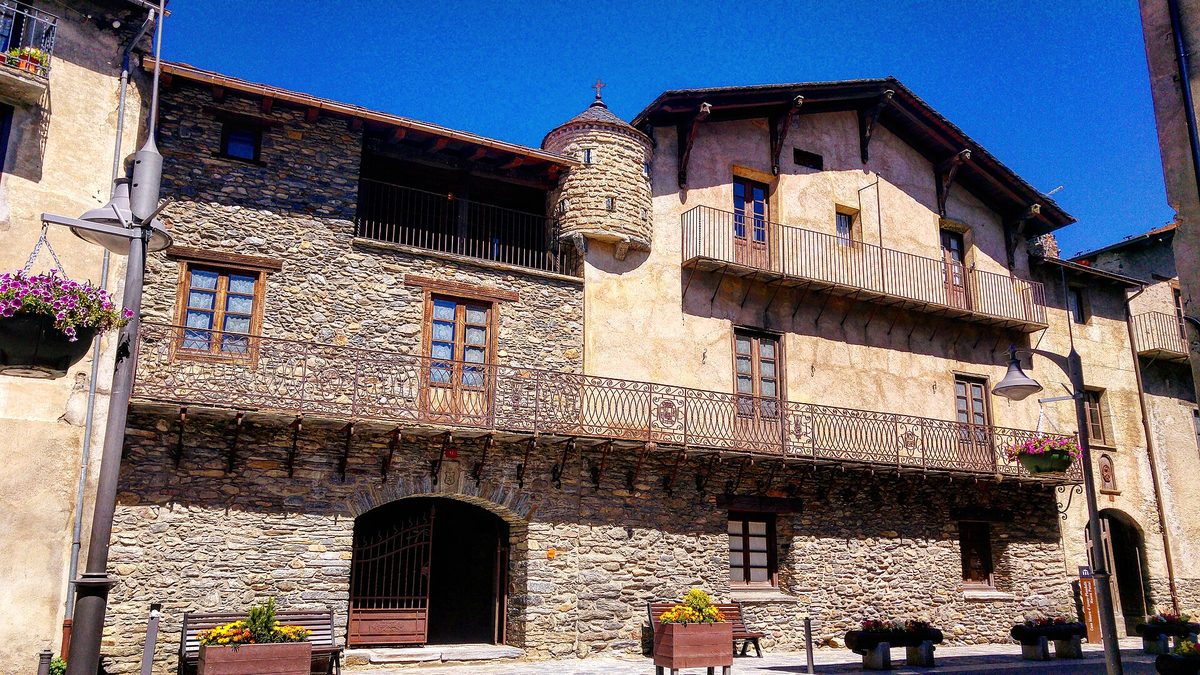
Start at the Placa Major, the square in front of the church, and work outwards along Carrer Major. The houses here are the real Pyrenean article: honey-grey stone, slate roofs weighing several tonnes each, wooden galleries facing south to dry tobacco and hay, and the occasional startling flourish of wrought iron on a balcony. That ironwork is not decoration for tourists. Ordino was Andorra’s iron town for three centuries, and the forges that made the country rich also made the railings on its front doors.
The streets are cobbled and steeply cambered, gardens spill over low walls, and there are no souvenir shops to speak of. There is a tourist office on Carrer Major, a handful of cafes, a couple of hotels and the National Auditorium. That is the sum of it. If you arrive expecting a compact old town on the scale of a Provencal hill village you will be briefly puzzled; give it twenty minutes and the scale starts working in its favour.
Sant Corneli i Sant Cebria
The parish church is first documented in 839 — one of the oldest written mentions of anything in Andorra — and the bulk of what you see is 12th and 13th century, with heavy later remodelling. The granite Romanesque bell tower is the landmark; inside, there are five baroque altarpieces from the 17th and 18th centuries and a Romanesque polychrome wooden bust of the Virgin, only 44 cm tall, one of the smallest such carvings in the country.
The detail I always point out to people: every iron grille and railing in the building came from the Ordino forges, made for the Rossell and Areny-Plandolit families. It is a village church that doubles as a catalogue of the local industry. Entry is free when the church is open, but like most Andorran village churches the doors are not reliably open outside summer. If it matters to you, ask at the tourist office rather than turning up and hoping.
Casa Rossell and the Manual Digest
A short walk from the square stands Casa Rossell, the other great Ordino manor house, and one of the more genuinely important buildings in Andorran history. It holds the original manuscript of the Manual Digest, written in 1748 by Antoni Fiter i Rossell and known ever since as “the Bible of Andorra” — the book that codified the country’s customs, government and famous maxims about staying out of everyone else’s wars.
Manage your expectations. Casa Rossell is not a walk-in museum in the way Casa d’Areny-Plandolit is; access is limited and not always available. Its dovecote and chapel are visible from the lane, and honestly that plus the story is enough for most visitors. Check with the tourist office if you want inside.
Ordino’s museums: the best in Andorra, and one very strange one
For a village of a few thousand people, Ordino has an absurd concentration of museums. Two are worth planning around.
Casa d’Areny-Plandolit
This is the single best museum in Andorra and I will happily argue about it. It is the manor house of the Areny-Plandolits, the only baronial family the country ever produced, and it survives essentially as they left it. The house dates from the 17th century, but most of what you walk through is mid-19th, the boom years funded by Don Guillem d’Areny-Plandolit, third Baron of Senaller and Gramenet, who made his money in iron and then spent a good deal of it here.
You get the noble hall, the dining rooms, the music room, the library, the chapel, the cellars, the defensive fittings, an armoury, a reconstructed dentist’s surgery and darkroom belonging to a later family member who was passionate about both, and a children’s toy room that quietly tells you everything about the gap between this family and everyone else in 19th-century Andorra. The house stayed lived-in until the 1950s and was bought by the Consell General in 1972.
Admission is €7, reduced €3.50, with free entry for children under 10 and a guided tour for €1.50 more if you book ahead. There is also a hologram show upstairs, “Don Guillem’s Dream”, which sounds like it should be dreadful and is in fact rather good — the last showing is an hour before closing, so do not arrive at the death. Allow an hour, an hour and a half if you take the guided visit.
The hours are the thing to watch. From January to May and October to December it opens 10am–2pm and 3pm–6pm and is closed on Sunday and Monday. In June and September it runs Tuesday to Friday 10–2 and 3–6, Saturday 10–2 and 3–8, Sunday mornings only. July and August are the same but with a 7pm weekday close. Mondays are always closed. This Monday-closed, Sunday-afternoon-closed pattern repeats across nearly every state museum in Andorra, so build your itinerary around it.
Museu de la Miniatura
And now for the odd one. The Miniature Museum, in the Edifici Maragda a couple of minutes from the church, displays fourteen works by the Ukrainian micro-sculptor Nikolai Siadristy, and you view every one of them through a microscope. A caravan of camels inside the eye of a needle. Sculptures in gold and platinum small enough to sit on a human hair. Each piece is a solved engineering problem as much as an artwork, and the fourteen took him eight years.
The museum also holds a collection of Chinese snuff bottles by Liu Shouben, Grand Master of Peking — 5 cm glass bottles painted from the inside with Andorran landscapes and, more recently, the Sagrada Familia and Chateau de Chambord — plus a run of Russian matryoshkas and papier-mache boxes.
Admission is €10, reduced €4.50 for groups and children aged 6 to 10, and it opens Monday to Saturday 9:30am–7pm and Sundays and holidays 9:30am–1:30pm. That is a lot of money for a small room, and I still say go. It takes about 40 minutes and it is the least generic thing you will do in Andorra. Children, in my experience, are completely gripped by it — the microscope does the work.
The Postal Museum, which no longer exists
Half the guides online still send you to Ordino’s Postal Museum, housed in the old Era del Raser barn. Do not go looking. The physical museum closed for good at the end of December 2023 and the whole philatelic collection moved online at museupostal.ad. It is a decent website — Andorra’s peculiar dual postal system, served by both the Spanish and French post offices, is genuinely interesting — but it is a website, not a stop on your walk.
Up the valley: Ordino’s hamlets, one by one
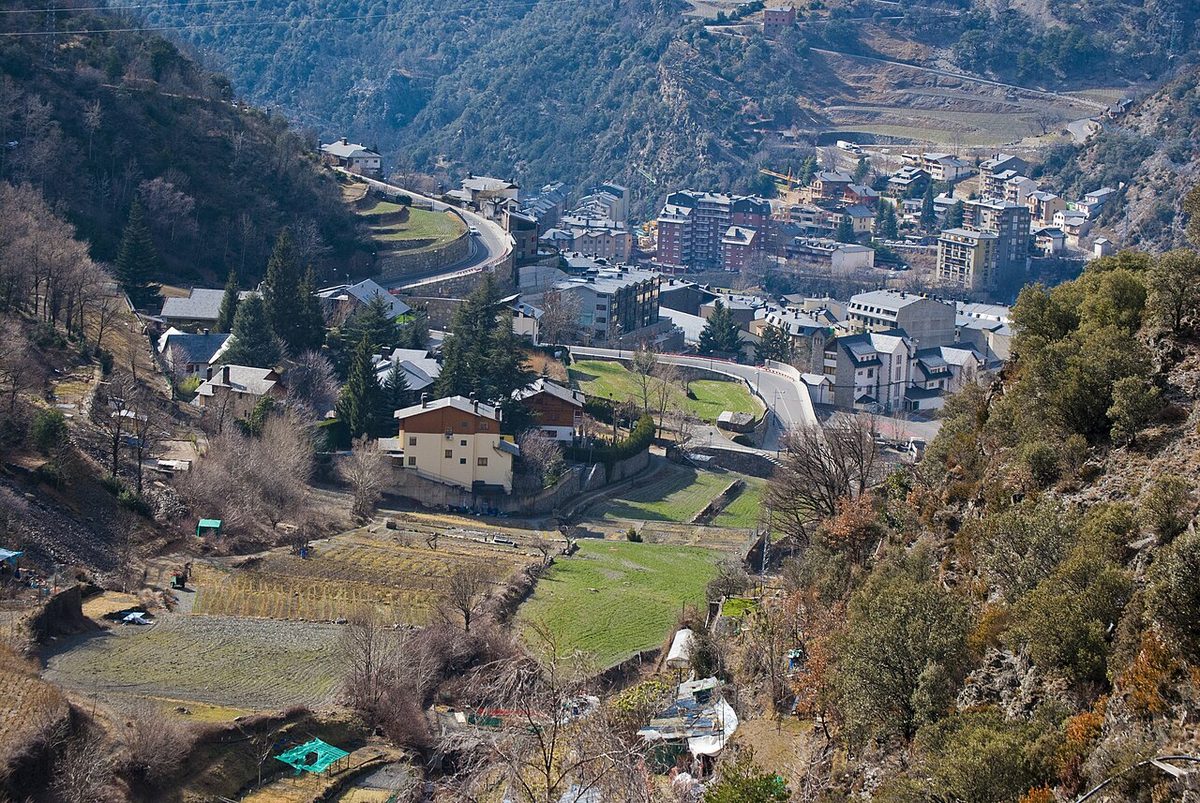
Here is the bit nobody tells you. The village of Ordino is the headline, but the parish is nine settlements strung up a single road, and the drive from the village to the top of the valley is only about twenty minutes. Doing that drive slowly, stopping wherever you feel like it, is the best half-day in northern Andorra.
Going north from Ordino on the CG-3, in order:
- Segudet — barely a hamlet, a few hundred metres uphill east of Ordino village, and the trailhead for the Casamanya ascent. Worth the five-minute detour for the view back down over Ordino’s rooftops.
- Ansalonga — small, working, unfussy. Most people drive through it without noticing.
- Sornas — a cluster of old houses on the eastern slope, off the main road.
- La Cortinada — home to Sant Marti de la Cortinada, a 12th-century Romanesque church with well-preserved wall paintings and, next door, a beautiful old dovecote and the Cal Pal sawmill. If Sant Corneli is shut, this is the church to try; it is the finer of the two artistically.
- Arans — tiny, with the small Romanesque church of Sant Cristofol and some of the best-preserved traditional houses in the valley.
- Llorts — my favourite. A single street of stone houses at around 1,400 m, hay meadows all around, and the old iron mine just above. It looks like a photograph of Andorra in 1930 and it is still lived in.
- El Serrat — the last village, at about 1,600 m, at the point where the road forks for Sorteny and Arcalis. A handful of hotels, a waterfall, and a distinctly end-of-the-road feeling.
None of these takes more than fifteen minutes to look at. All of them together, with a coffee somewhere in the middle, is a genuinely lovely morning and costs nothing, which puts it high on my list of free things to do in Andorra.
The Ruta del Ferro and the Llorts mine
If you do one walk in the parish, make it the Iron Route. It follows the old carriers’ path that hauled ore down from the Llorts mine to the forges of the valley, and it is one of the best-signed, most family-friendly walks in the country.
The route runs 4.2 km one way from the Llorts mine down to the church of Sant Marti de la Cortinada — call it 8.4 km if you walk it both ways, with only around 126 m of climb on the return. Reckon on two hours for the round trip at a gentle pace. The first half is downhill, the second half a slow uphill, and there is nothing technical about any of it.
Along the way you pass the mine itself, a 30-metre gallery driven into the hillside, plus interpretation boards and a series of iron sculptures by international artists set among the trees. The season is roughly June to October, sometimes stretching to May if the snow has gone. Do not attempt it in winter without proper gear; this is a shaded north-valley path and it ices.
The wider story is worth having in your head as you walk. Ordino’s forges — the Farga del Serrat and the Farga de l’Areny among them — made this the industrial centre of Andorra from the 16th century onwards. The money built the manor houses you looked at an hour earlier. If you want the full technical version, the Farga Rossell interpretation centre down in La Massana covers the process properly, though it has been closed for repairs at points recently, so check before you drive down.
Sorteny Valley Natural Park
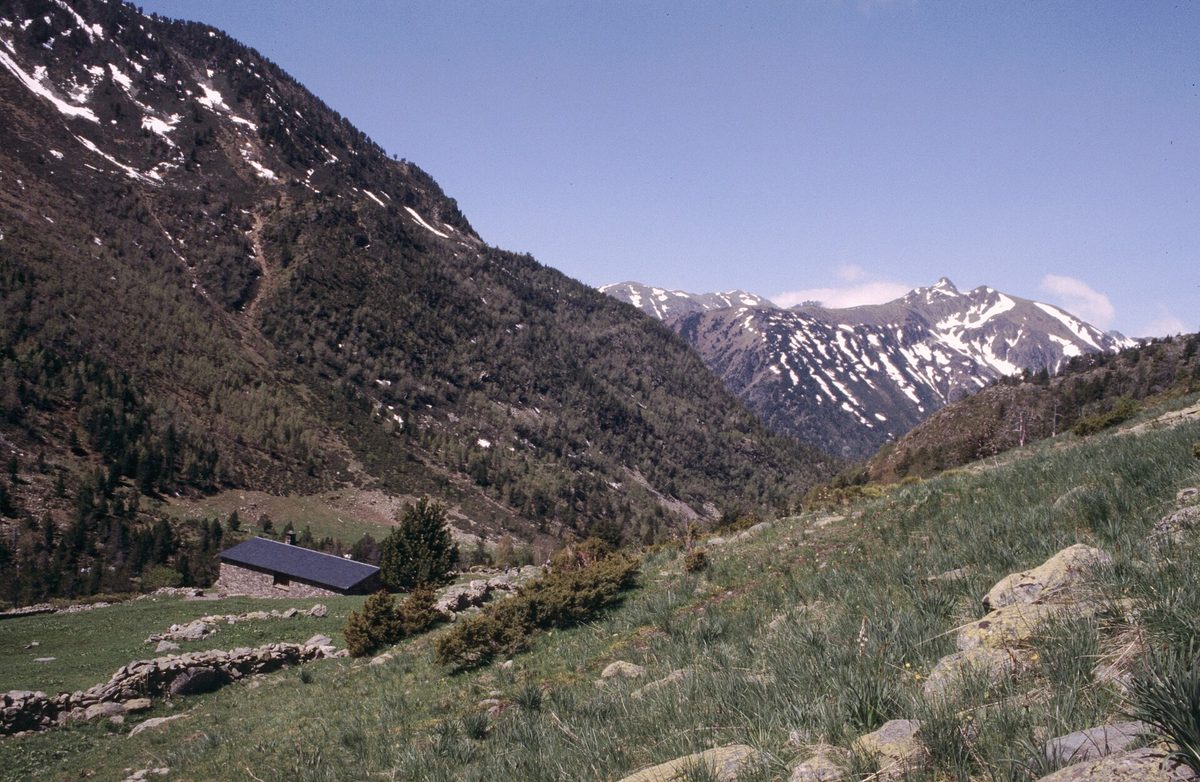
Turn right at El Serrat and you climb into the Vall de Sorteny, declared a natural park on 23 June 1999 and, botanically, the richest corner of the country. It covers about 1,080 hectares and forms the core of the Ordino Biosphere Reserve. The flower count is the reason to come: more than 750 plant species have been recorded here, around 60 of them with some degree of endemism, packed into one side valley.
There is a botanical garden of around 800 m² near the entrance, laid out by habitat with close to 300 labelled species, which is the fastest way I know to learn what you are looking at on the trails. The information hut opens seasonally — broadly mid-May to the end of August, with longer daily hours in July and August — and the park’s own season runs roughly June to November.
The Refugi de Sorteny sits at 1,965 m, about a 30-minute walk up from the Sorteny car park. It has been renovated and extended and now runs as a staffed refuge with a restaurant, which makes it a rare thing in Andorra: a high-mountain lunch you can reach with small children. From there the valley climbs towards Pic de l’Estanyo at 2,915 m for anyone who wants a proper day out.
Go in late June or July if flowers are the point. Go in late September if colour is. My longer write-up of Sorteny Valley has the trail detail; this is the summary version.
Ordino Arcalis: the wildest snow in Andorra
Search Ordino, Andorra online and you get two different places wearing the same name. At the very top of the valley, 25 minutes’ drive from the village, sits the ski area that shares the parish name. Two naming notes before we start, because both trip people up. It is Ordino Arcalis, not “Vallnord” — that brand was folded away after the resort joined Grandvalira Resorts in 2018, and Pal Arinsal followed in 2022/23, so anything still calling it Vallnord is out of date. And it is not part of the linked Grandvalira ski circuit: it is a separate mountain, a separate drive, sharing only a season pass.
Winter
Arcalis was built in 1983 by the people of Ordino parish and it still feels like their mountain. It runs from 1,940 m to 2,625 m, has around 30.5 km of pistes across 442 hectares, 16 lifts including a 2019 D-Line cable car, and roughly 1,500 parking spaces. Those are not big numbers. That is not the point.
The point is the aspect. Arcalis faces north, which in the Pyrenees is everything — it holds cold snow when south-facing bowls are turning to soup, it is usually the first Andorran resort to open and among the last to close, and it has the best snow record in the country. It is also one of Europe’s serious freeride venues, with 21 off-piste zones and around 120 marked itineraries graded across three difficulty levels, and it has been a Freeride World Tour stop since 2015. Strong skiers who find Andorra’s skiing too tame usually have not been here.
For everyone else, the honest picture: Arcalis has the longest green run in the Pyrenees and a well-regarded children’s school, so beginners and families are properly looked after, but 30 km of piste is a two-day mountain rather than a week. Most people pair it with Grandvalira or Pal Arinsal on an Andorra Pass. In winter there is a free ski bus up from the parish, which is a rather good reason to stay in Ordino village. My full write-up of Ordino Arcalis goes into lift-by-lift detail.
Summer, and the business of stars
In summer the road stays open to La Coma and the mountain becomes a hiking and biking area. Two things are worth the drive.
The first is the Tristaina lakes, a circuit of three glacial tarns at around 2,300 m. The standard loop is about 4.4 km with roughly 210 m of climb and takes two and a half hours at a relaxed pace. Go before 9am in July and August or you will not park at La Coma, and the water is a mirror early anyway.
The second is the Tristaina Solar Viewpoint — a suspended metal ring 25 metres across, built as a giant sundial, perched on the summit of Peyreguils at 2,701 m, a few metres from the French border. You can walk up to it year-round, but when the resort is running you can shortcut most of the climb using the Tristaina gondola and the Creussans chairlift. Check the lift timetable first; it is a long, exposed walk if you misjudge it.
Now, the stargazing. You will see Ordino described online as a Starlight destination. Careful: Andorra’s official Starlight Reserve and Tourist Destination certification, awarded in 2023, belongs to Comapedrosa natural park in the neighbouring parish of La Massana, not to Ordino. What is true is that the Ordino valley has excellent dark skies and the resort itself recommends the Coll d’Ordino and parts of Sorteny as two of the best naked-eye viewing points in the country. Guided night walks and telescope sessions run through summer, mostly around the August Perseids. Bring a red torch, warm layers even in August, and something to sit on.
The Coll d’Ordino
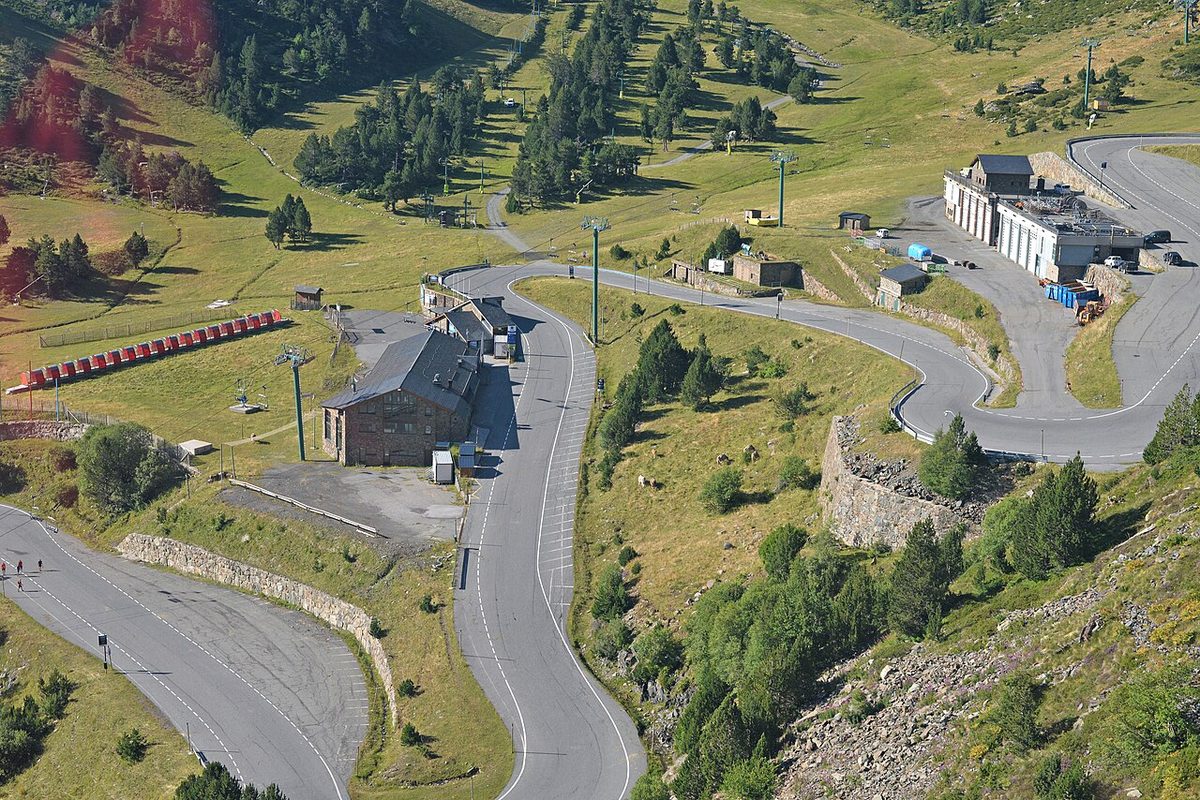
The Coll d’Ordino is the mountain road that climbs east out of the village, crosses a 1,980 m pass and drops down the far side into Canillo. It is 8.9 km and about 497 m of climb from the Canillo side at an average gradient of 5.6%, with six hairpins stacked into the first four kilometres, which is why it has featured in the Vuelta a Espana and the Tour de France.
You do not need to be a cyclist to enjoy it. It is a beautiful twenty-minute drive with pull-ins for photographs, and it is far and away the best short mountain road in Andorra for a first-time visitor. The Roc del Quer viewpoint, with its cantilevered walkway hanging over the valley, sits just off the eastern side of the climb and now charges an entry fee. The pass road usually closes or requires winter equipment between roughly November and April, so treat it as a summer and autumn route and read up on driving in Andorra before you commit in shoulder season. There is also a small parish bus up to the Coll in summer, which is a bargain at the parish fare.
Festivals, falles and the classical music habit
Ordino punches spectacularly above its weight culturally, and the reason is a building: the Auditori Nacional d’Andorra, the national concert hall, which sits in this village of a few thousand people rather than in the capital.
The tradition began with the International Narciso Yepes Festival, founded in 1983 by the Spanish guitarist himself and held at the auditorium every October for decades. Today the parish’s classical programming runs under two banners and it is worth knowing which is which. Ordino Classic is the parish’s own autumn and winter concert series, launched in 2022, spread across the auditorium and other venues. ClassicAnd is the national festival, shared between Ordino and Andorra la Vella, which ran its fourth edition from 29 May to 7 June 2026 with a line-up that included Elina Garanca and the Nacho Duato company. Programmes and dates shift every year — check the auditorium listings before you plan around a concert.
The other date to know is 28 June. Most of Andorra burns its falles on the night of 23 June for Sant Joan; Ordino does it on the eve of Sant Pere instead. Young people build a falla, set it alight and spin it overhead until it becomes a wheel of fire. It is loud, ancient and completely unstaged, and since 2015 it has been on UNESCO’s Intangible Cultural Heritage list as part of the “summer solstice fire festivals in the Pyrenees”. If your dates are flexible in late June, go.
Two more local traditions are worth catching if the calendar lines up: the Roser d’Ordino rose festival in July, and the bagpipe gathering on the first weekend of August, when the streets fill with buners in honour of the parish legend about a bagpiper who saw off a pack of wolves by playing at them.
Planning a visit to Ordino
The practical half. None of this is complicated, but a few details save you real time.
Getting there from Andorra la Vella
Two national bus lines serve the parish. L6 runs Andorra la Vella – Ordino – La Cortinada; L7 runs Andorra la Vella – La Massana – Ordino. Either takes about 15 to 20 minutes from the capital and costs around €2 one way at the time of writing. L6 departs the capital roughly every 30 minutes from just before 7am until about 10pm on weekdays, with a similar spread at weekends, and the last bus back down leaves Ordino in the region of 10pm midweek. That is unusually generous for a mountain village and it means you genuinely do not need a car for the village itself.
Once you are in the parish, the local comu-run buses are almost free — around €0.20 a trip — with one loop running north to El Serrat and Sorteny and another climbing to the Coll d’Ordino. In winter there is a free bus from the parish up to the Ordino Arcalis ski area. The general picture of getting around Andorra applies here: the buses are cheap, frequent and better than their reputation.
Driving is straightforward. Take the CG-3 north from Andorra la Vella through La Massana; it is about eight kilometres and fifteen minutes outside rush hour. There is free parking on the edge of the village, including a large car park below the main square, and I have never failed to find a space outside August. Do not try to park on Carrer Major itself. In winter, winter tyres or chains are a legal requirement on Andorran roads when conditions demand, and the Arcalis road in particular takes it seriously.
How long to spend
Be honest with yourself about what you want. For the village alone — a wander, the church, Casa d’Areny-Plandolit, the Miniature Museum and a coffee — give it half a day. Four hours is comfortable; six is generous.
For the village plus the valley — the hamlets, the Iron Route, an afternoon in Sorteny — give it a full day, ideally two. For anything involving Arcalis, Tristaina and a proper hike, you are looking at three days and you will not be bored. Ordino is also the most sensible single stop if you only have one day in the country and want to see something other than shops.
Staying in Ordino or in the capital?
This is the question I get asked most and the answer genuinely depends on you.
Stay in Ordino if you are here for mountains, quiet, skiing at Arcalis, or you have a car and want to wake up somewhere beautiful. The village has a small, good range of hotels, including places with spas, and El Serrat further up is the choice for first-lifts skiers. Evenings are peaceful to the point of silent — there is no nightlife and only a handful of restaurants, several of which close early or shut on quiet weeknights out of season.
Stay in Andorra la Vella if you want restaurant choice, shopping, the Caldea spa, easy bus links to every valley, and a wider price range. It is fifteen minutes away. Plenty of people base themselves in the capital and day-trip to Ordino, and that is a perfectly good plan.
My own preference, for a trip of three days or more, is to split: two nights in the capital, two up here. My guide to where to stay in Andorra compares all seven parishes properly.
Winter or summer?
Winter (December to early April) is about Arcalis, snowshoeing, and a village that looks extraordinary under snow with the slate roofs loaded. The trade-off: the high roads shut, Sorteny is inaccessible without ski-touring gear, the Iron Route is out, and museum hours contract.
Summer (late June to September) opens everything — the flowers in Sorteny, Tristaina, the Coll d’Ordino, the whole hiking network. July and August bring crowds to the car parks but the village itself never feels overwhelmed. Almost every summer visitor I have sent here has come back saying they wished they had given it another day; see also summer in Andorra.
Autumn is the underrated one. Late September and October give you the larches turning, mushroom season, empty trails and hotel prices that have come off their peak. If your dates are open, that is when I would come; the best time to visit Andorra guide runs through the seasons in full.
Eating, and what things cost
Ordino has a small but decent food scene built around bordes — old stone barns converted into restaurants with a wood grill at the back. Expect grilled mountain meats, trinxat, escudella in winter and charcuterie boards that arrive too big. Prices are broadly Spanish rather than French: a lunchtime menu del dia often lands somewhere around €15–20, dinner a la carte a good deal more. Book at weekends and in ski season, because there simply are not many tables. My overview of Andorran food explains what to order.
Budget roughly €17 per adult if you do both museums, nothing at all if you stick to the churches, the streets, the hamlets and the Iron Route. It is one of the cheapest genuinely good days out in the Pyrenees.
Ordino with children
Very good, with caveats. The Iron Route is flat, short, full of sculptures and crosses a river, which is most of what a seven-year-old needs. The Miniature Museum is a hit because microscopes are inherently exciting. Sorteny’s refuge gives you a mountain lunch without a mountain walk. Casa d’Areny-Plandolit has a children’s corner and free entry for under-10s, though the hologram show works better for adults. The caveat is evenings: there is nothing for teenagers to do after dark. For the wider picture see Andorra with kids.
Frequently asked questions
What is Ordino known for?
Ordino, Andorra is known as Andorra’s best-preserved and prettiest village, and as the country’s cultural centre. It holds two international designations: UNESCO Biosphere Reserve status for the whole parish since October 2020, and a UN Tourism Best Tourism Village award from 2023. It is also known for Casa d’Areny-Plandolit, the National Auditorium and the Ordino Arcalis ski area.
Is Ordino worth visiting?
Yes, and it is the single easiest correction to make to a shopping-focused Andorra trip. Half a day covers the village and its two museums; a full day adds the hamlets and a walk. If you only visit one place in Andorra beyond the capital, make it this one — nowhere else combines intact traditional architecture with this much to actually do.
How do you get from Andorra la Vella to Ordino?
Take national bus line L6 or L7 from Andorra la Vella. The trip takes about 15 to 20 minutes and costs around €2 one way at the time of writing, with departures roughly every 30 minutes from early morning until about 10pm. By car it is eight kilometres north on the CG-3 through La Massana, around fifteen minutes, with free parking below the village centre.
How long do you need in Ordino?
Half a day for the village core, its church and both museums. A full day if you want to add the hamlets of La Cortinada, Llorts and El Serrat, or walk the Ruta del Ferro. Two to three days if you are skiing at Ordino Arcalis, hiking in Sorteny or doing the Tristaina lakes circuit. Most people underestimate it and wish they had stayed longer.
Is Ordino officially the most beautiful village in Andorra?
There is no official Andorran beauty contest, so no village holds that exact title. What Ordino does hold is UNESCO Biosphere Reserve status and a 2023 UN Tourism Best Tourism Village award, both firsts for Andorra. It is not a member of the Spanish or French “most beautiful villages” associations, despite what some English-language guides claim.
Is it better to stay in Ordino or Andorra la Vella?
Stay in Ordino for mountains, quiet, skiing at Arcalis and beautiful mornings; accept that there is no nightlife and few restaurants. Stay in Andorra la Vella for choice, shopping, Caldea and bus links to every valley. They are only fifteen minutes apart, so day-tripping in either direction is easy. For longer trips, splitting your nights works well.
What is there to do in Ordino in winter?
Ski or snowboard at Ordino Arcalis, which has the best snow record in Andorra and serious freeride terrain, reached by a free parish bus. Snowshoe or ski-tour in the upper valley. Visit Casa d’Areny-Plandolit and the Miniature Museum, both open year-round on reduced winter hours. The Coll d’Ordino road and Sorteny are generally out of reach from November to April.
Can you visit Ordino as a day trip from Barcelona?
Technically yes, but I would not. Barcelona to Andorra is around three hours each way by road, which leaves you two or three hours in the parish after transfers — enough for the square and one museum, not enough for the valley. If Ordino is the reason you are coming, stay at least one night in Andorra.
The honest verdict
Ordino is the answer to the complaint people make about Andorra — that it is a duty-free strip with mountains behind it. Drive fifteen minutes north of that strip and you find a working village at 1,300 m that has kept its stone, its church, its festivals and its farms, and has somehow also acquired the national concert hall, the country’s best museum, a microscope full of camels, a UNESCO biosphere designation and one of the finest freeride mountains in the Pyrenees. That is a lot for a place you can walk across in ten minutes.
Give it more time than you think you need. Take the valley road all the way to El Serrat. And if you can possibly time it for the falles on the night of 28 June, do — it is the least touristy thing I have ever watched in a tourist country.
To carry on planning: the pillar guide to Andorra’s villages puts Ordino in context against the other 43, and Canillo makes the natural pairing over the Coll d’Ordino. For the valley in detail, read Sorteny Valley Natural Park, Ordino Arcalis and the Tristaina lakes. If you are building a wider trip, start with hiking in Andorra and whether Andorra is worth visiting at all — spoiler: from up here, obviously.
Photo credits
All photographs are from Wikimedia Commons under their stated licences, with thanks to the photographers: