I have a soft spot for El Tarter, and it took me a while to work out why. It isn’t the prettiest base in Grandvalira, it isn’t the liveliest, and it isn’t the one with the smartest hotels. What it is, quietly, is the one I keep recommending to friends who want the whole mountain without the whole circus. You ski off exactly the same lifts as everyone paying more up the road in Soldeu, you sleep somewhere calmer and cheaper, and you get Grandvalira’s best snowpark and a genuinely good children’s setup thrown in. That combination is easy to underrate on paper and hard to argue with once you’re there.
El Tarter is a valley village at around 1,710 m in central Grandvalira, sharing Soldeu’s mountainside and reached by gondola. It’s quieter and better value than Soldeu, with the same access to the whole 210 km domain. It suits families, mixed groups and park riders best: serious skiing by day, calm evenings after.
Last updated: July 2026. Prices and dates reference the 2025/26 season; Grandvalira publishes 2026/27 rates and an opening date in autumn, so treat the numbers here as close guides and check the official sites before you book.
El Tarter at a glance
Here’s the shape of the place before the detail. If you read two sections, make it this one and the honest El-Tarter-versus-Soldeu bit further down.
| El Tarter | |
|---|---|
| Village altitude | ~1,710 m — the valley floor of central Grandvalira, and the resort’s lowest base |
| Ski area | Grandvalira (210 km, 7 linked sectors); tops out at 2,640 m |
| Access | El Tarter gondola from the valley base straight up to the Soldeu/El Tarter mountainside |
| Best for | Families, mixed groups, value-seekers who still want Soldeu’s skiing, park riders |
| Not for | Nightlife-first trips, and anyone set on true ski-in/ski-out luxury |
| Signature features | Grandvalira’s flagship snowpark; Bababoom Circus kids’ circuit; the Àliga World Cup piste; L’Abarset après |
| Getting there | Barcelona ~3 hr; Toulouse ~3 hr by road; no airport or railway in Andorra |
| Season | Early December to early April; lifts roughly 09:00–17:00 |
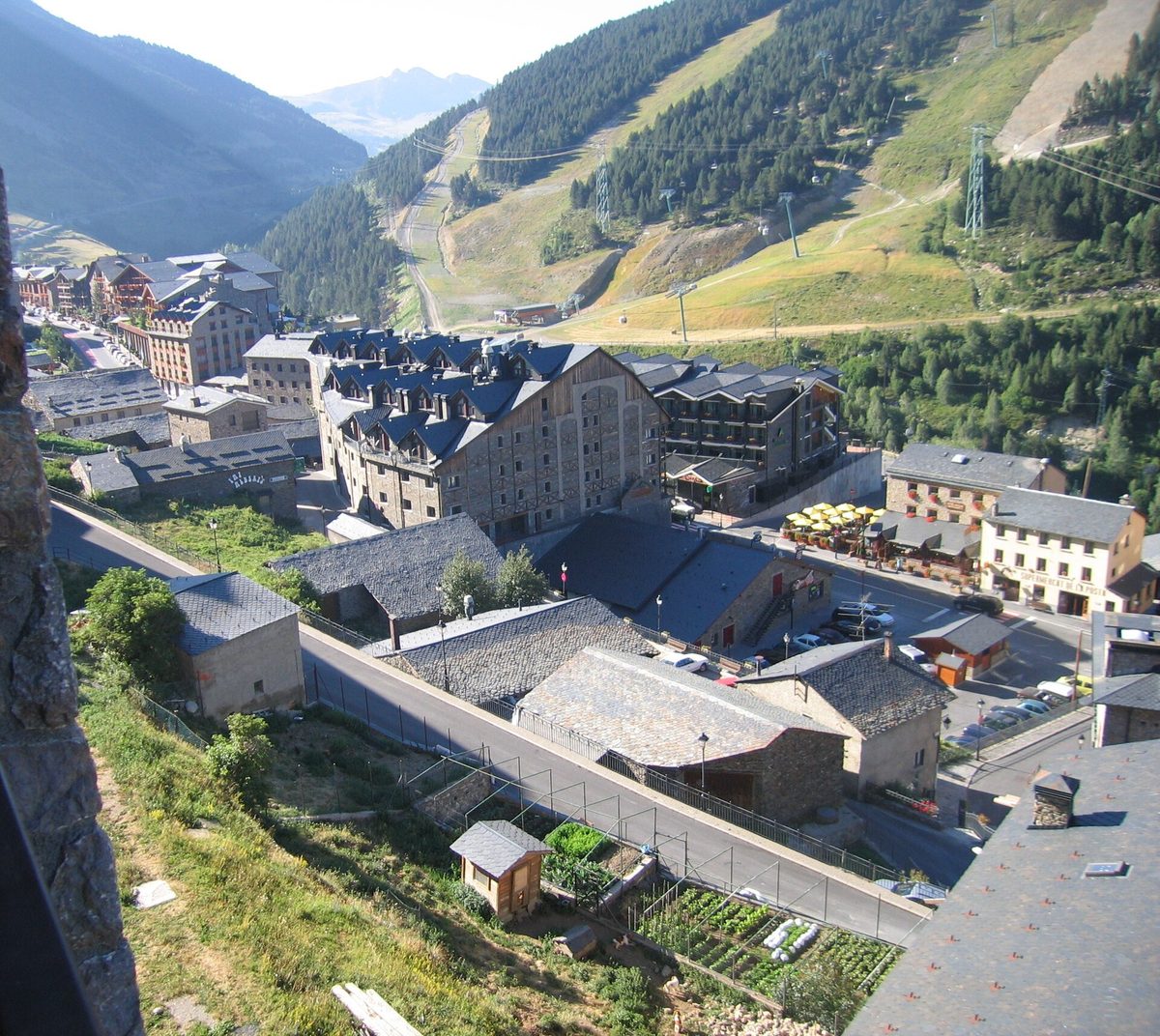
Where El Tarter sits, and the gondola that makes it work
Picture central Grandvalira as one long mountainside dropping into the Valira d’Orient valley. Soldeu sits partway up the slope at around 1,800 m; El Tarter sits a couple of kilometres down the valley at about 1,710 m, on the road between Canillo and Soldeu. That small difference in position is the whole story of the place, and it explains both what El Tarter gives you and what it doesn’t.
Because the village is down on the valley floor rather than perched on the piste, you get onto the snow by riding the El Tarter gondola up from the base station. It’s a quick, modern lift, and it deposits you high on the same mountainside that Soldeu’s own gondola serves — the Espiolets and Tosa area where the ski school runs and where the sector links fan out. In practice that means the moment you’re off the gondola, you have precisely the same mountain in front of you as someone who paid more to sleep in Soldeu. You have not bought a smaller ski area by choosing El Tarter. You’ve bought a different bedroom.
The trade-off is honesty about ski-in/ski-out, which I’ll keep returning to because the brochures fudge it. El Tarter is a gondola base, not a doorstep-snow base. You will ride up in the morning and, more often than not, ride the gondola back down at the end of the day rather than skiing to your front door. For most people that’s a complete non-issue — the gondola is fast and the base has a big, well-signposted car park right in front of it. But if your dream is clipping in at the hotel step, that’s a Soldeu or Pas de la Casa fantasy, not an El Tarter one. For the full picture of how the seven sectors connect, it’s worth reading this alongside the overview of skiing in Andorra; El Tarter is one well-placed chapter of a much bigger mountain.
The skiing: same 210 km, sensibly placed
Here’s the line that should anchor your whole decision. El Tarter is not a self-contained little hill. It’s an access point onto Grandvalira, the largest ski area in the Pyrenees — more than 210 km of pistes across seven linked sectors, rising from the valley to a top lift at 2,640 m. One pass opens the lot, and from the top of the El Tarter gondola you can ski the length of the domain: west toward Canillo and Encamp, or east through Soldeu and on to Grau Roig and Pas de la Casa, without ever taking the same run twice.
What sits immediately above El Tarter is some of the most enjoyable intermediate terrain in the country. The signature run is the Àliga, a long, fast red that drops back toward the El Tarter base — a properly satisfying cruiser and, since 2013, a FIS-homologated downhill course. It shared the billing with Soldeu’s Avet when the resort hosted the Alpine Ski World Cup Finals in 2019 and again in 2023, so when you point your skis down it you’re skiing a genuine World Cup piste, even if you’re doing it at a gentle Tuesday-morning pace. Around it, the mountainside is a spread of blues and confidence-building reds through the treeline, which is exactly the terrain that makes Grandvalira such a strong intermediate mountain.
Let me break it down by level, because “good skiing” means different things depending on where you are.
Beginners
El Tarter is a genuinely good place to learn, helped by a dedicated snow garden and beginner plateau up top and the same well-regarded, English-heavy Grandvalira ski school that made Andorra a British beginner favourite. The gentle greens and wide blues are separated from the faster cross-resort traffic, so nervous first-timers aren’t dodging people flying past at speed. My one structural tip stands for any Andorra base: book school for the first morning rather than mid-week — an early lesson sets up the entire holiday. Just be clear-eyed that a total beginner will ride the gondola up and down each day rather than skiing home, which is fine but worth knowing.
Intermediates
This is your mountain, and El Tarter is a smart place to launch from. The reds and blues rolling off the Soldeu/El Tarter ridge are long, wide and beautifully groomed, and from the top you can spend a whole day working east through Soldeu into Grau Roig, lunch somewhere in the middle, and roll back down the Àliga feeling like you earned the evening. A fit intermediate can cover a huge amount of the domain in a day from here. It’s some of the best cruising mileage in the Pyrenees, and the placement in the centre of the area means you’re never starting a cross-resort day from an awkward corner.
Advanced and expert skiers
The honest bit. If your holiday lives and dies on marked black runs, Grandvalira as a whole will keep you happy for a few days rather than a week — black terrain is only around 13% of the map. The real reward for strong skiers is off-piste, and El Tarter is well placed for it: the lift-served sidecountry under Pic d’Encampadana above the sector is some of the better freeride terrain in the domain, and the resort maintains signposted freeride circuits adapted to different levels. Your multi-day pass also covers a day at the steeper, wilder Arinsal and at Ordino-Arcalís up the road, which is where I’d send any expert getting restless after two days on the groomers.
Snowboarders and park riders
This is where El Tarter pulls decisively ahead of its neighbours, and it deserves its own section below — because the sector holds Grandvalira’s flagship snowpark, and if freestyle is your thing, sleeping here is close to a cheat code.

The snowpark, and L’Abarset après
El Tarter’s snowpark is the freestyle heart of Grandvalira and, by the resort’s own account, has the longest line of modules in the Pyrenees and one of the longest in Europe — commonly cited at around 1.3 km of features. That means multiple lines graded for different abilities: mellow rollers and small boxes for improvers working up their nerve, and progressively bigger kickers and rails for riders who know what they’re doing, up to genuinely pro-level jumps. If you or your kids are into park riding, basing in El Tarter puts you at the bottom of the lift that serves it, which over a week saves a lot of traversing from elsewhere in the domain. It’s the single most persuasive reason to pick this sector over Soldeu.
Then there’s L’Abarset, which is the après institution people mean when they say El Tarter has a scene despite being the quiet base. It’s an open-air complex up on the mountain that starts the day gently as a breakfast and lunch café and then, by mid-afternoon, flips into a DJ-driven party — proper decks, live acts, the works — before winding down in time for you to ski or ride the gondola back to a calm evening in the village. That’s the clever thing about El Tarter’s rhythm: the big party happens on the mountain in daylight, not in the streets at 2 a.m. You can have the boogie-in-your-ski-boots afternoon at L’Abarset and still get a full night’s sleep, which is a combination Pas de la Casa simply cannot offer. If loud, late, in-town nightlife is the point of your trip, you want Pas de la Casa instead, and I’d send you there happily.
El Tarter for families
If I had to pick the single group El Tarter suits best, it’s families — and it earns that reputation with more than just “quiet evenings.” The sector runs the Bababoom Circus, a themed children’s circuit up the mountain designed purely for small skiers: gentle, playful terrain dotted with features and surprises that turn learning into a game rather than a chore. Paired with the beginner snow garden and the Grandvalira ski school’s age-banded classes — with a nursery for the very youngest at several sectors — it means you can genuinely occupy children of different ages and abilities all day.
The accommodation stock helps too. El Tarter has a big supply of self-catering apartments, which for a family is often both cheaper and more practical than hotel rooms — you get space, a kitchen, and somewhere to dry sodden gloves. Add the calm evenings, the big base car park if you’ve driven, and the on-mountain daytime après at L’Abarset for the parents, and it’s easy to see why so many families quietly return here year after year. For how the ski-school age bands work and what else there is to keep children busy off the snow, the dedicated guide to Andorra with kids goes deeper than I can here.
Where to stay in El Tarter
El Tarter is small, so “where to stay” is really a question of how much comfort and polish you want, and whether you lean toward a hotel or a self-catering apartment. Broadly, the village splits into two categories.
Hotels and chalet-hotels. There’s a decent spread here, from tour-operator chalet-hotels popular with British families to more comfortable options with a spa. The best-known upmarket name on this mountainside is the Sport Hotel group’s cluster over in Soldeu, but El Tarter itself has solid, well-run mid-range places that put you a short walk or shuttle from the gondola base. This is the choice if you want half-board simplicity and someone else doing the cooking.
Self-catering apartments. This is El Tarter’s strong suit and a big part of its value reputation. There’s a large supply of apartments, which suits families, independent-minded travellers and groups splitting costs — especially paired with a supermarket shop. The trade-off is that you’re catering for yourself, but for many people that flexibility is the point.
Wherever you land, the practical note is the same: you’re basing near the gondola, not on the piste, so proximity to that base station (or to a reliable ski-bus stop) is what matters, not slope access. For how El Tarter stacks up against Soldeu, Canillo, Encamp and Pas de la Casa in detail, the full comparison lives in the guide to where to stay in Andorra.
Eating in El Tarter
For a small village, El Tarter eats well, and in a distinctly Andorran way. The local cooking is mountain-Catalan: grilled meats over wood, hearty stews, and a surprisingly serious approach to wine, often served in stone-walled rooms that feel a world away from the concrete of the higher purpose-built resorts. There’s a handful of good restaurants clustered in and around the village, the kind of places where a long, unhurried menú del día is the correct way to spend a rest-day lunch. Up on the mountain you’re spoiled for choice across the wider domain — Grandvalira claims more than 60 eating spots — with the Soldeu and Grau Roig destinations both an easy ski away.
The pattern that works for most people staying here: breakfast in your apartment or hotel, a quick mountain lunch (or the daytime party-and-food combination at L’Abarset), and then a proper sit-down dinner down in the village in the evening. It’s a calmer, more grown-up food rhythm than the chips-and-pints churn of a party resort, and it’s a big part of why El Tarter feels like a place to recover as much as to ride.
Getting to El Tarter
The thing to know first: there’s no airport and no railway inside Andorra, so however you come, the last leg is by road. That sounds like a problem and is really just a fact to plan around, because El Tarter sits right on the main valley road through central Grandvalira and is easy to reach once you’re in the country.
Most visitors fly into Barcelona (El Prat, roughly 210 km away) or Toulouse (Blagnac, around 200 km), then travel about three hours by road. Direct coaches run from both airports to Andorra, and onward local buses run the main valley constantly, stopping at the villages. If you drive, you get flexibility between sectors and the option of a duty-free supermarket run, but from November to April you’re legally required to carry winter tyres or chains, and the mountain approaches demand respect in a storm. Coming from the Spanish side you’ll reach Encamp and Canillo before El Tarter; from the French side you come over the Envalira pass through Pas de la Casa first. The full route-by-route breakdown, including the Barcelona and Toulouse bus options, is in the guide to how to get to Andorra.
El Tarter vs Soldeu: the honest comparison
This is the decision most people arrive actually trying to make, so let me be useful rather than diplomatic. El Tarter and Soldeu share the same mountainside and the same lifts — once you’re up top, you cannot tell which village you slept in. So you are not choosing a ski area. You’re choosing an atmosphere, a price bracket, and a style of access. Here’s the straight version.
Choose Soldeu if you want to be higher up the slope with more genuine ski-in/ski-out hotels, a livelier in-village evening scene with more bars and a bit of buzz, the smartest spa hotels on the mountain, and you don’t mind paying a premium for that polish and convenience. Soldeu is the default recommendation for first-timers who want everything in one walkable, comfortable package, and it’s the one I point most mixed groups toward when budget isn’t the deciding factor. The full case for it is in the guide to Soldeu.
Choose El Tarter if you want the same skiing for quieter evenings and better value, you’re travelling as a family or a mixed group who’d rather not be kept awake, you want the flagship snowpark and the Bababoom kids’ circuit on your doorstep, and you’re happy to ride a gondola up and down rather than ski to the hotel step. El Tarter is the sensible all-rounder — it does the practical things well and skips the premium you pay in Soldeu for a piste-side pillow.
The one real functional difference to weigh is that ski-in/ski-out gap. Soldeu genuinely offers it; El Tarter is a gondola base. If that matters to you — small children too tired to walk, a strong preference for clicking straight into a home run — it tilts things toward Soldeu. If it doesn’t (and for most people it honestly doesn’t), El Tarter gives you a near-identical mountain for less money and a better night’s sleep. That’s the whole trade, and there’s no wrong answer.

What a trip to El Tarter costs
El Tarter is where Andorra’s “cheaper than the Alps” reputation holds up well — not because the skiing is second-rate (it plainly isn’t, it’s the same snow as Soldeu) but because the accommodation skews toward good-value apartments, the village is calmer, and you’re not paying the Soldeu piste-side premium. A like-for-like week here typically lands below a comparable French or Swiss resort, with the gap widest on lodging, food and lessons.
Lift passes are the one cost that’s identical wherever you sleep in Grandvalira, because it’s all one ticket. The pricing is dynamic — like airline seats, it moves with the date and how far ahead you book — so an adult day pass ran from roughly €50 booked well in advance to around €67 for a peak-week walk-up in the 2025/26 season. Book online and early to catch the low end; the ticket window in February is the expensive way to do it. Two things genuinely save money: a two-day-or-more pass also covers Ordino-Arcalís and Pal Arinsal at no extra cost, effectively making it a three-mountain pass, and the age tiers are generous, with under-6s and over-75s skiing free. The full breakdown, including the senior and child bands and the money-saving tricks, sits in the guide to Andorra ski pass prices.
When to go
El Tarter runs on the same calendar as the rest of Grandvalira: the season typically opens in early December and closes in early April, with lifts running roughly 09:00 to 17:00. The mountainside above the village faces largely north, which is good news for snow retention, though at 1,710 m the village itself is the lowest base in the domain, so in a warm spring spell the very bottom of the home runs is the first place cover thins — one more reason the gondola down is your friend late in the season.
For timing, mid-January tends to bring cold, dry snow and the lowest core-season prices; early March gives you spring sunshine with full coverage still underfoot. The weeks to avoid if crowds bother you are the New Year fortnight and the late-February half-term pile-up, when Spanish, French and British school holidays collide. The month-by-month detail is in the guides to the Andorra ski season and the best time to visit Andorra.
Who should base in El Tarter (and who shouldn’t)
Base in El Tarter if you’re a family, a mixed group, or a value-minded skier who still wants every metre of Soldeu’s mountain; if you or your kids ride park; or if you simply want to ski hard by day and sleep in peace at night. It does all of that better, and cheaper, than anywhere else with this level of access to the heart of Grandvalira.
Look elsewhere if your trip is nightlife-first — in which case Pas de la Casa is the honest answer — or if true ski-in/ski-out luxury is non-negotiable, which points you up the road to Soldeu. El Tarter is exactly what it says it is: the quiet, well-priced, cleverly-placed base for serious Grandvalira skiing, with a world-class snowpark and a family setup as the bonus. I keep sending people here, and they keep thanking me for it.
El Tarter: frequently asked questions
Is El Tarter good for beginners?
Yes. El Tarter has a dedicated snow garden and gentle beginner plateau up the gondola, separated from faster cross-resort traffic, plus the well-regarded Grandvalira ski school with plenty of English-speaking instructors. First-timers ride the gondola up and down each day rather than skiing home, which is easy enough, and booking a first-morning lesson pays off across the whole trip.
El Tarter or Soldeu — which is better?
They share the same mountainside and lifts, so the skiing is identical; you’re choosing a village. Pick Soldeu for genuine ski-in/ski-out, a livelier evening scene and smarter spa hotels, at a premium. Pick El Tarter for quieter nights, better value, the flagship snowpark and a strong family setup, accepting that it’s a gondola base rather than doorstep snow.
How high is El Tarter?
The village sits at around 1,710 m, on the valley floor of central Grandvalira and the lowest of the resort’s bases. From the top of the El Tarter gondola the ski area rises to a top lift at 2,640 m across the wider domain. The largely north-facing aspect above the village helps the snow hold up well through the season.
Is El Tarter ski-in ski-out?
No — and it’s worth being clear about this, because some listings imply otherwise. El Tarter is a valley village reached by gondola, so you ride up to the snow in the morning and usually ride back down in the evening. It’s fast and convenient, but if you specifically want to click into a home run at your hotel step, that’s Soldeu or Pas de la Casa, not El Tarter.
Is El Tarter good for families?
Very. It runs the Bababoom Circus children’s circuit and a beginner snow garden, has age-banded ski-school classes and a nursery for the youngest at several sectors, and offers a big supply of self-catering apartments that suit families better than hotel rooms. Add the calm evenings and daytime après at L’Abarset, and it’s one of the best family bases in Andorra.
Does El Tarter have a snowpark?
Yes — it holds Grandvalira’s flagship snowpark, the freestyle heart of the whole domain, with what the resort calls the longest line of modules in the Pyrenees (around 1.3 km). There are lines graded for everyone from nervous improvers on small boxes to experienced riders on big kickers and rails, which is the single strongest reason to base in El Tarter over Soldeu.
How do you get from El Tarter to Soldeu?
On skis, easily — they’re on the same connected mountainside, so once you’re up the El Tarter gondola you can ski across to Soldeu’s slopes and back in the course of a normal day. In the valley, the two villages are a couple of kilometres apart on the main road, linked by frequent local buses and taxis, so an evening out in Soldeu from an El Tarter base is straightforward.
Is El Tarter cheaper than Soldeu?
Generally, yes. The lift pass is identical (it’s one Grandvalira ticket wherever you sleep), but El Tarter’s accommodation skews toward good-value self-catering apartments and you avoid the premium Soldeu charges for piste-side, ski-in/ski-out hotels. Food and lessons tend to work out a touch cheaper too, which is a big part of El Tarter’s value reputation.
Related guides
Planning the rest of the trip? This guide sits inside a wider set: the parent overview of skiing in Andorra, the full Grandvalira breakdown, the neighbouring bases at Soldeu and Pas de la Casa, and the practical companions on where to stay, ski pass prices, the ski season, travelling with kids, the best time to visit, and how to get to Andorra — each linked in context above.
Photo credits
All photographs are from Wikimedia Commons under their stated licences, with thanks to the photographers:


2 comments
Comments are closed.