I have stood on the main street of Encamp on a wet Tuesday in November watching a man argue with a delivery driver about where to put a pallet of bottled water, and thought: this is the most honest place in Andorra. No perfume shop wanted my attention. No one was photographing anything. The bell tower was still eleventh-century and still slightly crooked, and the supermarket next to it was still a supermarket.
Encamp is Andorra’s second-biggest parish and its most ordinary town — a working valley settlement at about 1,250 m on the CG-2, ten minutes from the capital, with two good small museums, serious Romanesque churches, and the Funicamp gondola that lifts you 6 km into Grandvalira. This guide is for skiers hunting value and travellers who want the real country.
Last updated: September 2026. Prices, opening dates and bus fares were checked against grandvalira.com, museus.ad, bus.ad, visitandorra.com and the Comu d’Encamp in September 2026. Andorran museum hours and lift dates move every season, so treat figures as close guides and check official sites before you book or travel.
Encamp at a glance
The shape of the place before we get into the detail. If you read two sections, make it this one and the honest verdict on the ski base further down.
| Encamp | |
|---|---|
| Altitude | Around 1,250 m (sources vary between 1,226 m and 1,266 m for the town centre) |
| Parish population | Roughly 13,500 — the second most populous parish after the capital |
| Parish size | 74 km², stretching from the valley floor to Pic dels Pessons at 2,865 m |
| Also in the parish | Pas de la Casa, 25 km up the road at 2,100 m — same parish, completely different place |
| The headline attraction | The Funicamp: a two-section funitel, roughly 6 km, about 25 minutes, Encamp to Solanelles at 2,500 m |
| Best for | Value ski bases, families, rainy-day museums, walkers, anyone tired of shopping streets |
| Not for | Postcard-hunters, nightlife, anyone expecting stone-village charm |
| Getting there | Bus L2 from Andorra la Vella every 12–15 minutes on weekdays; about 10 minutes by car on the CG-2 |
| Museums | National Automobile Museum (€5), Casa Cristo (€5.40), Sacred Art, MW Electricity Museum |
| How long to give it | Half a day as a stop; a week if you are using it as a ski or hiking base |
Where Encamp sits, and why it feels different
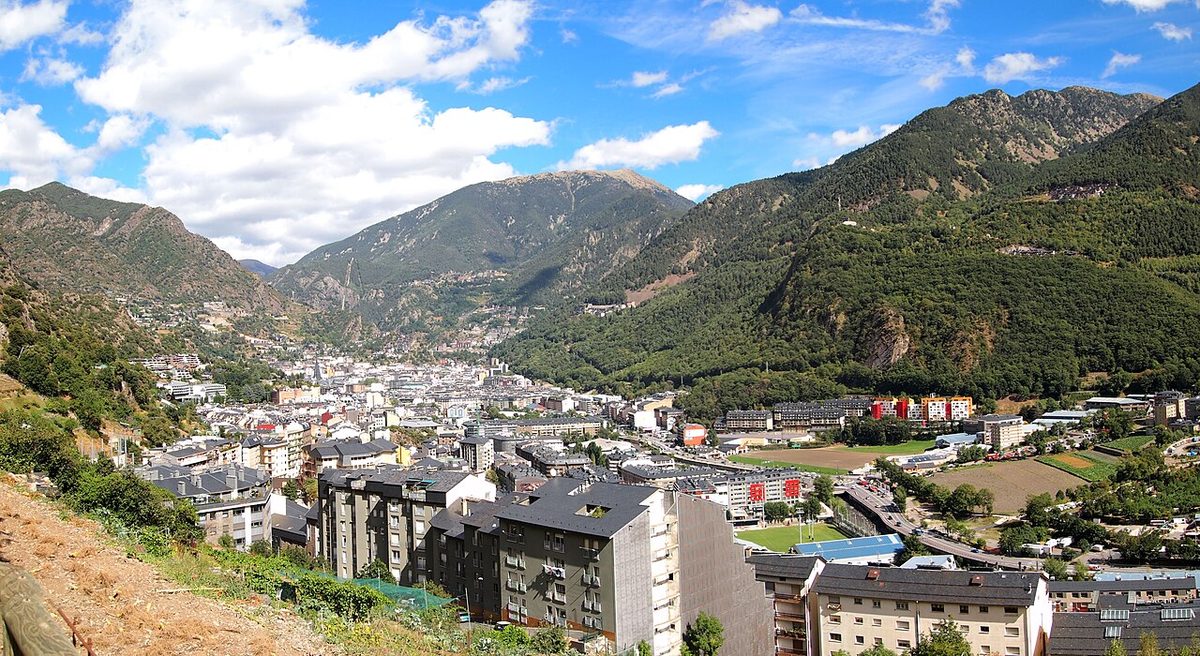
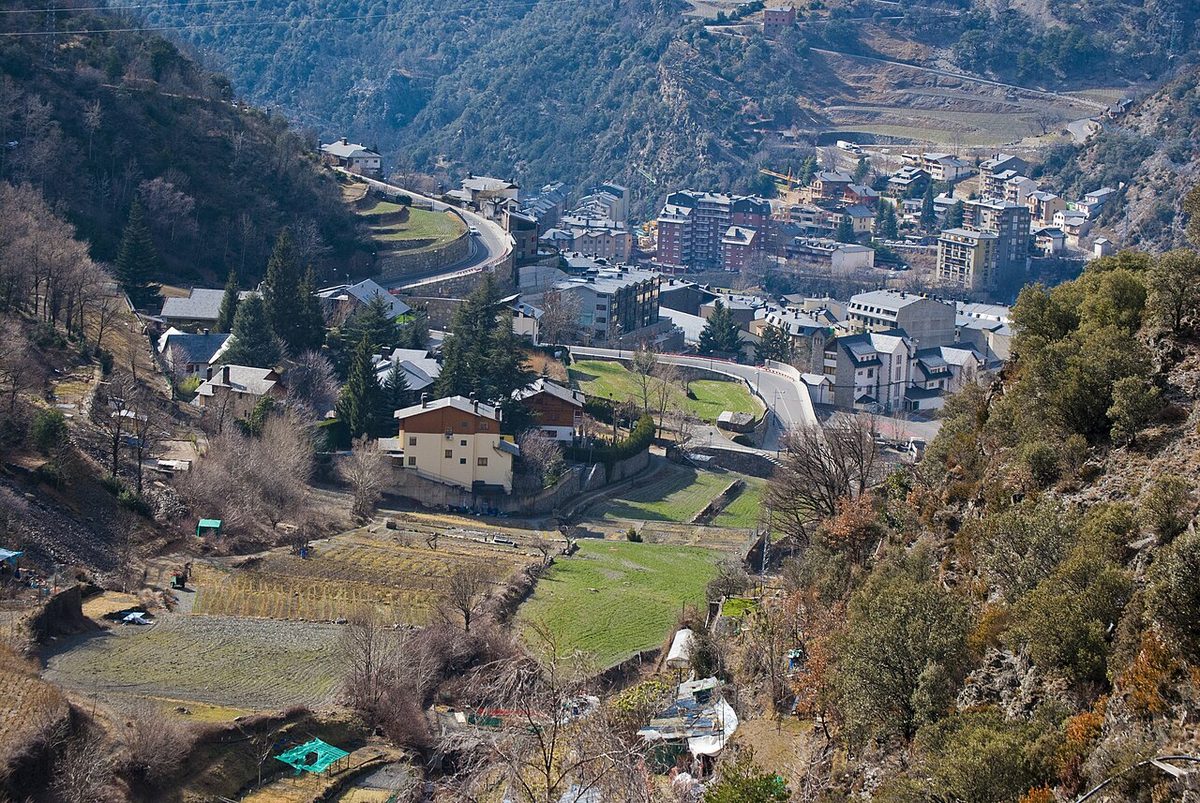
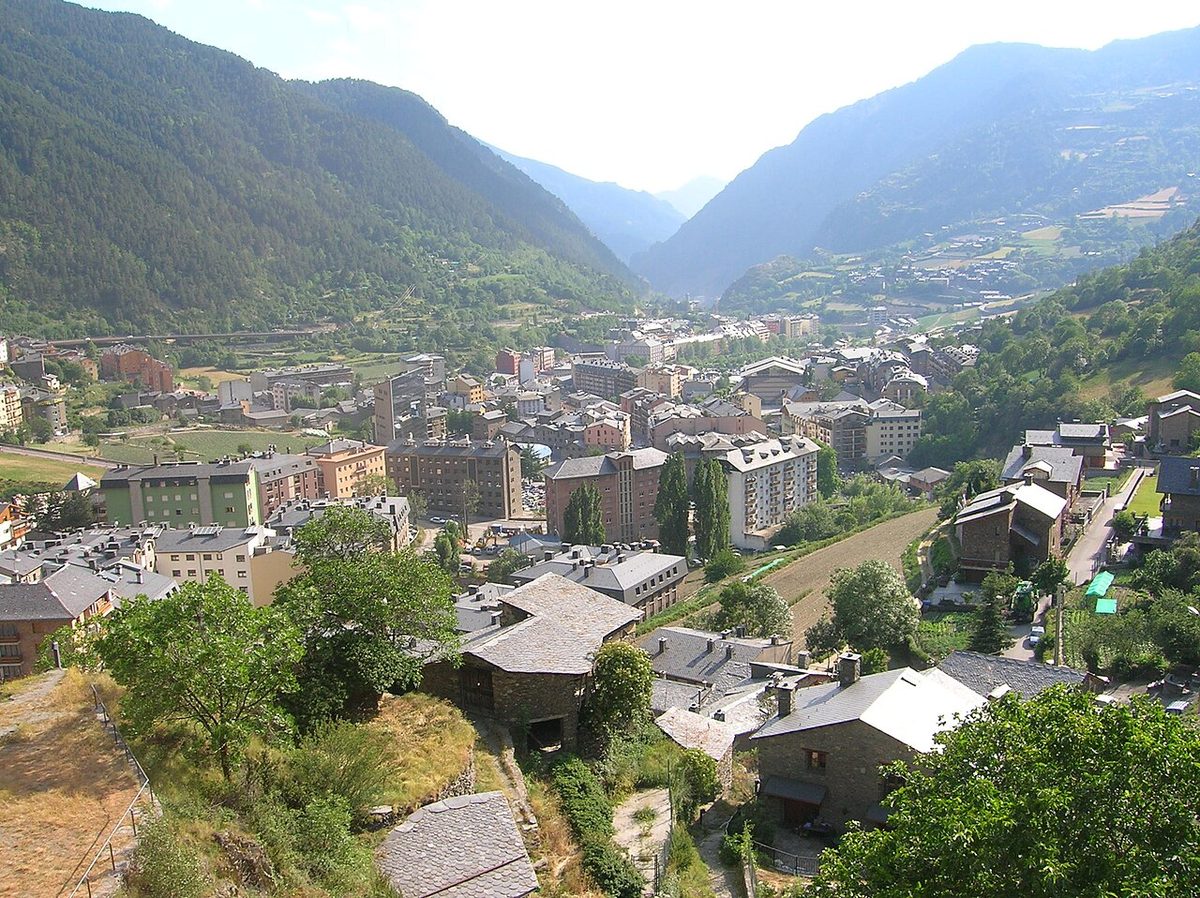
Drive north out of the capital on the CG-2, past the last of the retail parks in Escaldes-Engordany, and the valley narrows and lifts. Ten minutes later the road opens into a wider basin with a river through the middle, apartment blocks up both slopes, a sports centre, a couple of roundabouts and a very old bell tower poking out of it all. That’s Encamp.
The parish covers 74 km² and runs from the valley floor at around 1,250 m all the way up to Pic dels Pessons at 2,865 m. It also, confusingly, includes Pas de la Casa on the French border, 25 km up the road over the Envalira pass. Same parish, same mayor, entirely different universe. If someone tells you they stayed in Encamp and describe neon supermarkets and a wall of concrete at 2,100 m, they stayed in Pas. Book carefully.
Getting the geography straight matters because Encamp is a hinge. The CG-2 through the town is the only road to France, so everything heading for Pas de la Casa and the Envalira tunnel comes past your hotel window. Since 2012 the Dos Valires tunnel — 2,922 m, free, dual-tube — has also linked Encamp under the mountain to Anyos in La Massana, which turned a fiddly 15-minute mountain drive into about 5 minutes. From a bed in Encamp you can reach most of the country inside half an hour.
The honest case for an ordinary town
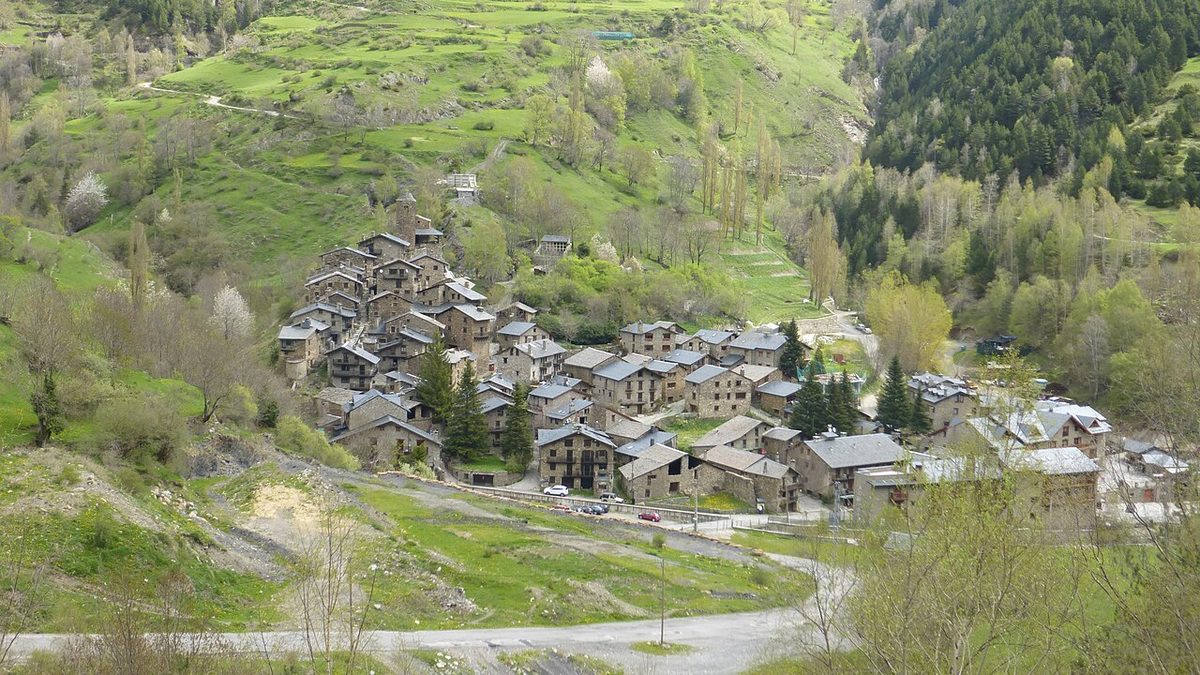
Nobody will tell you Encamp is pretty. The centre is a mix of 1970s and 1990s apartment blocks, and the riverside park is pleasant rather than memorable. Compared with stone-built Ordino or the Romanesque set-piece of Canillo, it does not compete on looks and does not try to.
What it has instead is a functioning town. The bakeries are for residents. The bar terraces fill with people who live here. Prices in the set-lunch menus are what Andorrans actually pay, not what visitors are charged. After a few days in the shopping corridor of Andorra la Vella, that lands as a relief rather than a disappointment. If you have read my round-up of Andorra’s villages, think of Encamp as the counterweight: the place that shows you how the country works rather than how it poses.
One more thing that surprised me. The parish holds an enormous share of Andorra’s glacial lakes — local tourism figures put it at around a third of them, more than twenty, spread between roughly 1,600 m and 2,400 m. A town that looks like a commuter suburb from the road has one of the best high-lake networks in the Pyrenees hanging directly above it.
The Funicamp: the one genuinely world-class thing in Encamp
Everything else on this page is a good reason to stop. The Funicamp is a reason to come.
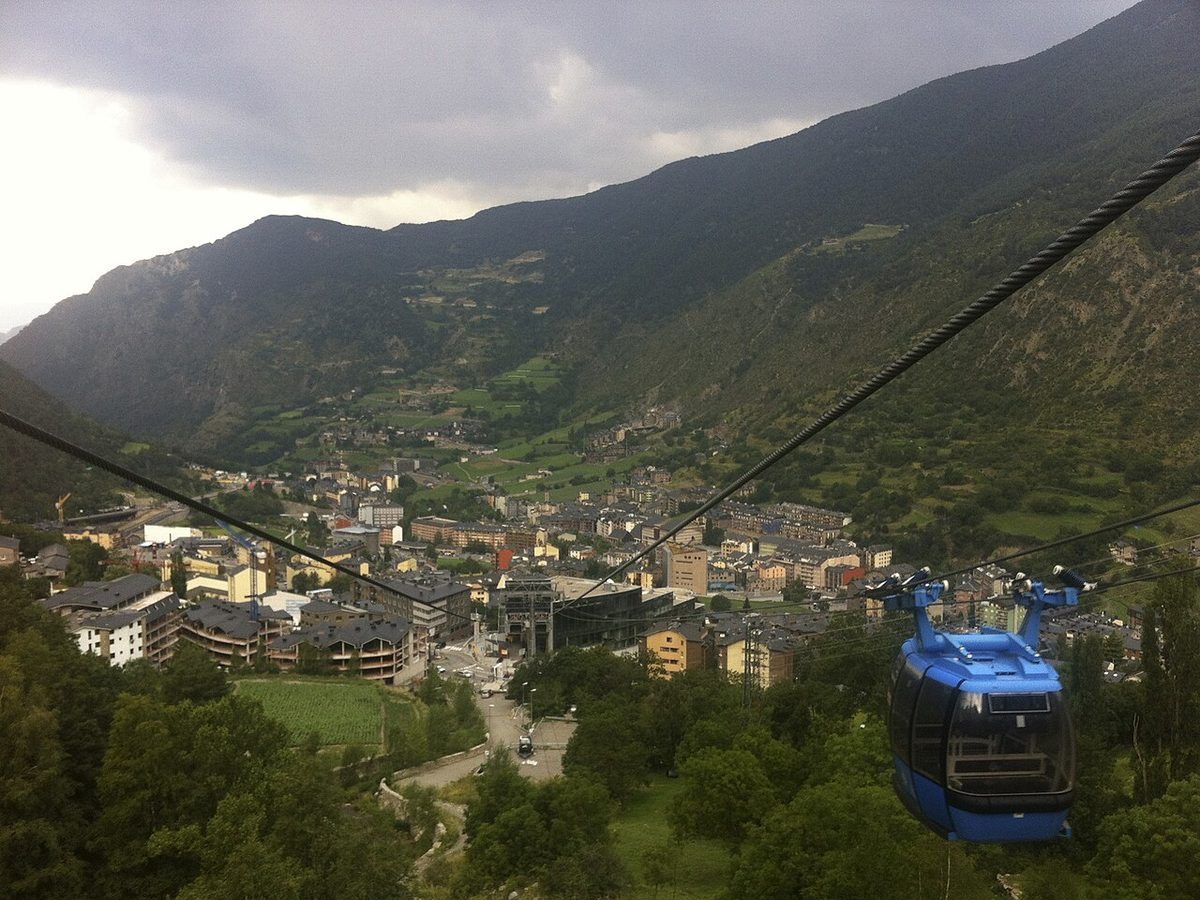
It is a funitel — a two-cable gondola, more stable in wind than a normal one — built in 1998 and running in two linked sections from the edge of town up to Solanelles at about 2,500 m. Total length is roughly 6 km, which makes it one of the longest lifts of its type in Europe, and Grandvalira bills it as the longest funitel on the continent. The official journey time is 25 minutes; some sources quote 15, which I suspect is one section rather than both. Assume 25 and you won’t be caught out.
What the ride is actually like
You board in a big concrete station at the bottom of the Cortals valley and, for the first few minutes, nothing much happens. Then the ground drops away and the whole Cortals opens up beneath you: pine, then scrub, then bare rock and old shepherds’ terraces, with the town shrinking to a grey smudge behind. In winter it is a long, quiet, slightly hypnotic ride over untracked snow. In summer you can see the walking paths threading up the valley and pick out where you’re going to be in an hour.
Twenty-five minutes is a long time in a gondola. Take a jumper — you leave town at 1,250 m and arrive at 2,500 m, and the temperature difference is real even in August.
At the top there’s the Racó de Solanelles restaurant, a genuinely good grill with a terrace and the kind of view that makes people go quiet. Since summer 2026 there’s also a sculpture up there called Petjades Enlairades by Naiara Galdós — a she-bear, referencing Encamp’s Ball de l’Ossa bear dance, which UNESCO lists as intangible cultural heritage. It is better than most mountain-top art.
Funicamp dates, prices and the gap nobody warns you about
This is the bit that trips people up. The Funicamp does not run all year. It has a winter season and a short summer season, and between them it sits still for months.
- Winter 2025/26 ran roughly 5 December to 6 April, opening around 8:45 am and closing around 5:30 pm. Access is included in the Grandvalira ski pass and in the pedestrian (non-skier) pass, so there is no separate gondola ticket.
- Summer 2026 ran 11 July to 8 September, 10 am to 4 pm, with the last ascent at 3 pm.
- Summer 2026 pedestrian prices were €16 return, €11 one way up, and €22 for the return plus the 4×4 bus on to Llac del Cubil. Under-5s free. Dogs allowed, if clean.
- 8 September is free. That’s Meritxell day, Andorra’s national holiday, and the Funicamp opens to everyone at no charge. If your summer dates are flexible, that is the day to go.
So: if you turn up in late April, May, June, October or November expecting to ride it, you will be looking at a locked station. I have watched this happen to a family who had driven from Toulouse for the day. Check the Grandvalira site for next season’s dates before you build a plan around it. The 2026/27 winter dates are usually published in the autumn along with the season’s lift pass prices.
What’s at the top in summer, beyond the view and lunch: waymarked e-bike and MTB circuits, the 4×4 bus to Llac del Cubil and the restored orri shepherd’s shelter there, guided high-mountain fishing sessions aimed at children aged 6 to 14, and the Clots de l’Aspra via ferrata — a short, low-difficulty route with Tibetan bridges at over 2,200 m, priced at around €52 per person including insurance, capped at six people per group. It is a very good first via ferrata for a family with teenagers.
Parking at the Funicamp: the detail most guides get wrong
You will read in plenty of places that the Funicamp has a huge free car park. That is not what the operators say now, and it is worth being precise because the difference is money.
The Funicamp’s own car park on Avinguda de François Mitterrand has 551 spaces including 17 accessible bays, is open 24 hours a day all year, takes cash or card, and charges a daily rate. Grandvalira describes both a covered deck of around 500 vehicles and an outdoor area, both paid. It is convenient and in a January whiteout it is worth every cent.
What is free is the Park & Ride system in the village itself: signposted car parks down in Encamp with a free shuttle bus up to the gondola station. In the Christmas and February peaks this saves a genuinely annoying amount of circling. Use it on busy days, pay for the Funicamp deck on quiet ones, and don’t believe anyone who tells you the base car park costs nothing.
Why Encamp is Andorra’s best-value ski base
Here is the case, plainly. A bed in Encamp costs meaningfully less than the equivalent bed in Soldeu, El Tarter or Pas de la Casa, because you are not paying the on-snow premium. Budget rooms here start around the €50–70 mark in low season and mid-range hotels sit comfortably below resort rates. From the Funicamp you reach Solanelles in 25 minutes and from Solanelles the whole of Grandvalira is open to you — 200-plus kilometres across seven linked sectors, with Grau Roig, Pas de la Casa, Soldeu and El Tarter all reachable on skis.
Now the honest half. Encamp is ski-in, not ski-out. You ride up in the morning and you ride down in the evening, and there is no piste back to your hotel door. That means:
- You are committed to the gondola’s hours. Miss the last down-lift and you are paying for a taxi from the top station area or, more likely, standing in a queue you should have joined ten minutes earlier.
- Morning queues at the base station in peak weeks are real. Be there for opening, not fifteen minutes after.
- Twenty-five minutes each way is fifty minutes of your ski day, every day. Over a week that’s most of a day on the snow.
- You are carrying boots and skis on a bus or a short walk at each end unless your hotel is one of the handful within a couple of minutes of the station.
Who this suits: intermediates and families who want maximum mileage per euro, groups where not everyone skis, and anyone who would rather have a real town in the evening than a resort bar strip. Who it doesn’t: people who want to step out of the door onto snow, and anyone who ranks après-ski above the lift pass. If that’s you, Pas de la Casa does it better and I say so in that guide. For the fuller comparison across the country, my rundown of where to stay in Andorra for skiing puts Encamp side by side with the alternatives, and the broader skiing in Andorra overview explains how the sectors connect.
One practical note for the budget-minded: Encamp is also where a lot of the country’s genuinely cheap accommodation lives, and the L2 bus into the capital runs until nearly 10 pm, so an evening out is not off the table.
Encamp things to do: museums, churches and a medieval hill
Andorra has an absurd number of museums for its size, and Encamp holds four of them. Two are worth planning around, one is a pleasant twenty minutes and one is the most underrated visit in the country. Note the family quirk of Andorran museum hours: state-run museums close on Mondays and often on Sunday afternoons, and winter schedules are tighter than summer ones.
Casa Cristo Ethnographic Museum
This is the one I send people to. Casa Cristo, on Carrer dels Cavallers in the old core, is a narrow three-storey house built in the late eighteenth century and lived in until 1947, when the family emigrated to France and simply left. The Comú d’Encamp bought it, restored it in 1995 and opened it as a museum in 2000, and the restraint of that restoration is the point — nothing has been prettied up.
You get the cellar, the tool store, the slate sink, the cupboard of white linen with a hundred-year-old christening gown folded in it, and the top-floor room kept for social occasions. It is small, austere and quietly devastating: this is what almost every Andorran family lived like a lifetime before the duty-free boom. Adults €5.40, children, students and pensioners €3.20, Passmuseu €2.70 at the time of writing. Open Tuesday to Saturday from September to June, daily 9:30 am to 7 pm in July and August. Give it 45 minutes to an hour. The house is not adapted for reduced mobility — there are stairs, and they are the original ones.
The National Automobile Museum
On Avinguda de Joan Martí, and much better than “car museum in a small country” suggests. It opened in 1987 and holds around 80 vehicles, roughly 60 motorcycles and about 100 bicycles, running from an 1885 Pinette steam car through to machines of the 1980s. The bicycle collection is the genuine surprise — curators rate it as a world-level holding, and watching the machine evolve from an unrideable curiosity into something recognisable is more interesting than the supercars.
General admission €5, reduced €2.50, guided tour supplement €1.50. Audio guides in five languages. Closed Sundays and Mondays from January to May and October to December; open Tuesday to Sunday morning in summer. Budget 90 minutes.
Worth knowing, because older guides don’t mention it: the museum closed at the end of August 2025 after asbestos was found in components on eight of the display vehicles during a refurbishment. Specialist firms removed the parts and tested the air over three months, and it reopened on 2 December 2025 on its normal timetable, with the building repainted and new signage. It is open and fine. I mention it only because “is the Andorra car museum still shut?” is a question people are still typing into Google.
Santa Eulàlia and the Museum of Sacred Art
The bell tower you can see from the road is the reason to stop even if you visit nothing else. Santa Eulàlia d’Encamp has a Lombard Romanesque campanile 23 m high — the tallest of its kind in the Principality — built in the second half of the eleventh century and leaning just enough to give it character. Inside there are Baroque altarpieces from the seventeenth and eighteenth centuries, a carved baptismal font, a modern stained-glass window by the Encamp artist Agustí Rios, and what is generally described as the oldest church porch in the country, plus one of Andorra’s few surviving conjuratòries — the little raised platform from which a priest would ritually curse an incoming storm.
Next door is the Museum of Sacred Art, with liturgical objects from the fourteenth to seventeenth centuries. Twenty minutes, and a sensible pairing with the church.
Sant Romà de les Bons and the Torre dels Moros
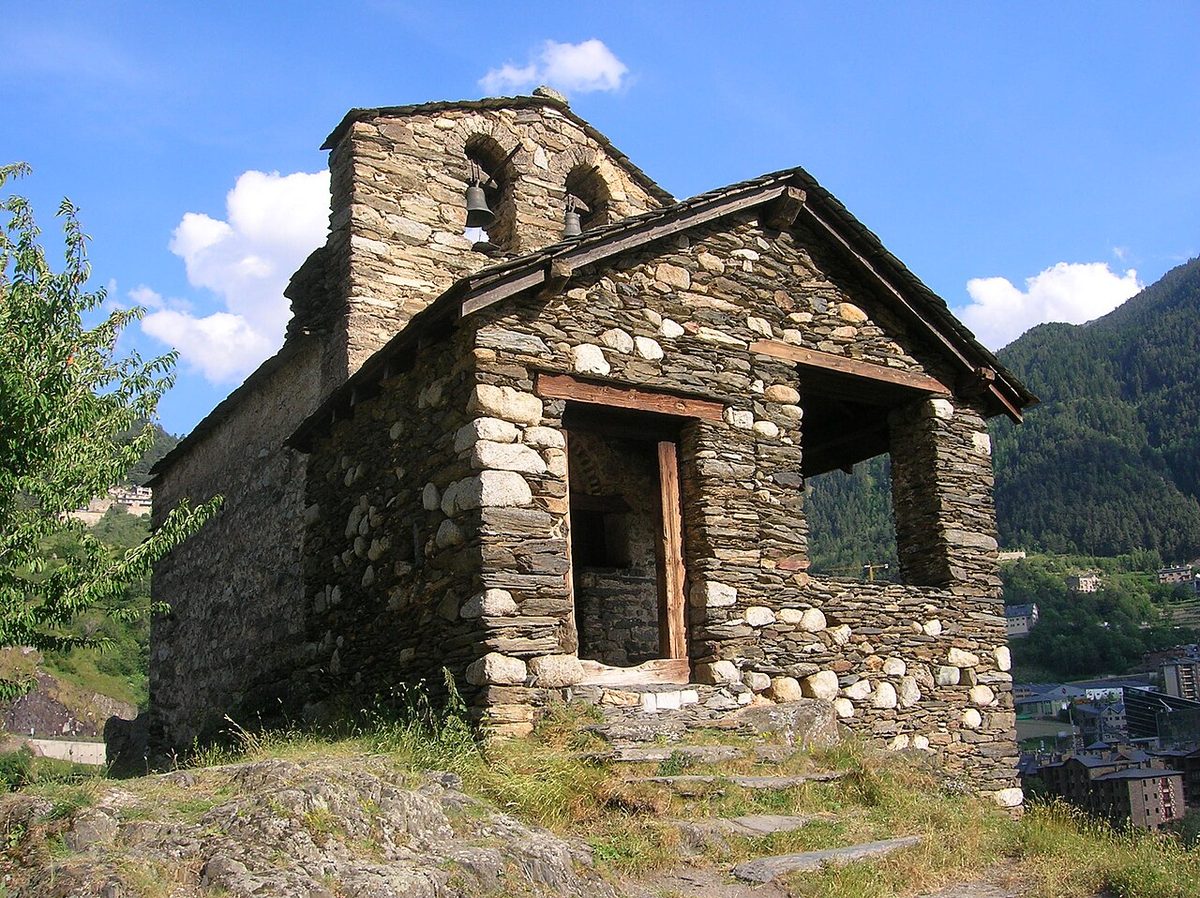
Walk or drive up behind the sports centre and you reach Les Bons, a small medieval site on a rock spur that is, for my money, the most atmospheric spot in the parish. The church of Sant Romà was consecrated in 1164: Lombard arcading on the apse, a barrel-vaulted nave that is unusual in Andorran Romanesque, and a square bell tower. The original twelfth-century wall paintings were removed long ago and now live at the MNAC in Barcelona; what you see in situ are high-quality reproductions, which is worth knowing before you get excited about the frescoes.
Beside the church stand the ruins of a fortified tower, the Torre dels Moros, associated with the Counts of Foix — the feudal lords whose long argument with the Bishop of Urgell produced the co-principality that still runs the country. If that quarrel interests you, it’s the spine of my history of Andorra. Go up in the last hour of daylight. The valley below turns gold, the reproductions stop mattering, and the whole thing suddenly looks a thousand years old, which it nearly is. The site is free and open, and the comu runs occasional candlelit guided visits in late summer.
The MW Electricity Museum and the hydroelectric path
The most unusual visit in Encamp, and the one almost no visitor does. The Engolasters power station, opened in 1934, was the machine that dragged Andorra into the twentieth century, and it still supplies a large share of the country’s own generation. The museum explains it in a hands-on way that works well for children over about six.
The reason to book, though, is the hydroelectric path: a guided route that takes you along the water intake channels and inside the dam structure at Lake Engolasters. It runs in limited slots, it books out in summer, and it is far more interesting than that description makes it sound. Reserve ahead.
Walking from Encamp: Engolasters, the Cortals and the high lakes
This is where the parish quietly outperforms its reputation. You can walk out of the town centre and be in high country within an hour, and the trails are well signed by Andorran standards.
Lake Engolasters and Sant Miquel
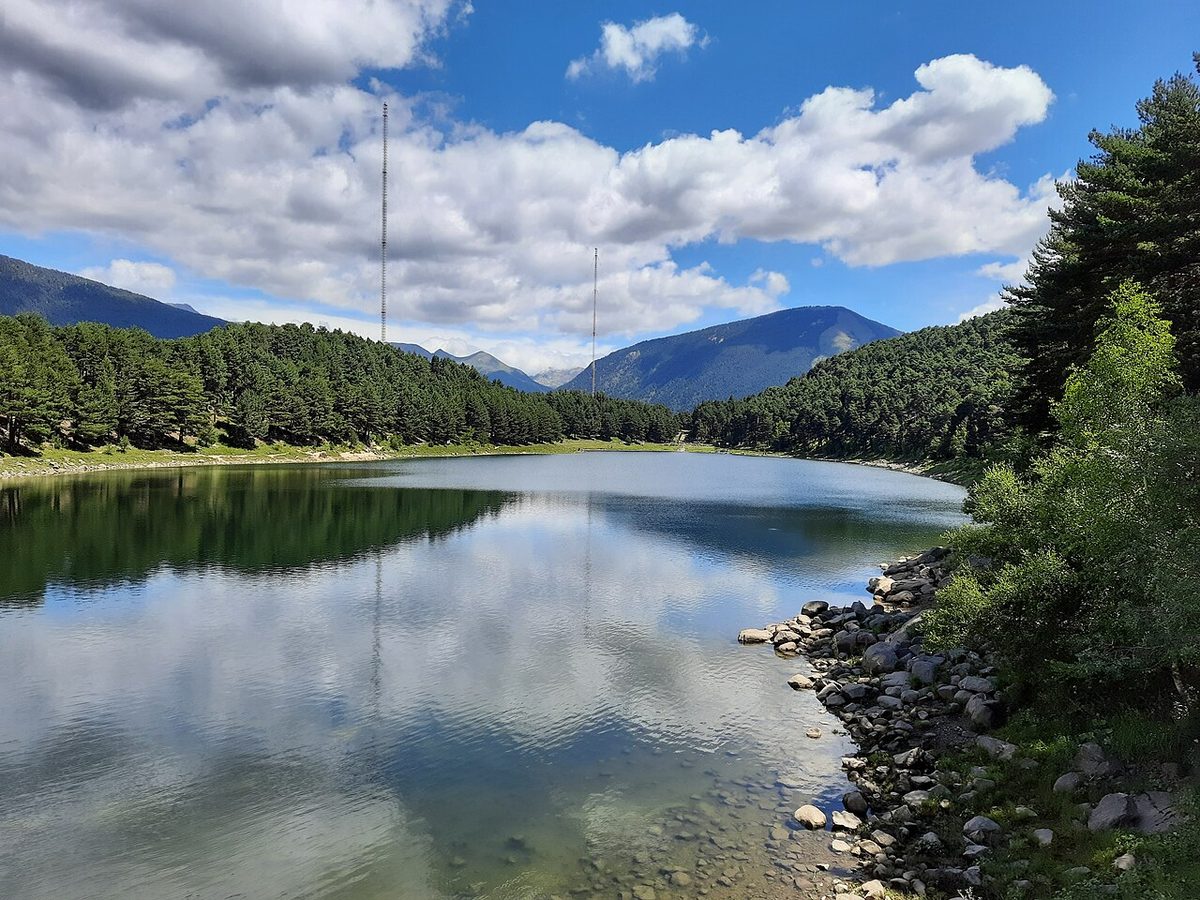
The classic outing. Lake Engolasters sits at around 1,616 m on the shelf above the valley, a dammed reservoir ringed by pine with a flat lakeside circuit of about 2.5 km that any child can manage. Beside it stands the church of Sant Miquel d’Engolasters, an eleventh-to-twelfth-century Romanesque chapel with a slim Lombard bell tower that is one of the loveliest small buildings in the country.
Two clarifications, because guides muddle this constantly. First, the lake and Sant Miquel are usually filed under Escaldes-Engordany, not Encamp, even though the plateau sits directly above Encamp and the town’s own signposted routes run up to it. Encamp had a cable car to Engolasters once; it was dismantled years ago, so today you drive the Engolasters road, or you walk.
Second, the pleasant flat canal walks called the Rec del Solà and the Rec de l’Obac are not Encamp’s. They form the green ring around Andorra la Vella and Escaldes, on the sunny and shaded sides of the capital respectively, and they are lovely — but you reach them from the capital, not from here. And while we’re correcting things: the Roc del Quer viewpoint, with the cantilevered walkway and the seated iron man, is in Canillo. It gets attached to Encamp listings all the time. It isn’t here.
What Encamp does have is the Camí de les Pardines, the signposted path linking the town with the Engolasters plateau by way of the Mare de Déu de l’Ecologia oratory — a small outdoor shrine the town honours with an offering every first Saturday in June. From the town it’s roughly an hour and a half to two hours up, with real valley views most of the way. My favourite version of the day: ride the Funicamp up in summer, walk the high ground, and come down on foot rather than in the gondola. Almost nobody does it that way.
Els Cortals d’Encamp
The narrow road climbing behind the town leads to Els Cortals, a scatter of old farm buildings and summer houses with a small chapel dedicated to Sant Romà, at the head of the valley the Funicamp flies over. In winter it’s a ski-touring approach. In summer it’s the trailhead for walks up to the Ensagents lakes and the Campea springs, and it feels a very long way from the CG-2 despite being only a few kilometres above it.
Higher again is Estany de l’Illa, at about 2,500 m in the Gargantillar — the second-largest lake in Andorra at 13.1 hectares, and a proper mountain day of roughly 8 km with 650 m of climb. Estany de les Abelletes, also in the parish, is the one Andorran anglers talk about for its rainbow and brown trout. You need a licence to fish, and you get it online through the government’s permits portal.
The Madriu, from the back door
A large slice of the Madriu-Perafita-Claror valley — a UNESCO World Heritage cultural landscape since 2004, and the best thing in the country if you like empty mountains — falls inside the parish of Encamp. Most people enter from Escaldes, but the eastern approaches over the ridge from Encamp are the quieter ones and connect into the GR-11 traverse. If you want the gentler end of the spectrum first, my guide to hiking in Andorra sorts the routes by effort, and there’s a separate list of summer things to do if the walking is only part of the plan.
Planning a visit to Encamp Andorra: buses, parking, food and time
The logistics here are the easiest in the country, which is a large part of the appeal.
Getting there
The L2 national bus runs Andorra la Vella to Encamp and back, every 12 to 15 minutes on weekdays and every 30 minutes at weekends and on holidays, from about 6:30 am to 9:45 pm. Journey time is 20 to 25 minutes end to end depending on traffic, less if you board further up the valley. The L3 (to Soldeu) and L4 (to Pas de la Casa) also stop in Encamp, which gives you a second and third option and, more usefully, a direct link up the mountain to Canillo, El Tarter and Soldeu without going back through the capital.
Fares are zonal. At the time of writing a zone 1 single is €1.90 and a return €3.55; a T-10 carnet is €12.40 and can be shared between people, which is the sensible buy for a family. Zone 2 singles are €3.45 and zone 3 €4.80 — the run out to Pas de la Casa on the L4 is a top-zone fare. Check bus.ad before you travel; the fares were revised in September 2026 and the timetables change with the school year. For the wider picture of moving around without a car, see my guide to getting around Andorra.
Driving, it’s about 10 minutes from the capital on the CG-2 outside rush hour and considerably more inside it, because that road is the country’s spine. From Barcelona expect around 3 to 3.5 hours; from Toulouse around 3. Remember that winter tyres or chains are legally required in Andorra from 1 November to 15 May, which catches out plenty of hire-car drivers — the details are in my notes on driving in Andorra.
Parking
Street parking in the centre is limited but there are free and cheap public car parks around the town, which is why Encamp is a popular place to leave the car and bus into the capital on a shopping day. For the gondola, see the Park & Ride note above: village car parks free with a shuttle, the Funicamp’s own 551-space deck paid.
Eating
Encamp is a set-lunch town. Several unremarkable-looking places along the main streets do a menú del dia at a price that would embarrass a resort restaurant, and they are aimed at people who work here. That is the honest recommendation: don’t hunt for a destination restaurant, walk in somewhere at half past one and order the menu. Up at Solanelles the Racó de Solanelles does charcoal-grilled meat with an enormous view, and it’s the best mountain lunch in the sector.
How long to spend
- Two hours — Santa Eulàlia, a coffee, and up to Les Bons for the view. A very good stop on the drive to or from Pas de la Casa.
- Half a day — add Casa Cristo or the Automobile Museum, plus lunch. This is the sweet spot for most visitors.
- A full day — both museums, the churches, and the Engolasters circuit in the afternoon.
- A week — only if you are using it as a base, which is exactly what it is for. Ski from here in winter; walk from here in summer.
My blunt verdict: Encamp is not a place you build a holiday around for its own sake, and anyone selling it as an undiscovered beauty spot is overselling. It is a superb base, an honest half-day of culture, and the bottom station of one of the most impressive lifts in Europe. Judge it on those terms and it delivers, generously.
Frequently asked questions
Is Encamp worth visiting?
Yes, with a clear head about why. It has the country’s tallest Romanesque bell tower, two genuinely good small museums, a medieval site at Les Bons and the Funicamp gondola. It is not scenic in the way Ordino is. Come for the lift, the value and the everyday Andorra, not for a pretty village.
How long is the Funicamp and how long does it take?
It is a two-section funitel of roughly 6 km, billed by Grandvalira as the longest funitel in Europe, and the official journey time from Encamp to Solanelles at about 2,500 m is 25 minutes. Some sources quote 15 minutes, which appears to describe one section only. Plan around 25 minutes each way.
Does the Funicamp run in summer?
Yes, but only for a short window. In 2026 it operated from 11 July to 8 September, 10 am to 4 pm with the last ascent at 3 pm, at €16 return or €11 one way. It is closed for several weeks between the ski season ending in April and the summer opening in July, so check the dates before planning a visit around it.
Is parking free at the Funicamp?
Not at the gondola itself. The Funicamp car park has 551 spaces, is open 24 hours all year and charges a daily rate. What is free is the Park & Ride: signposted car parks down in Encamp village with a free shuttle up to the station. On busy winter weekends the Park & Ride is the faster option anyway.
Is Encamp a good base for skiing in Andorra?
It is the best-value base in the country. Beds cost noticeably less than Soldeu or Pas de la Casa and the Funicamp puts you into Grandvalira in 25 minutes. The trade-off is that it is ski-in but not ski-out: there is no run home, so you are tied to the gondola’s opening hours at both ends of the day.
Is the National Automobile Museum in Encamp open?
Yes. It closed at the end of August 2025 when asbestos was found in components on eight display vehicles, and reopened on 2 December 2025 after specialist removal and air testing, on its normal timetable. Admission is around €5, reduced €2.50, and it closes on Sundays and Mondays through the winter months.
How do I get from Andorra la Vella to Encamp?
Take the L2 bus, which runs every 12 to 15 minutes on weekdays from early morning until around 9:45 pm and takes roughly 20 minutes. The L3 and L4 also serve Encamp. A single is around €1.90 at the lowest zone rate. By car it is about 10 minutes north on the CG-2, traffic permitting.
What is there to do in Encamp with children?
The Funicamp ride itself does most of the work. Beyond that: the MW Electricity Museum is hands-on and suits ages six and up, the Automobile Museum’s bikes and motorbikes hold attention, the Lake Engolasters circuit is a flat 2.5 km, and in summer there are guided high-mountain fishing sessions from the top station aimed at 6- to 14-year-olds.
The last word on Encamp
I like Encamp more than I expected to, and I think the reason is that it never asks to be liked. It gets on with being a town. The bell tower has stood over a working valley for nine hundred years and it is still standing over one — buses, bakeries, a delivery driver and a pallet of water. Ride the gondola for the spectacle, walk up to Les Bons at dusk for the atmosphere, spend an hour in Casa Cristo for the perspective, and sleep here for the arithmetic.
If you’re building the rest of the trip, the guide to Andorra’s villages covers the prettier parishes, Canillo is the obvious next stop up the same valley, and the honest answer on whether Andorra is worth visiting is where I’d start if you’re still deciding.
Photo credits
All photographs are from Wikimedia Commons under their stated licences, with thanks to the photographers: