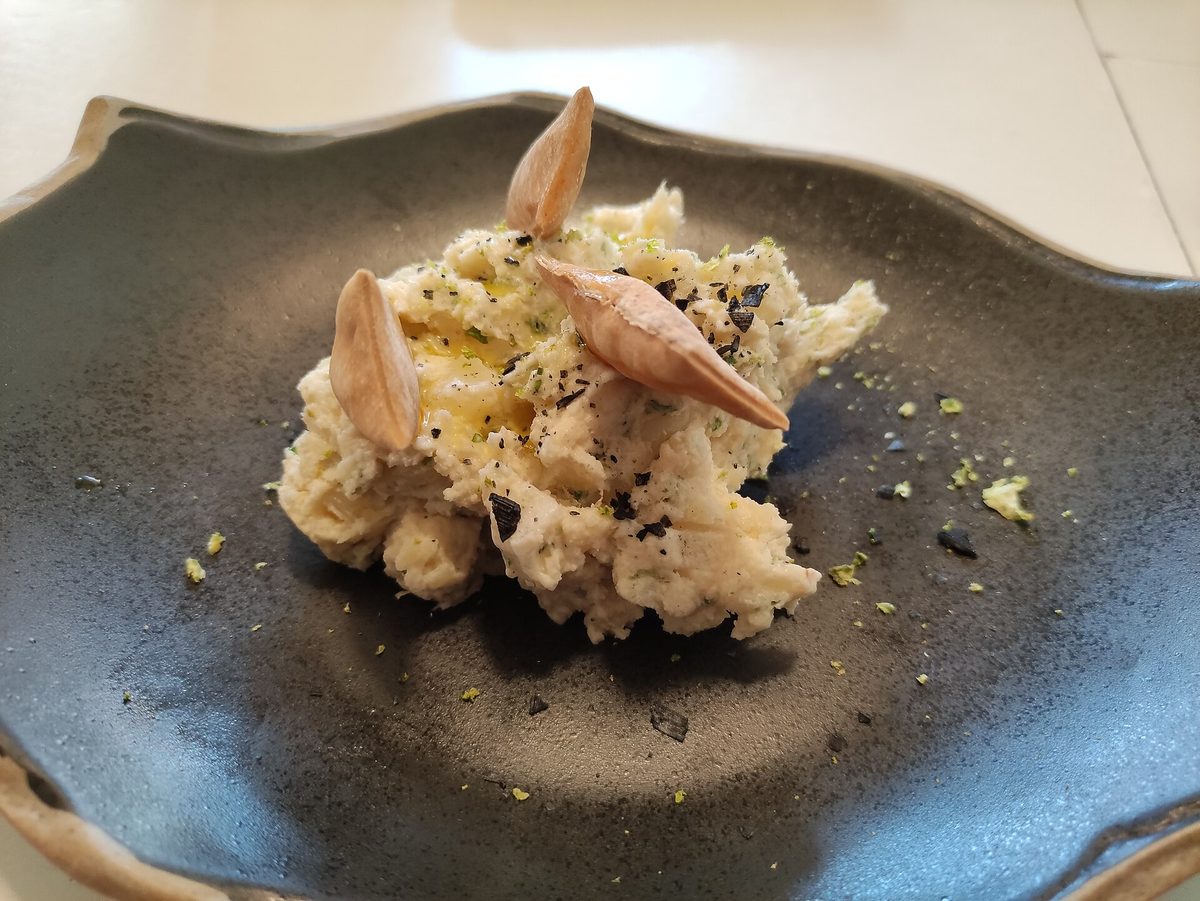
The first time I ate proper trinxat it was February, it was snowing sideways outside a stone barn above Andorra la Vella, and the thing arrived at the table looking like a small burnt hubcap. Potato-brown, crisp-edged, a slab of bacon laid across the top. I remember thinking: this is peasant food, and I have just paid restaurant money for it. Then I ate it, and understood.
Trinxat is a Pyrenean cake of winter cabbage and potato, mashed and fried in pork fat until crisp, topped with bacon. It belongs to Andorra, the Cerdanya and the Alt Urgell. This guide is for travellers who want to know what trinxat, escudella and the rest of Andorra’s mountain dishes are, and what to order.
Last updated: September 2026. Dishes, recipes and producer details were checked against visitandorra.com, the Catalan tourist board and the Ajuntament de Puigcerda in September 2026. Restaurant prices and opening patterns move with the season — treat any figure as a guide and check official sites before you travel.
Andorra’s mountain dishes at a glance
If you read one section before dinner, read this one. Every row gets unpacked further down.
| Dish | What it is, and when to eat it |
|---|---|
| Trinxat | Frost-touched winter cabbage and potato mashed and fried into a cake, with bacon or crackling. Peak season November to March; on menus year-round in the bordes |
| Escudella | The big meat-and-vegetable pot. Everyday version all winter; the full escudella i carn d’olla with pasta shells is Christmas Day food |
| Embotits | Cured pork — bull, donja, bringuera, bisbe. Made at the January pig slaughter, eaten all year as a starter board |
| Cargols a la llauna | Snails roasted in a metal tray over coals, eaten with allioli. A spring and summer thing |
| Civet de senglar | Wild boar slow-cooked in red wine, often with a little dark chocolate. Autumn and winter, hunting season |
| Xai a la brasa | Mountain lamb over the wood grill. All year, and the safest good meal in the country |
| Wild mushrooms | Ceps, rovellons and friends, in omelettes, rice and sauces. September to November |
| Formatge de tupi | Cheese fermented in a clay pot with oil, garlic and spirit. Pungent, spreadable, not for beginners |
| Coca massegada | Sweet oval flatbread with anise, almonds and dried fruit. Festivals and holidays |
| What to drink | Andorran high-altitude wine (roughly 1,000–1,200 m), then ratafia — dark walnut-and-herb liqueur — as a digestif |
| Where to eat it | A borda: an old stone hay barn or byre converted into a restaurant, with a fireplace and a wood grill |
What trinxat actually is — and why the cabbage matters
Strip it back and trinxat is three ingredients: cabbage, potato, pig. Boil the first two together until they surrender, drain them hard, mash them, then fry the mash in garlicky pork fat and press it into a cake so the base and top go properly crisp. Serve with bacon or rosta — the fried pork fat and crackling — laid over the top.
Yes, it’s close to bubble and squeak. Wikipedia says so and Wikipedia isn’t wrong. But the comparison undersells it, because the good versions have a texture that British bubble and squeak rarely gets: a dark, almost lacquered crust giving way to something soft and sweet and faintly smoky inside. It is one of the great cheap dishes of Europe.
The name tells you the technique
Trinxat is the past participle of the Catalan verb trinxar, to chop, shred or mash. So the dish is literally called “chopped”. Say it roughly trin-SHAT — the “x” is a “sh” sound, which trips up almost every English speaker who orders it. Locals often call it lo trinxat, with the old Pyrenean definite article rather than standard Catalan el. If you want the wider picture of the language you’ll be reading menus in, my guide to the language spoken in Andorra covers why Catalan is the official tongue here and how far Spanish and French get you.
Frost is the secret ingredient
Here’s the bit the recipe blogs skip. The cabbage is supposed to be col d’hivern — a hardy, crinkly winter cabbage — and it is supposed to have been through a frost before it’s cut. That’s not romance. Cold-hit brassicas convert stored starch into sugars as antifreeze, so a frosted cabbage is measurably sweeter and less sulphurous than one picked in mild weather. It’s the same reason parsnips and kale improve after a cold snap.
Which is why trinxat is genuinely, structurally, a winter dish. Farmers in the Cerdanya and up these valleys would leave the cabbages standing in the field until the frosts came, then cut them and eat trinxat right through the cold months alongside whatever pork was left from the autumn slaughter. Eat it in Andorra in January and you’re eating it more or less in its proper context. Eat it in August and you’re eating a fine potato cake made with whatever cabbage the wholesaler had.
It was poor people’s food, and it shows
Nothing about trinxat is expensive or clever. It is a use-what-you-have dish from a place that historically didn’t have much — Andorra was a hard, isolated smallholding economy of shepherds and subsistence farmers well into the twentieth century, as the history of the country makes plain. Potatoes store. Cabbage stands in the snow. Pork fat is what you have because you killed a pig in January. That’s the whole logic of the plate.
The dish has since climbed the social ladder, which happens to good peasant food everywhere. You’ll now find it plated in rings with a poached egg and a foam on it in ambitious kitchens. That version can be lovely. It is not, however, more authentic than the hubcap.
A proper trinxat recipe you can actually make at home
This is built on the official Andorran version published by the national tourist board — which itself comes out of Cuina casolana d’Andorra, M. Dolors Ribes Roige’s 1991 book of Andorran home cooking — cross-checked against the Cerdanya recipe the Catalan tourist board publishes. I’ve adjusted quantities for a normal domestic pan and flagged where the traditional version and the practical version part company.
It serves four as a main course, six as a side. Budget about 50 minutes, most of it unattended boiling.
What you need
- 1 large winter cabbage — savoy is the best supermarket substitute; see the honest note below
- 1–1.3 kg floury potatoes, peeled and cut into rough chunks (Maris Piper, russet, King Edward)
- 150–200 g streaky bacon or pancetta, in thick slices or lardons — the fattier the better
- 4 cloves of garlic, sliced
- Olive oil, plus lard if you have it
- Salt, and black pepper if you want it (the traditional version barely uses pepper)
- Optional but traditional: 2 marinated or salted herrings, torn into pieces, to serve
The method
Quarter the cabbage, cut out the thickest part of the core and shred the rest coarsely. Put it in a big pan of well-salted water and boil it. When it’s about half done — five or six minutes in, still with some bite — add the potato chunks and carry on boiling until the potato is completely soft and starting to fall apart at the edges. You are not making mashed potato for a Sunday roast here. You want it over-cooked.
Drain it, properly. Then drain it again. Wet trinxat will never crisp, and the single most common home failure is water. Let it sit in the colander steaming for a couple of minutes, then tip it back into the dry hot pan over a low flame for another minute to drive off the last of the moisture.
Meanwhile, warm a good slug of olive oil in a heavy frying pan and gently colour the sliced garlic. Fish the garlic out before it burns. Fry the bacon in the same oil until it’s properly crisp, then lift that out too and keep it somewhere warm. What you now have in the pan is the actual flavour of the dish: garlic-scented pork fat.
Pour most of that fat over the drained cabbage and potato, keeping a tablespoon or two back in the pan. Add the fried garlic. Now mash and chop it together — a potato masher, then a couple of minutes of hacking at it with the edge of a wooden spoon or a knife. It should be roughly mashed and streaky, not a smooth puree. Season hard; potatoes and cabbage both eat salt.
Get the pan hot again with the reserved fat. Tip the mixture in and press it down into a flat cake filling the base of the pan. Leave it alone for six to eight minutes over a medium heat — genuinely leave it, no fiddling — until the underside is deep brown and crusted. Then the frightening bit: slide it onto a plate, invert the pan over the plate, and flip. Another six minutes on the second side. Slide it out, lay the bacon over the top, and cut it into wedges at the table.
If flipping a 25 cm potato cake fills you with dread, do what a lot of Andorran kitchens do and make four small ones in a smaller pan, or press the mixture into rings. It tastes identical and you keep your dignity.
The honest notes
On the cabbage. The real thing needs frosted col d’hivern, and you almost certainly cannot buy it. Savoy is the closest widely available substitute — same crinkled leaf, same density, close enough in flavour that nobody will accuse you of fraud. Buy it in midwinter if you can. Plain green cabbage works but goes a bit flat; kale makes a good, more assertive version that is not strictly trinxat but is delicious. Avoid white or pointed cabbage, which turn watery.
On the pork. Andorran and Cerdanya cooks use rosta — the crackling and rendered fat left from frying cured pork belly. Streaky bacon is the workaround. If you can find slab pancetta or salt pork, use that instead and render it slowly.
On the herring. Salted herring alongside trinxat sounds wrong and is, in fact, historically standard: salt fish travelled to the mountains when fresh fish couldn’t. It cuts the fat beautifully. Try it once before you dismiss it.
Making it vegetarian. You can, and some Andorran kitchens will do a meat-free version on request, but be clear-eyed: drop the pork and you lose the fat that carries the whole dish. Use a generous amount of good olive oil, add a little smoked paprika, and finish with fried breadcrumbs or toasted almonds for the crunch the crackling would have given you.
Leftovers. Refry a cold wedge in a hot pan the next morning and put a fried egg on it. That is arguably the best way to eat trinxat and nobody in the Pyrenees would blink.
Escudella: the pot that owns winter
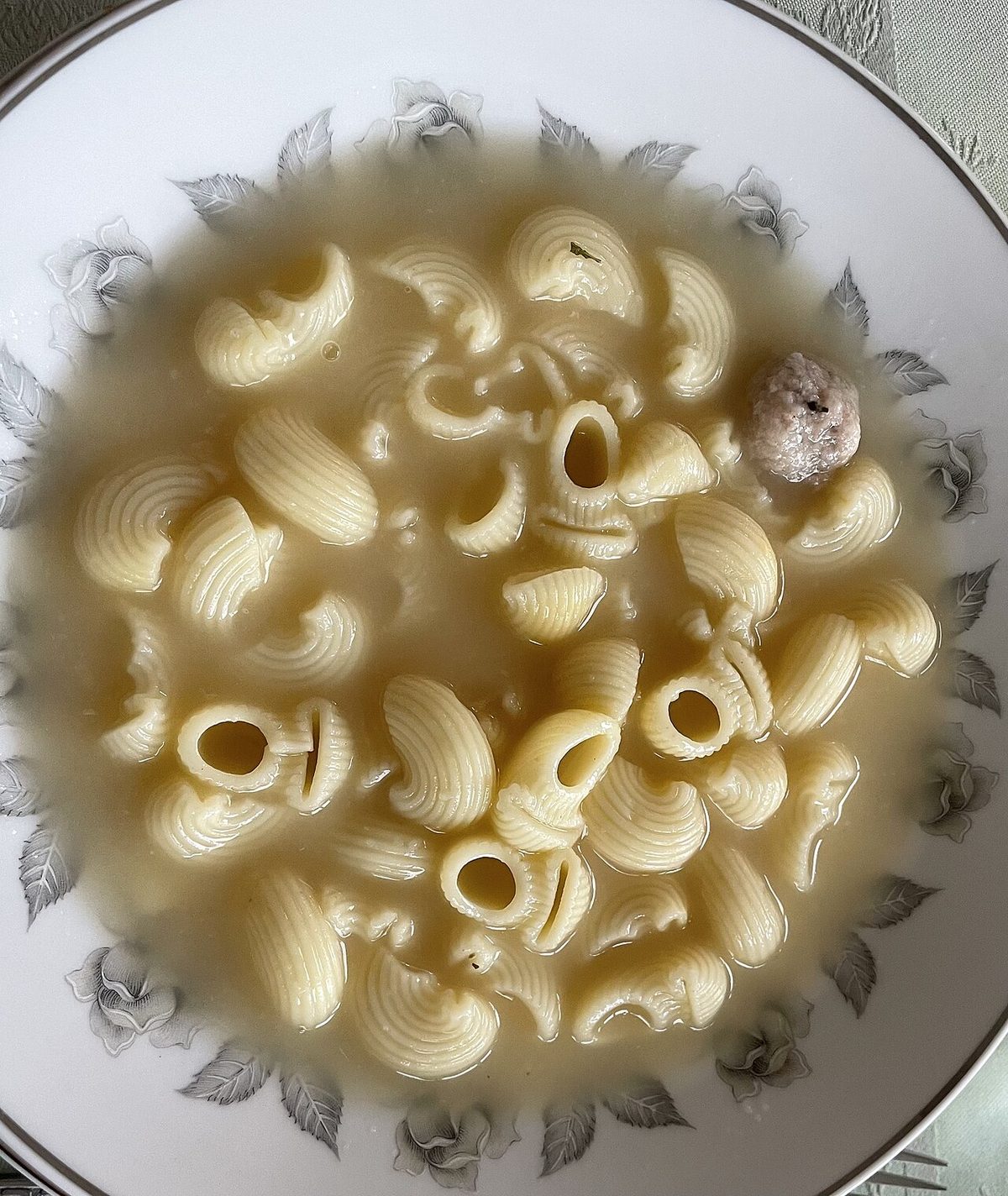
If trinxat is the everyday plate, escudella is the occasion. The word comes from the bowl it was served in, and in its everyday Andorran form it’s a fairly gentle thing: a pork-and-vegetable broth with beans or chickpeas, potato, cabbage and pasta, simmered long and served hot enough to hurt. Andorra’s own tourist board describes it as a light pork stew with seasonal vegetables, and on a Tuesday in February that’s exactly what it is.
The full-dress version is another animal. Escudella i carn d’olla — “bowl and meat from the pot” — is the Catalan Christmas centrepiece, and Andorra keeps the tradition wholesale. Into one enormous pot go several meats at once: pork (belly, ear, trotter, snout, a bone), chicken or hen, veal, sometimes lamb, plus botifarra sausage and often black pudding. Alongside them, chickpeas or white beans, cabbage, potato, carrot, turnip, celery.
It arrives as two courses, and that surprises people
This is the part first-timers get wrong. Escudella i carn d’olla is not one bowl. The broth comes first, on its own, cooked with galets — big hollow pasta shells the size of a thumb, which at Christmas are sometimes stuffed with meat. That course is called sopa de galets or sopa grossa. Only then does the carn d’olla arrive: the drained meats, sausages and vegetables piled onto a platter and carved at the table.
So if a waiter brings you a modest bowl of pasta soup and vanishes, do not fill up on bread. The meat is coming.
The pilota is the thing to look for
Buried in the pot is the pilota: one giant oval meatball of minced pork and veal bound with egg, breadcrumb, garlic and parsley, poached in the broth and sliced like a terrine for serving. In many families it is the single most fought-over item on the platter, and a cook is judged on it. If you see it on a menu, that’s a kitchen doing the dish properly rather than reheating a soup.
When and where you’ll find it
Escudella is winter food and mostly December food. Around Christmas it is everywhere — homes, hotel menus, village festivals — and there is a decent chance of a communal escudella being ladled out at a parish event if you happen to be here for one. If you’re planning a trip around it, my month guides to Andorra in December and Andorra in winter cover what else is happening in the calendar. Come in July and you may struggle to find a real one; some bordes keep it on year-round for visitors, but it’s a shadow of the December version.
So what is the Andorra national dish, really?
You will read confident, contradictory answers to this, which is a hint. Here is the honest position.
Escudella has the stronger claim. It’s the dish tied to the national calendar, it’s what Andorran families cook for the biggest meal of their year, and both the tourist board and most reference sources treat it as the national dish. A national dish is usually the one attached to the national holiday, and that is escudella by a distance.
Trinxat has the stronger identity. It’s the dish visitors actually remember, the one that appears on nearly every traditional menu in the country, and the one most specific to this exact corner of the Pyrenees. Escudella, for all its status, is a shared Catalan dish — you’ll eat a version of it in Barcelona and across rural Catalonia. Trinxat belongs to a much smaller triangle: Andorra, the Cerdanya and the Alt Urgell, and essentially nowhere else on earth.
Then there’s an awkwardness nobody likes to raise: trinxat’s heartland is arguably the Cerdanya, over the border in Catalonia, where they hold an annual Festa del Trinxat in Puigcerda — a mass gala dinner in late winter that draws around a thousand people from Catalonia, France and Andorra. Andorra doesn’t have exclusive title to it. It shares it.
My answer, for what it’s worth: escudella is the national dish, trinxat is the national flavour. If someone tells you flatly that it’s one and not the other, they haven’t looked very hard. The wider picture is in my overview of Andorran food and what to eat here, which runs the whole cuisine rather than just these two.
The rest of the mountain table, dish by dish
Trinxat and escudella get the headlines, but a week of eating here turns up a lot more. These are the ones worth going out of your way for, roughly in the order I’d order them.
Embotits: bull, donja, bringuera and the January pig
Every traditional meal in this country starts, or should start, with a board of cured pork. Andorran embotits come out of the matanca, the pig slaughter that traditionally happens at the beginning of January, and the striking thing is how much of the animal ends up on the plate.
Bull is a fat, cooked sausage of offal and lean pork — bull blanc is the pale version, bisbe the blood-dark one. Soft, rich, faintly livery, and the single most local thing on the board. Bull de donja is specifically Andorran in origin, and donja is the name you’ll hear locals use with a certain pride. Bringuera is the pig’s head made into a plump cooked sausage, typical of Andorra and the neighbouring Alt Urgell, cured up at altitude — around 1,100 m in some producers’ cellars — which gives it a long, insistent flavour. There’s also llonganissa, the everyday dry sausage, and various blood puddings.
You may also be offered girella, a sausage of lamb offal and rice. Be aware it is more properly a dish of the Pallars valleys to the west than an Andorran one, though it crosses over onto boards here. Nobody is deceiving you; the Pyrenees don’t respect borders where charcuterie is concerned.
Two practical notes. Portions are generous, so one board between three is plenty before a main. And if you want to take some home, remember that meat and dairy from Andorra are outside the EU customs area — check the current rules in my guide to Andorra’s duty-free allowances before you load the car.
Formatge de tupi and the cheese question
Andorran cheese is mostly small-scale and mostly good: soft cow’s milk rounds, firmer tommes, some goat. The one to seek out, and the one to approach carefully, is formatge de tupi. Traditionally it’s a way of not wasting cheese ends: they’re packed into a tupi, a glazed earthenware pot, with olive oil, garlic and a slug of spirit or ratafia, then left to ferment into something spreadable, sharp and genuinely aggressive.
It is the blue cheese of the Pyrenees in temperament — a small amount on bread, not a wedge. I like it enormously. Half the people I’ve introduced it to do not. Order it as part of a board rather than committing to a plate.
Cargols a la llauna
Snails, and the Catalans and Andorrans take them seriously. A la llauna means “on the tin”: the snails are set mouth-up on a metal tray over a bed of salt and roasted hard over coals or in a fierce oven for ten minutes or so, then served hot with allioli — and here, often with allioli de codony, quince aioli, which is a mountain speciality and works far better than it sounds.
You eat them with a toothpick or a tiny fork, and you will be slow and clumsy at it for the first dozen. This is spring and summer food, tied to the season when snails are gathered. If you’re here in the warm months, this is the dish that most obviously separates the curious traveller from the cautious one.
Civet de senglar and the game season
Hunting runs deep here, and autumn puts game on menus across the valleys. Civet de senglar — wild boar stew — is the flagship: the meat marinated for a day or two, then braised long in red wine with onion, carrot, thyme and bay, and finished, in the traditional Andorran recipe, with grated dark chocolate stirred in to thicken and round out the sauce. It sounds like a gimmick. It is centuries old and it works.
You’ll find jugged hare and rabbit on the same menus, often with mushrooms. This is heavy, dark, deeply savoury cooking and it is not summer food. October and November are the months. For what else the season offers, Andorra in autumn is my honest read on the country’s quietest and arguably prettiest period.
Xai a la brasa and everything else off the wood grill
If you order one thing in a borda and you don’t want to gamble, order meat off the brasa. Mountain lamb (xai, or be), kid, veal chops, black pork, sometimes a mixed grill brought out still spitting on a slab of hot slate. Salt, fire, maybe a smear of allioli. That’s it.
It’s not sophisticated and it’s frequently the best meal of the trip. Grilled meat is also the most reliable option in the ski resorts, where kitchens are cooking at volume for hungry people — worth knowing if you’re basing yourself up at Soldeu or somewhere similar rather than in the valley.
Truites de carreroles: the wild mushroom omelette
Autumn again. Andorrans are serious mushroom hunters, and the haul includes ceps, rovellons (saffron milk caps), grey knights, morels and fairy-ring mushrooms. The simplest and best use is a truita — a flat Spanish-style omelette, not a French folded one — loose in the middle, thick with mushrooms and a little garlic and parsley.
Be careful with the word truita, incidentally: in Catalan it means both “omelette” and “trout”. If a menu offers truita a l’andorrana, that’s the trout — river trout pan-fried with cured ham and almonds, and another dish very much worth your time.
Coques, and coca massegada
Coca covers a whole family of Catalan flatbreads, savoury and sweet. Savoury ones come topped with vegetables or sausage; sweet ones with pine nuts, candied fruit or sugar and anise, and they show up at every festival.
The Andorran one to look for is coca massegada: an oval enriched bread of flour, milk, eggs, sugar and anise, scattered with almonds and dried fruit. It is somewhere between brioche and a plain cake, best with coffee, and it is festival and holiday baking rather than an everyday item. Bakeries in Andorra la Vella and the bigger villages make it around the main feast days.
Puddings: mel i mato and crema andorrana
Dessert here is short and unfussy. Mel i mato is fresh unsalted curd cheese with mountain honey poured over it, and it is close to a perfect ending after a plate of grilled lamb — cool, plain, slightly squeaky. Two ingredients, no technique, absolutely no need for improvement.
The other standard is crema andorrana, which is essentially crema catalana: a citrus- and cinnamon-scented custard with a sheet of hard caramel cracked over the top. It differs from creme brulee in that the custard is thickened with cornflour rather than baked in a bain-marie, so it’s lighter and more obviously flavoured with lemon peel. Locals will insist the Andorran version is richer. I’ve never been able to tell, and I’ve tested this repeatedly in the line of duty.
What to drink with all of this
Andorran wine, which really does exist
Almost nobody arrives expecting Andorra to make wine, and it does — on terraces roughly between 1,000 and 1,200 metres, among the highest commercial vineyards in Europe. The scene is tiny. A handful of producers, a few tens of thousands of bottles a year in total, hand-harvested because no machine can work slopes that steep.
At the time of writing the two names you’re most likely to see on a list are Borda Sabate 1944 and Casa Auvinya, both in the parish of Sant Julia de Loria in the south of the country. Borda Sabate is the larger and longer-established of the two, farming organically at around 1,190 m; Casa Auvinya has planted since 2005 at about 1,200 m and produces in very small numbers, including a syrah off slopes that are close to unwalkable. Both run visits, but availability changes season to season — book direct and check before you drive down.
Is the wine good? Yes, and more interesting than good: the altitude gives cold nights and big day-night temperature swings, which means high acidity and unusually bright aromatics for a red. Is it cheap? No. Small production at 1,200 m never is, and Andorra’s famously low taxes make far less difference to a wine list than people expect — a point I make at length in my honest breakdown of what Andorra actually costs. Drink one bottle of the local stuff for the experience, then move to Catalan or Rioja for the rest of the week without guilt.
Ratafia, the digestif you should say yes to
At the end of a big meal someone will produce a bottle of something dark and syrupy and pour you a small glass without asking. That’s ratafia: green walnuts and a long list of herbs and spices macerated in spirit and sugar, traditionally started around midsummer and left to steep for months. It tastes of walnut, cinnamon, citrus peel and something faintly medicinal.
Every valley has its own recipe and every family swears theirs is correct. Take the glass. It is the single most convivial thing on the Andorran table, and after a plate of trinxat you will be grateful for it.
Where to eat it: the borda tradition
You can eat all of this in a smart restaurant in the capital. You’ll eat it better in a borda.
Bordes were the working outbuildings of Andorran farms — stone barns and byres, built low and thick-walled to store hay and shelter animals through the winter, scattered up the hillsides above the villages. As farming shrank and tourism grew, dozens were converted into restaurants: heavy granite walls, blackened beams, an open fireplace, and a wood-fired grill you can usually see from your table. It is the most atmospheric way to eat in this country and, mercifully, it hasn’t been sanitised into a theme.
A few things worth knowing. The government runs a Cuina Tradicional d’Andorra seal for restaurants cooking documented traditional recipes with local produce; at the time of writing the holders listed by the tourist board included Can Manel and Borda de l’Avi, along with the restaurants of the Isard, Abba Ordino Babot and Termes Carlemany hotels. That list changes, so check visitandorra.com rather than taking my word for it. Borda Estevet, on the Carretera de la Comella just above the capital, is the borda the tourist board itself photographs for its trinxat recipe.
Practically: most bordes sit a few minutes’ drive outside the towns, so you either need a car or a taxi — public buses are excellent along the main valley but won’t get you up a side road at 10 pm, as I explain in the guide to getting around Andorra. Book at weekends and through the ski season. And expect Spanish hours: lunch from about 1.30 pm, dinner rarely starting before 8.30. For options that don’t involve leaving town, where to eat in Andorra la Vella covers the capital in detail.
An Andorran eating calendar
Season matters more here than in most places, because a lot of these dishes are genuinely tied to the farming year rather than to a marketing calendar. Rough guide:
- December to February: peak trinxat, peak escudella. Christmas brings the full escudella i carn d’olla. January is charcuterie month, when the traditional pig slaughter happens and the year’s embotits are made.
- March to May: the tail of winter food, then wild chicory and spring greens dressed with bacon and nuts. Snails start appearing.
- June to August: cargols a la llauna, grilled meat, cold charcuterie boards, trout. Lighter eating, and the season when a long day on the trails earns you the lot.
- September to November: the best eating of the year, honestly. Wild mushrooms everywhere, game season opening, the first frosts sweetening the cabbage. If food is your reason for coming, come now — and see the best time to visit Andorra for how that fits with the weather and the crowds.
If you only eat one Andorran meal, order this
Here’s my verdict, and I’ll commit to it rather than hedging.
Go to a borda. Order a small board of embotits to share, then trinxat, then something off the wood grill — lamb if it’s on. Drink one bottle of Andorran wine. Finish with mel i mato and accept the ratafia.
That gets you the cured pork tradition, the country’s signature plate, the fire, the vineyard oddity and the digestif, in one sitting, for somewhere around €35–50 a head at the time of writing. If it’s December, swap the trinxat for escudella and you have the national meal instead of the national flavour.
What I’d skip: the “international” menus along the main shopping streets, which exist to feed people between purchases and taste like it. And the tasting-menu take on trinxat, unless you’ve already had the honest version to compare it against. Eat the hubcap first.
One more thing. If you’re building a short trip and want to fit a proper long lunch into it, the two days in Andorra itinerary leaves room for exactly one borda dinner, and that’s the meal I’d protect above any museum on the list.
Frequently asked questions
What is trinxat made of?
Winter cabbage, potato and pork fat, in roughly equal spirit if not equal weight. The cabbage and potato are boiled together until soft, drained hard, mashed and chopped, then fried in garlicky pork fat and pressed into a cake. It’s finished with crisp bacon or rosta — fried pork belly and crackling — laid over the top.
Is trinxat the national dish of Andorra?
Not officially. Escudella, the winter meat-and-vegetable stew eaten at Christmas, is the dish most sources and the Andorran tourist board treat as the national dish. Trinxat is the more distinctive one, though, and the one most closely tied to this specific corner of the Pyrenees. Call escudella the national dish and trinxat the national flavour.
How do you pronounce trinxat?
Roughly trin-SHAT, stress on the second syllable. In Catalan the letter “x” between vowels usually makes a “sh” sound, so it is never “trin-cat” or “trin-zat”. You may also hear it called lo trinxat locally, using the old Pyrenean article.
What is the difference between trinxat and bubble and squeak?
They’re close cousins. Both fry leftover cabbage and potato. The differences: trinxat is made on purpose rather than from leftovers, uses frost-touched winter cabbage specifically, is mashed much more thoroughly, is fried in pork fat with garlic, and is pressed into a single crisp-crusted cake rather than loose hash. It’s also topped with cured pork.
Can I get a vegetarian version in Andorra?
Sometimes, if you ask, but don’t count on it in a traditional borda — the pork fat is the point of the dish. Vegetarians generally do better with wild mushroom omelettes, grilled vegetables, pa amb tomaquet, mel i mato and the excellent local cheeses. Vegans will find Andorra hard work outside the capital, where modern restaurants cater better.
When is the best time of year to eat trinxat and escudella?
Midwinter for both. Trinxat is at its best from November to March, when the cabbage has been through a frost; escudella peaks around Christmas, when the full two-course escudella i carn d’olla appears. Both are served year-round in tourist-facing restaurants, but the December and January versions are noticeably better.
What is a borda, and do I need to book?
A borda is an old stone farm building — a hay barn or animal shelter — converted into a restaurant, usually with a fireplace and a wood grill. There are several dozen across the country. Yes, book: they’re small, they’re popular with locals as well as visitors, and weekends and the ski season fill up. Most sit a short drive outside the towns.
How much does a traditional Andorran meal cost?
At the time of writing, expect somewhere around €35–50 a head for a full borda dinner with wine, and roughly €18–25 for a weekday menu del dia at lunch, which is far and away the better value. Andorra’s low taxes barely touch restaurant bills, so pricing sits close to rural Spain rather than well below it.
The last word
Andorran cooking is not going to win any prizes for finesse, and it isn’t trying to. It’s the food of a small, cold, once-poor country that learned to make cabbage, potato, pork and fire into something you look forward to all winter. That’s a harder trick than it sounds, and this country pulls it off.
Order the trinxat. Order the board of donja and bringuera you can’t pronounce. Say yes to the ratafia. Then come back in October and do the whole thing again with mushrooms and boar.
If you want to go further: my main guide to Andorran food and drink covers restaurants, meal times and costs in more detail, the best villages in Andorra tells you which valleys the bordes are hiding above, and Ordino is where I’d base myself for a food-first weekend.
Photo credits
All photographs are from Wikimedia Commons under their stated licences, with thanks to the photographers:
