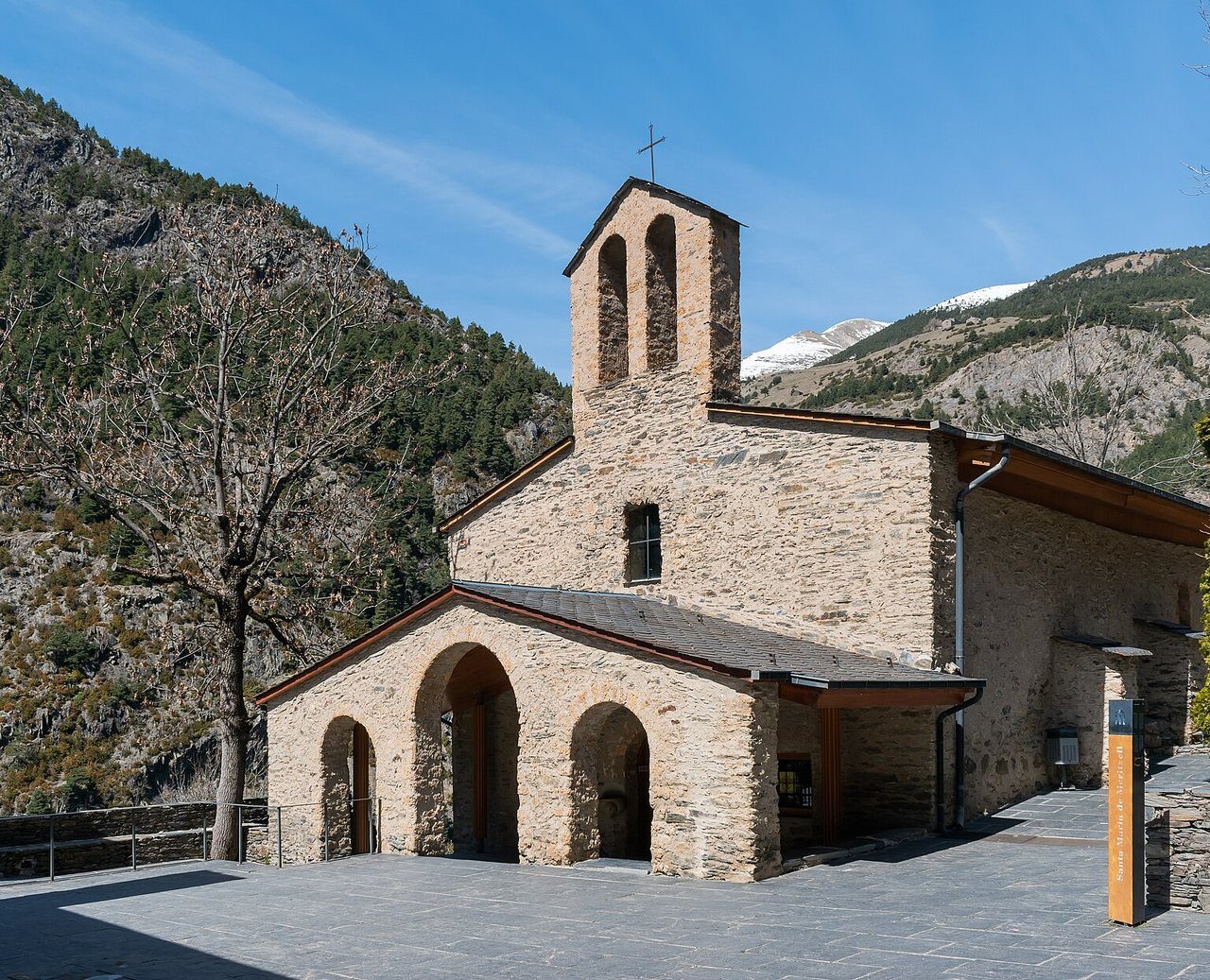
If Meritxell is on your list for the road between Encamp and Canillo, you probably have three questions. Is it worth stopping for? What exactly burnt down in 1972? And why does the shrine of Andorra’s patron saint look like a Romanesque monastery redrawn by a 1970s architect?
The Meritxell sanctuary is the shrine of Our Lady of Meritxell, Andorra’s patron saint, in the parish of Canillo: a restored village church gutted by fire in 1972, and the basilica Ricard Bofill designed to replace it, inaugurated in 1976. Both are free and open daily from 09:00 to 20:00 (checked November 2026); give it an hour.
For the bigger picture, start with Andorra’s history and its two co-princes; this page stays on one hillside, from the winter-rose legend to the night of the fire and the basilica that replaced the old church. Opening hours, tour times and transport details below were checked in November 2026 against museus.ad (the Government’s heritage site), Visit Andorra (the national tourist board) and bus.ad.
The Meritxell sanctuary at a glance
| What you need to know | Details |
|---|---|
| Where | Meritxell, AD100 Canillo: a sheltered spot above the Valira d’Orient, on the old road between Encamp and Canillo |
| Opening hours | New sanctuary and old church daily 09:00-20:00; times can change for religious services |
| Admission | Free |
| Guided tours | October to May: Tuesday to Saturday, 10:00-14:00 and 15:00-18:00. June to September: Sunday mornings too, and later finishes. Free in July and August |
| Time needed | 45 minutes for both buildings; allow extra for a guided tour |
| By bus | Line L4 (Andorra la Vella to Pas de la Casa) to the Ctra. de Meritxell / CS-230 stop, then 800 m on foot |
| By car | Reachable by road; winter tyres, or chains or snow socks carried, from 1 November to 15 May |
| Mass | Sundays 12:30; Saturdays 18:00 (tourist board listing: check it before you plan around a service) |
| Feast day | 8 September, Andorra’s national holiday; shops generally close |
| Facilities | Toilets, audio guides, adapted for reduced mobility |
| Best for | History, architecture and a quiet hour when the weather shuts the mountains |
Why does Meritxell matter so much to Andorrans?
Because this is where the country keeps its patron saint, Our Lady of Meritxell (Nostra Senyora de Meritxell in Catalan), and the story of how she came to be here is half folk tale, half constitutional history.
The legend of the winter rose
The founding legend, as the Government’s English leaflet on the Meritxell ensemble tells it, begins on the Day of the Magi, 6 January. The people of Meritxell were walking to Mass in Canillo when they found a dog rose in full flower in the middle of winter, with an image of the Virgin among its thorns. Canillo carried her to its parish church and promised her a fine new home. Next morning the altar was empty, and a passer-by mentioned a statue sitting under a flowering rose bush at Meritxell.
Canillo concluded that she would rather be in Encamp, so Encamp collected her and made the same promise. Back she went to the rose, and this time the ground around her was clear although it had snowed heavily. The hint was taken, and the chapel went up where she had been found. The leaflet is refreshingly frank that this is a stock plot: the Pyrenees have dozens of Virgins with near-identical finding stories, usually with the statue walking home three times. That doesn’t make it any less charming, and the exhibition in the old church still opens under a staged rose bush in flower.
A hamlet on the old road
Meritxell itself was never more than a hamlet. Its first written mention comes on 8 January 1176, when 380 heads of household from the valley signed a treaty with the canons of La Seu d’Urgell cathedral; one of them was Joan Subran of Meritxell. By the end of the 18th century, Meritxell and neighbouring Molleres had eight houses and 30 inhabitants between them. The hamlet sat on the Camí Ral, the old main road from Encamp to Canillo, and when the modern CG-2 was built at a distance, the through traffic went with it. That is why it still looks like a farming hamlet rather than a roadside strip.
From village Virgin to patron of the valleys
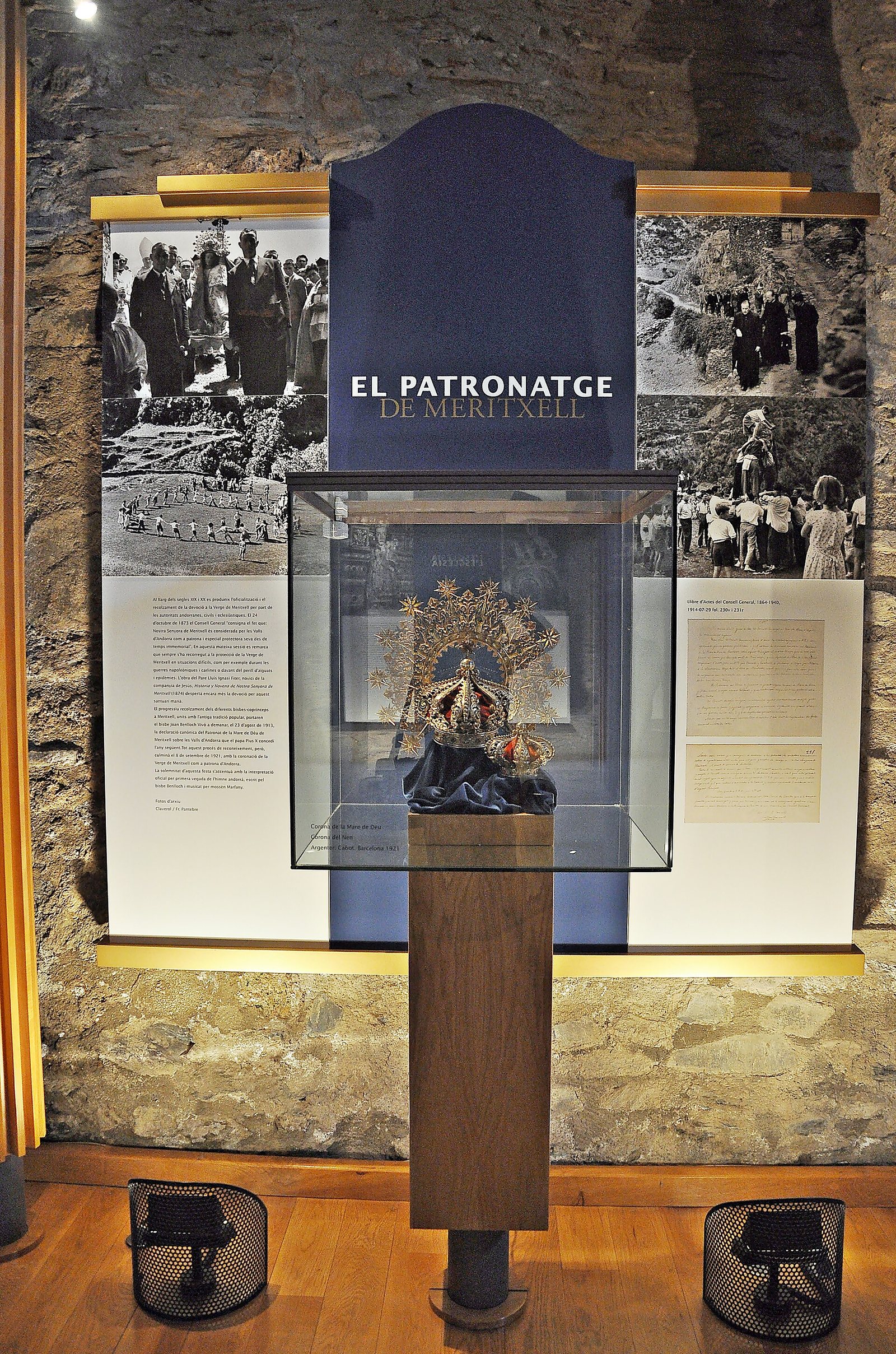
People had long turned to Meritxell in hard times. When the General Council confirmed her on 24 October 1873 as patron and special protector of the valleys since time immemorial, the same session recalled how Andorrans had sought her protection through the Napoleonic and Carlist wars, floods and epidemics. The Church took longer. Bishop Joan Benlloch, who as Bishop of Urgell was also one of Andorra’s two co-princes, asked for the canonical patronage on 23 August 1913, and Pope Pius X granted it the following year. The General Council then made 8 September, the feast of the Nativity of the Virgin, Andorra’s National Festival.
The coronation and the anthem
The high point came on 8 September 1921, when the image was crowned as patron saint of Andorra. The Government’s leaflet records that the same ceremony saw the first performance of the national anthem, with words by Bishop Benlloch and music by Mossèn Marfany (mossèn is the Catalan title for a priest). Until 1993 the General Council traditionally held a session at the sanctuary every Meritxell Day. The Constitution adopted that year ended it, as part of separating political from religious power, and the day went back to being a social and religious festival.
What happened on the night of the fire?
On 8 September 1972 the valleys celebrated Meritxell Day, and on the night of 8-9 September the sanctuary caught fire; the Enciclopèdia Catalana puts it at about 02:30, hours after the feast. By morning little more than the walls were standing. The Government’s leaflet says the fire destroyed the sanctuary and everything in it, including its altarpieces and the Romanesque Virgin and Child at the heart of the cult: a polychrome wooden figure that the tourist board gives as 83 cm tall, and that the heritage service dates to between the 11th and 12th centuries.
The reaction was national. The leaflet recalls how the loss was described at the time: a catastrophe, and the destruction of a piece of Andorra’s own personality and heritage. It also includes a line worth knowing: even now, questions remain about what became of the image of the patron saint. Make of that what you will.
The image venerated today is a reproduction, carved from the photographs that survived of the original, and the new sanctuary was born of the same disaster: the leaflet dates the project to the night of the fire itself. So Meritxell is an unusual pilgrimage site. The medieval statue is gone, the old church is a restored shell that now holds an exhibition, and every 8 September the pilgrims still walk up, which tells you how much the place means here.
What is in the old church?
Free, 20-30 minutes. Start here rather than in the basilica: the old church explains the new one. Santa Maria de Meritxell is the stone building with the arched porch and the double bell gable, and its fabric comes in layers. A small Romanesque chapel stood on this rock before the second half of the 12th century; of it, only the west wall survives, built into the later one, along with the apse foundations found during excavations in 1991. Around 1658 the church was rebuilt in Baroque style, bigger and turned to run north to south, with the bell gable and the south porch you see today. In 1866 Josep Oromí, a painter from La Seu d’Urgell, covered its walls in trompe l’oeil architecture and painted curtains, leaving no surface bare.
After the fire the ruins were restored, and since 1994 the church has housed Meritxell Memòria, a permanent exhibition on the history and cult of Meritxell. It opens theatrically under that rose bush in flower, then uses panels shaped like altarpieces to tell the story of the village, the patronage and the fire, with the most telling objects that survived and old photographs of life around the sanctuary. It is small, and that is its strength.
The second exhibition, Bibles of the World, opened in September 2016 and gathers more than 1,200 Bibles and New Testaments. If you like books as objects, allow longer than you think.
the best half-hour at Meritxell. Without it the basilica is an interesting building; with it, the basilica becomes the answer to a question.
How do you read Ricard Bofill’s basilica?
The new sanctuary makes far more sense once you know what it was meant to be, and how much of it never happened.
The megaproject that shrank
The leaflet says three practices, Moragues, Bohigas-Martorell-Mackay and Ricard Bofill’s, worked on a first scheme that was left unfinished before Bofill took charge. His own vision was enormous: a giant sanctuary with a viaduct spanning the valley, an artificial lake, a bridge, a street of shops and restaurants, a monumental stairway with terraces, rain shelters, huge sculptures and amphitheatres for gatherings. The economic crisis, politics and the public’s response cut it back to what stands today.
The first stone went in on 8 September 1974, the leaflet says, and the sanctuary was inaugurated on 8 September 1976 with work still unfinished. The General Council’s Meritxell Day address for the 50th anniversary credits the architects Anna and Ricard Bofill. Both the old and the new buildings are protected as heritage of cultural interest, and Pope Francis made the sanctuary a minor basilica in 2014, the same year it joined the Marian Route of shrines alongside El Pilar, Torreciudad, Lourdes and Montserrat.
What to look for
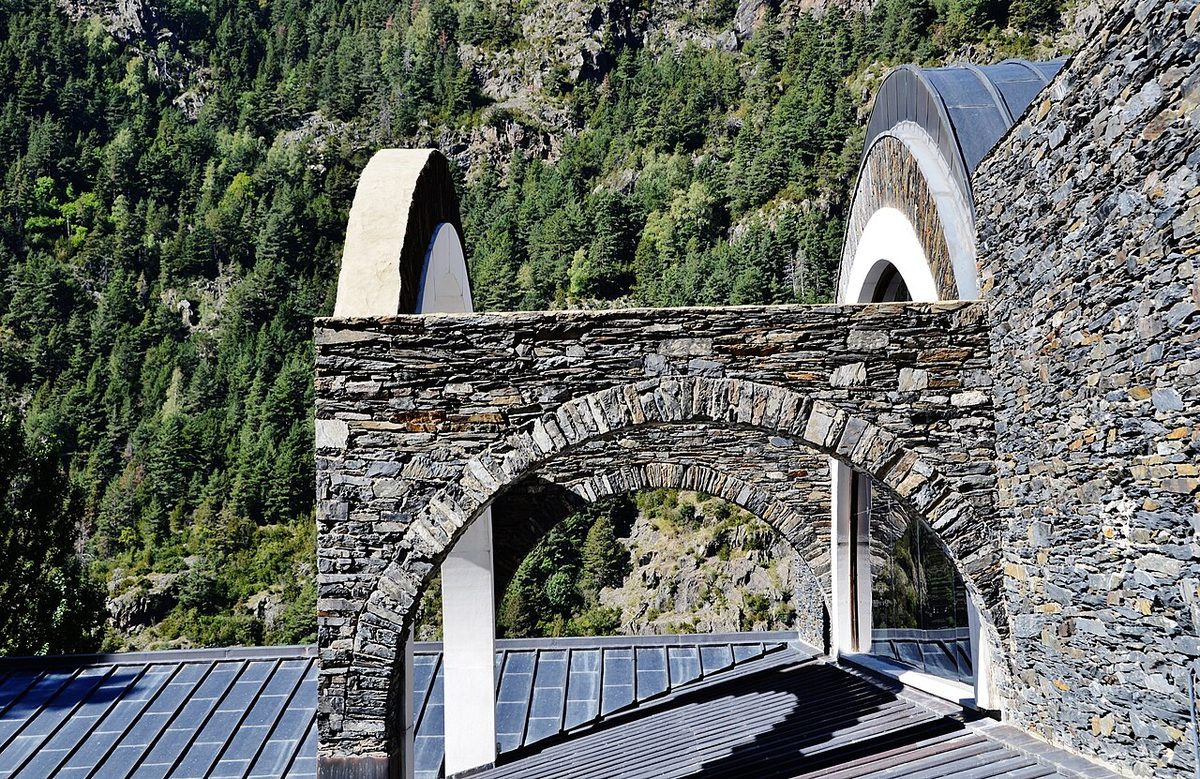
Free, 15-20 minutes, longer in the cloister. Bofill described the building as a recreation of the Romanesque, and once you know that, it reads easily:
- The white arches. The huge white semicircular arches that hold up and decorate the building are an homage to the burnt ruins of the old church, and the leaflet calls those ruins the main reference for the whole design.
- Slate and white. Dark slate ties the walls to the mountains and to Andorran building tradition; the white prefabricated pieces stand, in the tourist board’s reading, for snow.
- The bell tower. Square, like the towers of Catalan Romanesque monasteries, and clad in copper strips that Bofill expected the damp to turn green, so the tower would melt into the mountainside. The leaflet admits, a little ruefully, that the Andorran climate never obliged.
- The cloister and courtyard. The southern cloister has rib vaults in the manner of a medieval monastery; to the north, an open courtyard recalls Islamic architecture, and the tourist board links the large windows to Islamic techniques too.
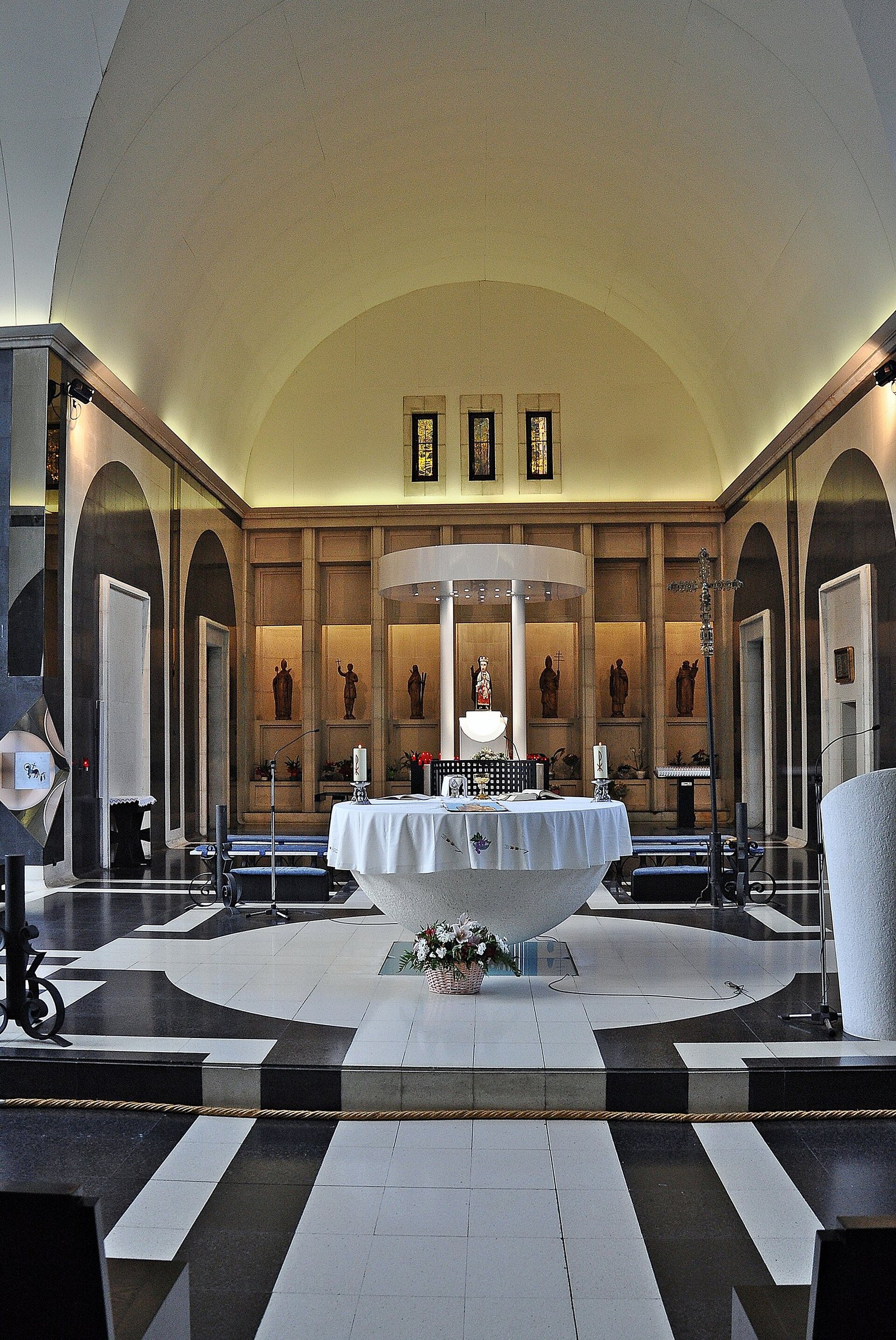
- The plan and the floor. A distorted Greek cross with a square apse under a barrel vault, proportioned on the golden ratio, and a black-and-white geometric floor that the leaflet traces to the Italian Renaissance.
The image and the seven saints
Inside, the tourist board describes a deliberately austere church, bare of decoration except for a stained-glass window that explains the meaning of the name Meritxell. Everything points to the image of Our Lady of Meritxell: a polychrome carving made from photographs of the lost original, with the still, geometric look of a Romanesque Virgin enthroned with the Child. Around the church stand the patron saints of all seven parishes, carved in wood by the sculptor Sergi Mas: Saint Saturninus of Canillo, Saint Eulalia of Encamp, Saint Cornelius of Ordino, Saint Acisclus of La Massana, Saint Stephen of Andorra la Vella, Saint Julian of Sant Julià de Lòria and Saint Peter Martyr of Escaldes-Engordany. Matching each saint to its parish is a decent test of how well you know Andorra’s seven parishes.
not everyone’s idea of a pilgrimage church, and that is rather the point. If late-20th-century architecture interests you, give it time: the leaflet counts it among the most representative Andorran buildings of the end of the 20th century. If you came for medieval atmosphere, the old church next door holds what is left of it.
Visiting the Meritxell sanctuary: hours, tours and Mass
Both buildings, the new sanctuary and the old church with its two exhibitions, open every day from 09:00 to 20:00, and entry is free (checked November 2026 on museus.ad). Times can change around religious services. If you walk in during Mass, remember that the basilica is a working church first and a sight second: sit quietly at the back, or see the old church first and come back.
Guided tours by season
Guided visits keep their own timetable, published on the museus.ad page for the Sanctuary of Meritxell:
- October to May: Tuesday to Saturday, 10:00-14:00 and 15:00-18:00.
- June and September: Tuesday to Friday 10:00-14:00 and 15:00-18:00; Saturday 10:00-14:00 and 15:00-20:00; Sunday 10:00-14:00.
- July and August: Tuesday to Friday 10:00-14:00 and 15:00-19:00; Saturday 10:00-14:00 and 15:00-20:00; Sunday 10:00-14:00. Tours are free in these two months.
There are no tours on Mondays at any time of year, or on Sundays from October to May. Audio guides are available, there are toilets, and the visit is adapted for reduced mobility. For group bookings or to confirm a tour, the heritage service answers on +376 726 109 or +376 851 253 and at [email protected].
Mass at Meritxell
Visit Andorra lists Mass every Sunday at 12:30, and at 18:00 on Saturdays and on the eves of Easter Sunday and All Saints. Service times can change, so check the tourist board’s Meritxell page before you plan around one. Sunday at 12:30 is also the time to avoid if you want the basilica quiet.
daily 09:00-20:00; free; L4 bus or car; 45 minutes for both buildings, longer with a guided tour; best for history, architecture and wet afternoons.
How do you get to Meritxell?
The sanctuary stands in what the tourist board calls a sheltered valley in the parish of Canillo, on a rock above the Valira d’Orient river and below the road that climbs to the village of Prats; museus.ad gives the address simply as Meritxell, AD100 Canillo. It belongs to Canillo parish, home of Soldeu and El Tarter, although the old road made it as much a neighbour of the parish of Encamp as of Canillo village.
By bus
Line L4, from Andorra la Vella to Pas de la Casa, stops at Ctra. de Meritxell / CS-230, and museus.ad gives the walk from the stop to the sanctuary as 800 m. Timetables change, so check the current one on bus.ad, the national bus network’s site, before you set out; our page on getting around Andorra by bus and car has the wider picture.
By car
The tourist board confirms you can drive to the sanctuary. From 1 November to 15 May Andorra’s winter-equipment rules apply: winter tyres, or chains or snow socks carried in the car. The police’s report on the 2025-26 winter lists Meritxell among the places where they ran checks, so this is not a theoretical rule here. For parking, especially on 8 September, check with the comú of Canillo (the parish council) at canillo.ad. Our advice on driving in Andorra covers the rules in more detail.
On foot
The tourist board’s Meritxell page lists a free nature route to the Meritxell oratories and the village of Prats, and the Andorran news site Alto reported in September 2026 that a 14-station Via Crucis now runs to the Creu de Carlemany in Prats. On 8 September pilgrims walk to the sanctuary very early in the morning; for the rest of the year, the 800 m from the bus stop is walk enough for most visitors.
What happens on Meritxell Day, 8 September?
Meritxell Day, 8 September, is Andorra’s national holiday and the feast of Our Lady of Meritxell, and it is the sanctuary’s big day. It starts with a pilgrimage on foot very early in the morning; after that, the tourist board describes Masses, concerts, sardanes (the Catalan circle dance) and tastings. The details change every year, so look for the programme from the Government and the comú of Canillo nearer the time rather than relying on last year’s.
The practical catch for visitors is shopping. Meritxell Day is one of the four days a year when Andorra’s shops generally close, so a shopping run on Meritxell Day is a wasted trip: plan the shopping side of your trip around it. If you are in the country that day, make it a Meritxell day rather than a retail one.
The 50th anniversary in 2026
The year 2026 marked 50 years since the inauguration, and the sanctuary had a proper birthday. The General Council’s Meritxell Day address described a programme of a photography exhibition, talks, themed tours, music and dance. Four new bells, bringing the total to nine, rang for the first time in September 2026. Alto also reported more than 25,000 visitors in summer 2026, citing Government data that names Meritxell the country’s most-visited monument. Not bad for a building that was never finished.
When should you go, and how long do you need?
Autumn is the sweet spot. The summer crowds have gone, tours run Tuesday to Saturday from October, and the slate looks its best against turning leaves; Meritxell slots easily into an autumn trip to Andorra.
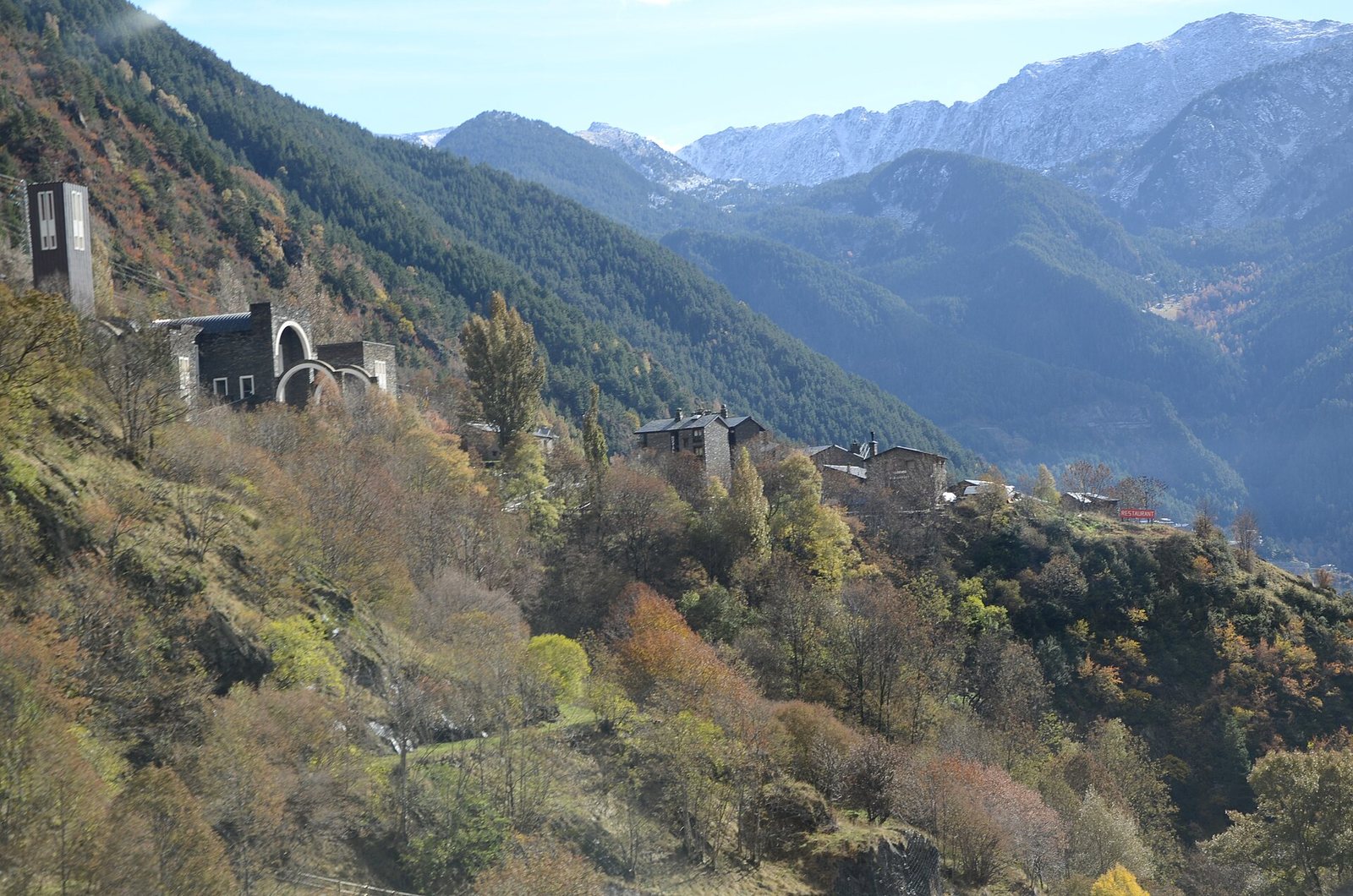
Winter changes little indoors. Both buildings keep the same 09:00-20:00 hours, which makes Meritxell a useful plan for the day the wind shuts the lifts. Our page on Andorra in winter covers the rest of the season, and the tyre rules above apply before you drive up.
Summer is good value, because guided tours are free in July and August, and from June to September they also run on Sunday mornings. Aim for the first or last hours of the day if you want the basilica to yourself.
8 September is for the festival, not the architecture. Come for the pilgrimage and the atmosphere, or pick another day.
20-30 minutes in the old church and its exhibitions, 15-20 in the basilica and cloister, extra time for a guided tour, and longer if you add the nature route towards Prats. It fills a morning or an afternoon rather than a whole day.
What else can you pair with Meritxell?
Meritxell sits on the road up the Valira d’Orient, so the rest of Canillo and Encamp is close at hand, and the pairings below suit different moods.
The Tibetan Bridge and Roc del Quer
From €6, prices checked November 2026. Canillo’s two cliff-edge sights make the adrenaline half of a Meritxell day. The Tibetan Bridge of Canillo opens at weekends and on public holidays in November and December, 10:00-16:00 weather permitting, at €17 for adults with the shuttle bus from Canillo included. The Roc del Quer viewpoint opens daily 10:00-16:00 from November 2026 to February 2027, at €6, and a viewpoint-only visit needs your own car.
Sant Joan de Caselles
If you want the medieval original after Bofill’s recreation, Sant Joan de Caselles, the Romanesque church near Canillo, is the obvious contrast. Entry is free, and it keeps regular visiting hours in July and August.
A rainy day or a longer trip
On a wet day Meritxell is mostly under cover and costs nothing, which puts it near the top of any list of things to do in Andorra when it rains, and among the best free things to do in Andorra in any weather. It already features in our two-day Andorra itinerary and our summer itinerary for Andorra, if you want it fitted into a full plan.
Is the Meritxell sanctuary worth visiting?
Yes, if you care why Andorra is the way it is. In an hour you get a folk legend, a medieval hamlet, the Church-and-state history of the patronage, a national trauma and a piece of 1970s architecture that was meant to be far bigger than it is, all for nothing.
Skip it if you have one day, a ski pass and perfect snow, or if churches leave you cold and the weather is made for walking. It is a rewarding hour, not a reason to cross the country.
little here is as it was. The statue is a reproduction, the old church is a restored shell, and the basilica is a fragment of a much larger plan. Read that as the story rather than the flaw, and Meritxell becomes one of the more moving places in Andorra.
worth a detour on any trip along the Valira d’Orient; worth a special journey for architecture enthusiasts, and on 8 September.
Meritxell is free, and it sits between two of Andorra’s oddest collections: the National Automobile Museum in Encamp (€5) and the Museu de la Moto in Canillo (€5.50, open Wednesday to Sunday in winter; prices checked November 2026). Both are covered in the round-up of museums in Andorra worth your time.
Frequently asked questions
Is the Meritxell sanctuary free to visit?
Yes. Both the new basilica and the old church, with its Meritxell Memòria and Bibles of the World exhibitions, are free, and museus.ad lists them open every day from 09:00 to 20:00 (checked November 2026). Guided tours run on a separate seasonal timetable and are free in July and August. Times can change around religious services.
Who designed the Meritxell sanctuary?
Ricard Bofill designed the new sanctuary, and the General Council’s 2026 anniversary address credits the architects Anna and Ricard Bofill. It was inaugurated on 8 September 1976, unfinished and far smaller than Bofill’s original vision, which included a viaduct across the valley, an artificial lake and amphitheatres. The old church beside it is a Baroque rebuild, from around 1658, of a Romanesque chapel.
When did the Meritxell sanctuary burn down?
On the night of 8-9 September 1972, hours after the Meritxell Day celebrations. The fire destroyed the old sanctuary and its contents, including the Romanesque statue of the Virgin, and left little more than the walls. The ruins were restored and have housed the Meritxell Memòria exhibition since 1994, while Ricard Bofill’s new basilica took over as the place of worship.
Is the statue of Our Lady of Meritxell the original?
No. The Romanesque original was lost in the 1972 fire. The image venerated today is a polychrome reproduction carved from photographs of the original, and it keeps the still, geometric look of a Romanesque Virgin and Child. The Government’s heritage leaflet adds that questions remain about what became of the original image.
Who is the patron saint of Andorra?
Our Lady of Meritxell. The General Council confirmed her as patron of the valleys on 24 October 1873, Pope Pius X granted the canonical patronage in 1914 after Bishop Benlloch’s request, and the image was crowned on 8 September 1921. Her feast day, 8 September, is Andorra’s national holiday, and the sanctuary at Meritxell is her shrine.
How do you get to the Meritxell sanctuary by bus?
Take line L4, Andorra la Vella to Pas de la Casa, to the Ctra. de Meritxell / CS-230 stop; museus.ad gives the walk from there as 800 m. Timetables change, so check bus.ad before you travel. Drivers can reach the sanctuary by road, with winter tyres, or chains or snow socks carried, required from 1 November to 15 May.
When is Meritxell Day, and is it a holiday?
Every 8 September. It is the feast of Our Lady of Meritxell and Andorra’s national holiday, with a pilgrimage to the sanctuary very early in the morning, then Masses, concerts and sardanes. Andorra’s shops generally close for the day, one of four such days a year. The programme changes each year: check with the Government and the comú of Canillo nearer the date.
Are there Masses at the Meritxell sanctuary?
Yes. Visit Andorra lists Mass every Sunday at 12:30, and at 18:00 on Saturdays and on the eves of Easter Sunday and All Saints. Service times can change, and visiting hours can shift around services, so check the tourist board’s Meritxell page before you plan a visit around one.
Can you visit Meritxell in winter?
Yes. Both buildings open daily from 09:00 to 20:00, and from October to May guided tours run Tuesday to Saturday, 10:00-14:00 and 15:00-18:00. Drivers need winter tyres, or chains or snow socks in the car, from 1 November to 15 May, and the police ran winter-equipment checks at Meritxell in the 2025-26 winter.
For the political side of the same story, the Casa de la Vall in Andorra la Vella is the next stop; for the words on every sign at Meritxell, our primer on Catalan and the languages of Andorra helps, and the full list of things to do in Andorra fills in the rest of the day.
Photo credits
All photographs are from Wikimedia Commons under their stated licences, with thanks to the photographers:
- The old church of Santa Maria de Meritxell: Krzysztof Golik, CC BY-SA 4.0, via Wikimedia Commons — source
- The patronage display in the Meritxell Memòria exhibition: Alberto-g-rovi, CC BY 3.0, via Wikimedia Commons — source
- Ricard Bofill’s slate and white arches at Meritxell: MARIA ROSA FERRE ✿, CC BY-SA 2.0, via Wikimedia Commons — source
- The apse and altar of the new basilica at Meritxell: Alberto-g-rovi, CC BY 3.0, via Wikimedia Commons — source
- The new sanctuary of Meritxell on its hillside in autumn: MARIA ROSA FERRE ✿, CC BY-SA 2.0, via Wikimedia Commons — source
